The recently launched consortium is aimed at helping the shipping industry eliminate the wasteful practice of “Sail Fast, then Wait” (SFTW) through a collaborative platform.

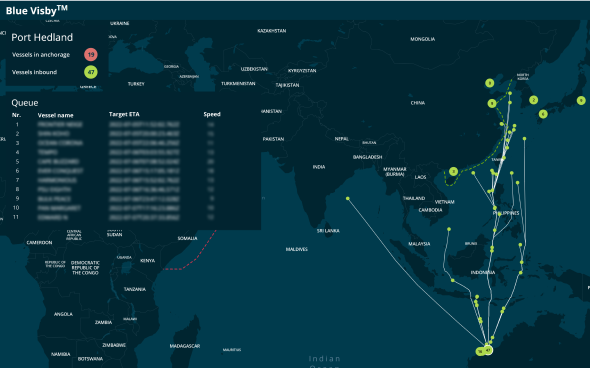
It is working on the development of the Blue Visby Solution that uses digital technology developed by software company NAPA to optimise the arrival time of oceangoing vessels and reduce their speed and CO2 emissions.

Solution operation screen. Courtesy of Marubeni

For its part, Marubeni will support the demonstration and implementation of this solution using its fleet of gas and chemical tankers throughout its chemical trading network with the aim of implementing low-carbon transportation of chemical products.

In the shipping industry, vessels typically sail quickly to an area near their destination and then idle there until they can enter the port, resulting in unnecessary CO2 emissions.

According to the various stages of proof-of-concept research, including an analysis of 150,000 voyages by 13,000 freighters worldwide in 2019, using the solution would enable a reduction of cruising speed and standby time in 87% of voyages.

With the Blue Visby solution, vessel operators will be given an optimal arrival time, so that they can then successfully adjust the vessel’s cruising speed and reduce fuel consumption by using the most efficient route and speed to reach the vessel’s destination, with a potential average CO2 emissions reduction of 16%, the developers claim.

Source: https://www.offshore-energy.biz/marubeni-joins-blue-visby-consortium-to-reduce-shipping-emissions-via-digital-solutions/


Bulk carrier WEN FENG 18 reportedly suffered fire in engine room in the afternoon Aug 2, while proceeding in Shanghai approach channel with cargo of ore. Bulk carrier had to be anchored in fairway, understood she was disabled. Fire was extinguished by switching on fire fighting CO2 system. She was still anchored as of 2130 Beijing time Aug 3, with at least 3 tugs at her side.

New FleetMon Vessel Safety Risk Reports Available: https://www.fleetmon.com/services/vessel-risk-rating/


UC San Diego’s Scripps Institution of Oceanography today announced that naval architecture and marine engineering company Glosten has been selected as the naval architect for the university’s new California coastal research vessel. The new vessel will feature a first-of-its-kind hydrogen-hybrid propulsion system.

Selected after participating in the university’s request for proposal process, Glosten will provide the preliminary design, contract design and detailed design for the research vessel to be operated by Scripps Oceanography.

“This vessel will be the first of its kind, and the selection of the naval architect is a major milestone for Scripps,” said Bruce Appelgate, associate director and head of ship operations at Scripps Oceanography. “Fundamentally, our ships have to be reliable and capable in order to support the innovative research our scientists conduct at sea. On top of that, the ship we envision needs to demonstrate that zero-emission power systems work effectively under demanding real-world conditions. It’s the job of the naval architect to provide the necessary engineering, design, and integration skills needed for this project to succeed on every level.”

California legislators last summer allocated $35 million toward the design and construction of this vessel, which will serve as a platform for education and research dedicated to understanding the California coast and climate change impacts to the coastal ecosystem.

“I am proud to see Scripps Institution of Oceanography arrive at the critical milestone of selecting a naval architect for this one-of-a-kind hydrogen-hybrid research vessel,” said Senate President pro Tempore Toni G. Atkins. “Scripps and California continue to set the global standard for developing innovative solutions to address our most pressing environmental challenges. This vessel will play a critical role in supporting policy decisions to protect our state’s precious coastal environment from climate change impacts, while demonstrating hydrogen’s critical role in California’s carbon-free future.”

As a student-centered, research-focused public university, seagoing experiences are a cornerstone of educational programs at UC San Diego. This new vessel will continue the university’s educational mission to train the next generation of scientists, leaders and policymakers. It is envisioned that the vessel will carry up to 45 students and teachers to sea on day trips, improving the university’s capacity for experiential learning at sea. The new vessel will replace research vessel Robert Gordon Sproul, which has served thousands of University of California students in its 42 years of service but is nearing completion of its service life.

“Scripps Institution of Oceanography’s hydrogen-hybrid coastal research vessel is a significant demonstration of California’s commitment to fighting climate change, decarbonizing our blue economy, and improving air quality for port-adjacent disadvantaged communities,” said Liane Randolph, chair of the California Air Resources Board (CARB). “The selection of a naval architect is an important step in bringing this innovative project to reality.”

This new vessel will feature an innovative hybrid propulsion system that integrates hydrogen fuel cells alongside a conventional diesel-electric power plant, enabling zero-emission operations, in line with the University of California’s Carbon Neutrality Initiative, which targets carbon neutrality by 2025. The design is scaled so the ship will be able to operate 75% of its missions entirely using a non-fossil fuel—hydrogen—with only pure water and electricity as reaction products. For longer missions, extra power will be provided by clean-running modern diesel generators.

The proposed 125-foot vessel will be equipped with instruments and sensing systems, including acoustic Doppler current profilers, seafloor mapping systems, midwater fishery imaging systems, biological and geological sampling systems, and support for airborne drone operations. These capabilities, along with state-of-the-art laboratories, will enable multidisciplinary research, advancing our understanding of the physical and biological processes active in California’s coastal oceans. This new vessel will be dedicated to California research missions, with the capability to study issues vital to the California economy such as the health of marine fisheries, harmful algal blooms, severe El Niño storms, atmospheric rivers, sea-level rise, ocean acidification, and oxygen depletion zones.

Scripps Oceanography has worked with Glosten previously, initially more than 60 years ago on the design of Research Platform Floating Instrument Platform known as FLIP. Glosten was also involved in the midlife refit of Roger Revelle, a $60 million renovation that advanced the scientific capability and service life of Scripps’s largest ship.

The anticipated schedule for design and construction includes one year to complete the basic design. Following U.S. Coast Guard approval of the design, the university will select the shipyard where the design will be constructed. Construction and detail design will likely take an additional three years.

When completed, it will join the fleet of vessels managed by Scripps including the Navy-owned research vessels Sally Ride and Roger Revelle, which conduct global oceanographic research, and the Bob and Betty Beyster, a nearshore scientific workboat. All research vessels are stationed and maintained at the university’s Nimitz Marine Facility in Point Loma.

Source: https://www.marinelink.com/news/glosten-tapped-design-scripps-new-498454

The first grain ship to leave a Ukrainian port in wartime passed through the Bosphorus Strait on Wednesday en route to Lebanon for a delivery that foreign powers hope will be the first of many to help ease a global food crisis.

The Razoni left Odesa on the Black Sea early on Monday carrying 26,527 tonnes of corn and anchored at the entrance of the Bosphorus Strait on Tuesday night.

The shipment was made possible after Turkey and the United Nations brokered a grain and fertilizer export agreement between Moscow and Kyiv last month – a rare diplomatic breakthrough in a drawn-out war of attrition.

The ship entered the Bosphorus Strait around 1130 GMT, following the completion of the inspection by Russian, Ukrainian, Turkish and U.N. personnel working at a Joint Coordination Centre (JCC) in nearby Istanbul.

Ukraine said it had 17 more vessels loaded with agricultural products awaiting approval to set sail.

Ukraine’s ambassador to Lebanon, Ihor Ostash, said the Razoni was expected to arrive in Tripoli port in four to five days.

Three ships a day
The JCC said the ship was cleared after a three-hour inspection. Information from the crew about the Razoni’s journey will be used to fine-tune procedures to continue the safe passage of commercial vessels under the deal, it added.

The U.N.-brokered deal relaunched the export of grains from one of the world’s top producers after they were stalled for more than five months after Russia’s Feb. 24 invasion. The agreement aims to help ease shortages and rising prices.

After the first successful departure, a senior Turkish official, who requested anonymity, said three ships may leave from any of the three Black Sea ports of Odesa and nearby Pivdennyi and Chornomorsk every day, instead of the previously planned one.

The 120-day deal will be extended by a month at a time if exports are not completed due to the weather or problems with inspections, the official said, adding that the initial period appeared sufficient for Ukrainian silos to be emptied.

U.N. spokesperson Stephane Dujarric said that more outbound movement was being planned from Ukraine on Wednesday, adding that about 27 ships were covered by the export deal.

Denys Marchuk, deputy chair of the Ukrainian Agrarian Council, said at a briefing on Wednesday that Ukraine would like to include ports in the Mykolaiv region, to the east of Odesa, into the deal.

“The infrastructure ministry and the agriculture ministry are beginning to actively discuss with the coordinating council in Istanbul that it might be worth involving other ports, in particular in the Mykolaiv region,” he said.

Marchuk said Ukraine had exported 5-6 million tonnes of grain per month via its sea ports before the war but it was not possible to reach that level with the conflict and not all ports in operation.

Source: https://www.marinelink.com/news/first-ukraine-grain-ship-cleared-passes-498490


The second-largest U.S. liquefied natural gas (LNG) exporter on Wednesday said it reached an agreement with a federal regulator that will allow it to resume some operations at its Quintana, Texas, plant in October.

Freeport LNG shut the plant, which supplies about 20% of U.S. LNG exports, following an explosion and fire on June 8. Its closure helped to push up LNG prices in Europe and Asia, and dampening U.S. natural gas prices.

The operator reached a consent agreement with the Pipeline and Hazardous Materials Safety Administration (PHMSA) that included corrective measures the company must take to allow it to resume partial operations, it said in a statement.

Freeport LNG is “evaluating and advancing initiatives related to training, process safety management, operations and maintenance procedure improvements, and facility inspections,” without detailing the measures planned.

The June explosion was caused by an over-pressurized pipeline, officials have said. Full operations at the Texas Gulf Coast facility are not slated to resume until the end of the year.

The initial restart will include three liquefaction trains, two LNG storage tanks and one LNG loading dock. The restart will enable the plant to deliver roughly 2 billion cubic feet (BCF) per day of LNG, enough for existing long-term customer agreements, the company said

Source: https://www.marinelink.com/news/us-regulator-allow-freeport-lng-resume-498489


Thai Ministry of Labor reached an agreement with Korean Shipbuilding Association including Hyundai, to open a window for Thai skilled workers willing to go to Korea. Korean shipbuilding industry is experiencing a shortage of skilled workers, such as welders (some 4,000 vacancies); electricians (1,800 vacancies); painters (1,400 vacancies). South Korea has increased migrant quota by 20%, aiming at skilled work force, with Thais being among top wanted workers. South Korea meanwhile, was to send industry representatives to Thailand to test applicants’ skills. Korean Government is considering the shift in age limits, allowing more workers to enter Korean labor market. Understood proposed age shift applies both to current Korean and Thai age limits.
Many Thais choose to enter Korea as tourists and work illegally. Bangkok Post estimates last year a total of 18,221 Thai nationals were legally employed while the number of illegal workers known as phi noi or “little ghost” was estimated to be at about 140,000, according to statistics provided by South Korean Embassy.

There is a language proficiency test required from Thai workers, who seek employment in Korea, there are other requirements which have to be met, and finally, Thais who officially apply for employment entry but were rejected, will lose some 30,000 Baht, understood in forms of miscellaneous fees, which have to be paid.
Obstacles and barriers don’t decrease the number of Thais willing to work overseas, now, when the labour market in South Korea is bursting with activity with the pandemic restrictions easing.

Another problem questioning migrant workers project success, arises in South Korean Shipbuilding Industry itself. There’s a growing Korean labor unrest and protest against industry’s efforts to bring in less expensive foreign labor. Says Maritime Executive:

“Workers across South Korea’s shipbuilding industry are intensifying their labor actions protesting the shortage of skilled workers and the industry’s efforts to bring in less expensive foreign labor to meet the current shortages in key skills. The umbrella union that represents workers at eight of the major shipbuilders announced today that it would join the strike against Hyundai Heavy Industries.
Protests began in late April in response to the government’s announcement that it would relax visa requirements at the request of the shipbuilders. The new visas are specifically for skilled workers for the shipbuilding industry including welders, painters, and others with essential skills.

The move came after the shipbuilders pressed the government saying that they did not have enough skilled workers to keep pace with their orderbooks and the flow of new contracts. Each of the major shipyards is reporting that their orderbooks are full into 2024 with as many as 37 additional ships ordered in just the first three months of 2022. The 2022 orders were equivalent to half of 2021’s already elevated pace continuing the surge in business for the shipbuilders.
The unionized workers of Hyundai’s three shipyards, as well as Samsung Heavy Industries, Daewoo Shipbuilding & Marine Engineering, HSG Sungdong Shipbuilding, K Shipbuilding, and HJ Shipbuilding & Construction, are all supporting the labor actions. They are blaming the shipbuilders for creating the problem and now undermining the long-term health of the industry and their jobs.
The unions are calling for higher wages, improved labor conditions, and the rehiring of workers let go in recent years. The unions contend that employment fell from over 200,000 mid-decade to around 90,000 in 2021. Automation has offset some of the declines but many tasks they highlight required skilled workers. The unions argue the shipyards laid off too many workers and are doing little to attract young people to join the workforce.”

Industry seems to suffer mostly from rising costs of everything, from raw materials to logistics, with probably, new technologies, required to meet new and unreasonable “environment” regulations, being the most costly issue. Cost of everything is on the rise, no wonder industries are trying to economize and save each extra dollar or won. World economy isn’t as of recent, an economy of peaceful times of prosperity, ruled by free market and common sense, it’s an economy of war and survival.

Source: https://www.fleetmon.com/maritime-news/2022/39049/thai-workers-wanted-korean-shipbuilding-industry-c/


Fire erupted in engine room of 26-meter yacht GOOD VIBES while she was sailing in Freus, between Ibiza and Formentera islands, Balearic islands, Med, on Aug 3. Spanish SAR boat SALVAMAR ACRUX responded, disabled yacht was towed to Ibiza. Yacht guests were evacuated, skipper and owner remained on board.
Motor yacht GOOD VIBES, GT 96, length 26 meters, built 2020, guests 8, crew 2.
New FleetMon Vessel Safety Risk Reports Available: https://www.fleetmon.com/services/vessel-risk-rating/


According to a statutory news post by classification society DNV, the focus will be on crew certification and competencies.

CICs are held every year and focus on a particular topic for a three-month period. Last year, this was ship stability. The CIC is usually initiated by the Paris and Tokyo MoUs with the majority of other PSC regimes joining.

Included in the routine PSC inspections

The CIC will be included in the routine PSC inspections from September to November 2022. A pre-defined questionnaire will be used to assess that ships comply with STCW conventions. Any deficiencies found during the CIC will be reported in the PSC inspection report with the related PSC Code.

DNV warns that deficiencies in STCW certification and other operational requirements are likely to trigger an ISM-related deficiency, because they are affecting the Safety Management System (SMS).

DNV: ‘We anticipate that the CIC will not be limited to certification or document control due to several fake crew certificates and lack of competence of seafarers regarding their certification in the past. Therefore, DNV’s view is that one part of the CIC will focus on the evaluation of competences of the master, officers and crew when performing duties and during emergency scenarios.’

It is expected to cover a variety of operational inspection areas, the classification society adds: ‘from efficient communication between crew members, and assessing navigational controls such as ECDIS, to voyage planning or safe navigation, and witnessing emergency drills.’

DNV recommendations

  • Check if all crew members’ certificates of competence are at hand and valid.
  • Check if the Muster List is up-to-date and crew members are familiar with their assigned duties.
  • Keep hours of rest updated.
  • Evaluate the effectiveness of familiarisation for the master and officers in charge.
  • Familiarise the crew with their duties and with the checklist PSC officers will use in the inspection when this is published (in August).


Source: https://swzmaritime.nl/news/2022/08/01/port-state-control-campaign-on-stcw-kicks-off-in-september/


Severe underwater biofouling slows the affected ship and can increase its fuel consumption by as much as forty per cent, boosting emissions. In addition, the accumulation of marine life may cause the spread of invasive aquatic species in environments they’re transported to, affecting biodiversity, ecosystem health and the livelihoods of coastal communities. It’s something that regulators, ship operators, port authorities and conservation bodies are increasingly concerned about.

Clean Hull Initiative

The environmental NGO Bellona Foundation has now launched the Clean Hull Initiative (CHI) to address the biofouling issue.

‘The CHI brings together a growing number of stakeholders in both the private and public sectors and aims to develop an industry-wide recognised and accepted standard for proactive hull cleaning which currently does not exist,’ says Bellona’s project manager Runa Skarbø. ‘We believe the standard is an important means to establish proactive cleaning as part of the biofouling management toolbox and will also drive innovation and the market for commercial proactive hull cleaning solutions.’

Frederic Hauge, founder of the Bellona Foundation, adds: ‘Together we will seek to sort out the regulatory barriers currently in the way of solving the biofouling issue. Also, we want to reduce barriers for the further uptake of emerging proactive hull cleaning technology as a preventative tool.’

Focus on proactive cleaning

There are of course other collaborations and initiatives that seek to tackle the biofouling issue, but Skarbø points out the CHI is unique in the sense that it is addressing proactive cleaning issues. She says regulatory inconsistencies worldwide create a major barrier to ship operators wanting to manage biofouling proactively, and for in-water cleaning (IWC) providers operating in multiple locations.

Compounded by the absence of any international regulation or standard for hull cleaning, today there is no international regulating body for ports and anchorages where IWC takes place. Local biofouling and/or IWC management guidelines vary hugely, if they exist at all.

Revision of IMO biofouling guidelines

The International Maritime Organization (IMO) is currently revising its biofouling guidelines.

Sveinung Oftedahl, specialist director in the Norwegian Ministry of climate and environment: ‘The revision of the guidelines is currently being undertaken by a dedicated sub-committee and the work is progressing well, with completion targeted next year.’

According to him, the key goal is to increase uptake and effectiveness of the guidelines: ‘The intention is to make the guidelines clearer and less general meaning “specific recommendations on what to do, how to do it, when to do to it” as well as include user-specific guidance and allocate clearly the responsibilities of various stakeholders. Moreover, the guidelines are to reflect chronological sequence from ship design to end of service life.’

CHI stakeholders

The CHI stakeholder members currently include Jotun, iKnowHow, Armach Robotics, Notilo Plus, Hapag-Lloyd, Wallenius Wilhelmsen, DNV, the Mærsk Mc-Kinney Møller Centre for Zero Carbon Shipping, Litehauz, Port of Antwerp Bruges, ShipShave, VesselCheck, LimnoMar, Endures, CleanSubSea, the University of Maryland Center for Environmental Science (Alliance for Coastal Technologies and Maritime Environmental Resource Centre, ACT/MERC) and University of Strathclyde.

Source: https://swzmaritime.nl/news/2022/08/03/ngo-bellona-launches-initiative-to-tackle-biofouling-through-proactive-cleaning/


In a bid to enhance maritime security, the Nigerian Maritime Administration and Safety Agency, has signed a Memorandum of Understanding (MoU) with the National Institute of Transport Technology, Zaria, on research and training towards enhancing maritime safety and security in Nigeria.

This was contained in a statement by the Assistant Director, Public Relations, NIMASA, Osagie Edward on Sunday.

According to the statement, the Director-General NIMASA, Dr Bashir Jamoh, and his counterpart at NITT, Dr. Bayero Salih Farah, while signing the documents in Zaria, said that the MoU was hinged on research and training with a view to enhancing local content and boosting the quality assurance of the institute.

The statement further explained that the MoU is a follow up on earlier agreements reached between both agencies in their quest to further domesticate specialized training programmes at management cadre in the maritime sector.

Jamoh however described the MoU as a mutually beneficial partnership, aimed at supporting the core mandate of the NITT, while also in line with his administration’s commitment to capacity building for NIMASA staff.

“The MoU is to formalize and strengthen the existing relationship between NIMASA and the NITT in terms of research, training and capacity development in general.  We appreciate your visit to NIMASA sometime ago and we are glad that much progress is being made in terms of our collaboration,” Jamoh said.

Source: https://shipsandports.com.ng/nimasa-partners-nitt-to-boost-maritime-security/


Company DETAILS

SHIP IP LTD
VAT:BG 202572176
Rakovski STR.145
Sofia,
Bulgaria
Phone ( +359) 24929284
E-mail: sales(at)shipip.com

ISO 9001:2015 CERTIFIED