IMO Secretary-General Kitack Lim on Friday (22 July) welcomed the signing of an agreement between, the Russian Federation, Türkiye, Ukraine and the United Nations to establish a humanitarian maritime corridor to allow ships to export critical cargoes of grain and foodstuffs from Ukraine.

The agreement was signed in Istanbul, Türkiye after several weeks of talks. Senior IMO officials participated as part of the UN delegation.

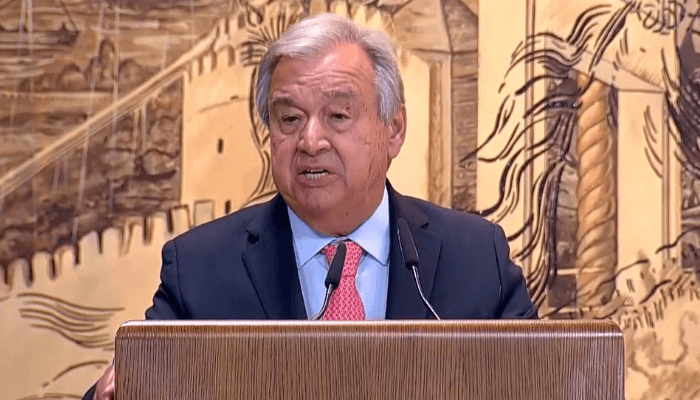
Mr. Lim attended the signing ceremony in Istanbul.

Mr. Lim attended the signing ceremony in Istanbul
Credits: IMO

“I am very pleased that all parties have reached agreement on the way forward for ships to safely transport much-needed grain and other commodities through the Black Sea. This agreement would not have been possible without the spirit of cooperation by the countries involved and the leadership shown by UN Secretary General António Guterres in proposing this initiative,” IMO Secretary-General Lim said.

“The safety of ships and seafarers remains my top priority. IMO instruments, including the International Ship and Port Facilities Security (ISPS) Code, underpin this agreement for safe and secure shipping through the Black Sea. I commend the efforts of all involved, particularly the IMO Member States – Russian Federation, Türkiye and Ukraine.”

The IMO Council, at its 35th Extraordinary Session in March, requested the IMO Secretary-General to collaborate with relevant parties to initiate the establishment and support the implementation of a blue safe maritime corridor in the Black Sea and the Sea of Azov.

Stabilizing global food supplies

Speaking at the signing cerempony, UN Secretary General António Guterres said, “Let there be no doubt – this is an agreement for the world. It will bring relief for developing countries on the edge of bankruptcy and the most vulnerable people on the edge of famine. And it will help stabilize global food prices which were already at record levels even before the war – a true nightmare for developing countries.

Specifically, the initiative we just signed opens a path for significant volumes of commercial food exports from three key Ukrainian ports in the Black Sea – Odesa, Chernomorsk and Yuzhny. The shipment of grain and food stocks into world markets will help bridge the global food supply gap and reduce pressure on high prices.”

Reference: IMO


The fight against piracy and response to current maritime security challenges on the Gulf of Guinea have been reinforced with the utilization of the Yaounde Architecture Regional Information System (YARIS).

The YARIS platform, an information sharing tool or system for Maritime Law Enforcement Agencies in the Gulf of Guinea region, was developed in partnership with the Gulf of Guinea Inter-Regional Network (GoGIN ) project to aid the implementation of the Yaounde Architecture with the support of the European Union (EU).

The Yaounde Architecture comprises the inter-regional Coordination Centre (ICC), coordination and information-sharing structure which connects the Regional Maritime Security Centre for Central Africa (CRESMAC) and the Regional Maritime Security Centre for West Africa (CRESMAO).

The Coastal space is divided into five operational maritime zones -where activities are coordinated by five Maritime Multinational Coordination Centres (MMCC).

The YARIS platform is therefore an information sharing tool amongst the 27 maritime centres of the Yaounde Architecture, their partners and all stakeholders involved within 6,000 kilometres of the coast.

Operational since September 2020, the platform correctly connects 96 per cent of the Yaounde Architecture member states and centres.

Beyond inter-regional coordination, YARIS is also a tool for connecting national administrations and enforcement agencies.

Mr Daniel Appianin, Deputy Director-General of Operations, Ghana Maritime Authority, speaking at the closing of the national training and implementation of a National YARIS Network in Accra, commended the participants for their commitment and desire to develop and promote information sharing, leading to a secured Gulf of Guinea and to enhance legitimate use of Ghana’s maritime domain.

The stakeholders, numbering 29, underwent a 15-day training in the use of YARIS to master and maintain its functionalities, coordination and operations for combating piracy, illegal fishing, vessels in difficulty and miscellaneous trafficking.

The training enabled participants from Ghana’s maritime law enforcement agencies to utilize the platform to enhance surveillance and information sharing capabilities to improve maritime safety and security operations.

After the modular training, the operational centres will be connected to the national YARIS network, enabling them to facilitate the exchange of information and the coordination of operations at sea.

Mr Appianin said the country had experienced unprecedented levels of maritime insecurity activities in the Gulf of Guinea Region, including Ghanaian waters which had led to needless loss of lives, property and destruction to the maritime environment.

Conceived primarily as a maritime situational awareness tool, he said, the YARIS allowed knowledge on what was going on at sea and to coordinate crisis situation operation, incorporating email and videoconference services.

He noted that YARIS would therefore improve collaboration between coastal states to combat piracy and respond to current maritime security challenges that the coastal Gulf of Guinea State members were facing including drug and arm trafficking, illegal fishing, and environmental damages.

“The system further provides and facilitates real-time coordination of maritime operations at various levels and offers a wide range of complementary tools, such as the creation of dedicated situations, opening logs, chats, building views and use of smart layers,” Deputy Director-General of Operations explained.

Mr Pieter Smidt Van Gelder, Deputy Head of Delegation of the EU to Ghana, said the coordination of maritime safety and security was essential to monitor and combat any illegal activity at sea.

The European Union, he stated, had supported the implementation of the Yaoundé Code of Conduct signed in 2013 which placed information sharing at a strategic level with a network of maritime centres.

“In close relationship with ECOWAS and the Economic Community of Central African States, the EU has funded multiple actions and projects in the field of maritime security including capacity building and training modules carried out in Accra.

Mr Gilles Chehab, Head of Component – Capacity Building of the GoGIN Project, told the Ghana News Agency that the YARIS platform was a recognised tool by many national and regional and international agencies and external partners to link 24 Yaoundé Architecture Centres.

Squadron Leader Francis Tetteh, Pilot, Ghana Air Force, expressed optimism that with the knowledge imparted, it would offer participants the ability to detect and mitigate maritime crimes and threats in the country’s waters and the Sub-region.

Source: Business Ghana


A crew member reported missing from a Chinese bulk carrier, off the coast of Geraldton, has been found alive and well in the water.

The man, aged in his 30s, walked off a rescue boat wrapped in a blanket and into a waiting ambulance.

Western Australian police and border force officers were on hand during the transfer.

The Chinese national was taken to Geraldton Regional Hospital for medical assessment.

Man wrapped in blanket sets onto ambulance
The man walks to a waiting ambulance, at the port in Geraldton.(ABC Midwest Wheatbelt; Rachael Clifford)

Authorities were first notified of the missing crew member about 6.40pm yesterday.

The Chinese bulk carrier ship was anchored 11 kilometres off the Geraldton coast at the time.

An initial air and land search coordinated by Australian Maritime Safety Authority (AMSA) involving a jet was carried out last night, but did not find the man.

Volunteer and career search crews were deployed, including an AMSA jet at first light.

A search vessel found the man about 24km north-west off the Geraldton coast at 8.40am today.

Source: https://www.abc.net.au/news/2022-07-25/missing-chinese-sailor-found-alive-in-waters-off-geraldton/101266662


The Russian-flagged tanker Inda – formerly the Linda, sanctioned by the U.S. Treasury and accused of transporting Iranian oil – has been loitering off the coast of India since late May. Familymembers of the crew are growing concerned for their wellbeing, according to Russian media.

Yulia Khairulaeva, the wife of a crewmember aboard the Inda, told the Russian outlet Lenta.ru (a property of Russian government bank Sverbank) that the crew had gone several months without food or medicine while loitering off the coast of India.

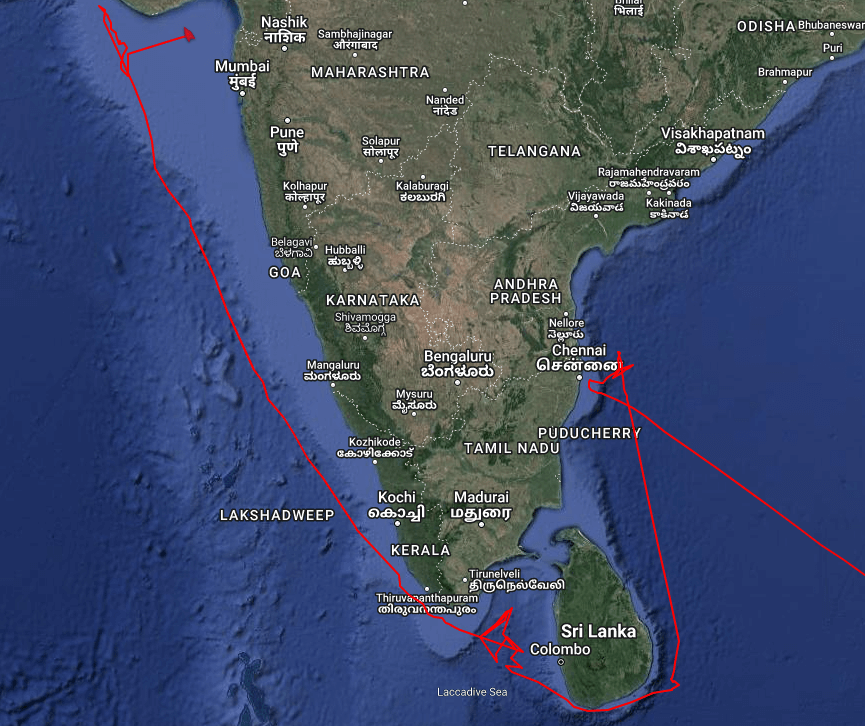
Her account aligns with AIS tracking data. Inda arrived off Chennai on a voyage from the Singapore Strait on May 25, but she did not enter port. Instead, she headed south for Sri Lanka at a slow bell, rounding its southern coast and then transiting northwest along India’s coastline, never exceeding three knots. She arrived off Gujarat in early July, and she has loitered about 50 nautical miles off Alang in recent weeks. She reports her draft as eight meters (in ballast).

Tracking courtesy Pole Star

Lenta’s reporters contacted the operator, Transmorflot, and learned that the vessel needs repair but could not enter port in India due to sanctions. Western sanctions on Russia have limited impact in India, but the Inda was specifically blacklisted by the U.S. Treasury in February for connections to sanctioned bank Promsvyazbank. Transmorflot is also named on the Treasury’s blacklist.

Khairulaeva asserted that a lack of medicine on board the ship is causing health problems for some of the crewmembers, and that food is running low. She said that the crewmembers were well past their contract end dates – some have been aboard for 15 months – and she accused the vessel’s owner and the crewmembers’ union of failing to intervene on the crew’s behalf.

Inda (ex name Linda) is a 2003-built Aframax flagged in Russia. She has been owned by Transmorflot since 2020.

Source: https://www.maritime-executive.com/article/report-sanctions-strand-russian-tanker-crew-off-india


It might be Maersk’s smallest container ship, but the new inland service represents a unique solution to ensuring the movement of containers. Maersk says the service will provide a faster, more reliable inland waterways solution to move containers between India and neighboring Bangladesh.

The new service kicked off by transporting 50 containers from Kolkata in India to a river port near Dhaka in Bangladesh on a barge. According to Vikash Agarwal, Managing Director, Maersk South Asia, while the route has created trade opportunities for the two countries over the last decades, by advancing into containerized transport provides a safer option for cargo. The first shipment on the Indo-Bangladesh Protocol Route was completed for Coca-Cola Bangladesh Beverages.

According to Maersk, the cargo movement on inland waterways or rivers is much more reliable, especially in monsoons, when the turbulent weather can cause delays while transporting goods over the ocean. Moreover, with the ocean network running under capacity pressure, the alternative inland waterways route that is quicker and more reliable offering a solution that also addresses the bottleneck at the land border between the two countries.

“The maiden barge voyage has been successfully executed where there has been a significant reduction of transit time,” said Soumyendu Sen Sarma, Director – Finance, Coca-Cola Bangladesh Beverages. “The delivery schedule of the cargo, which used to be routed through the transshipment hub and then arrives in Chittagong and further to the destination, used to be impacted severely with delays. The speed of delivery with the new solution offered by Maersk over inland waterways is going to be extremely beneficial for us.”

The Governments of both countries have encouraged trade on the Indo-Bangladesh Protocol Route and according to Maersk recently strengthened the customs processes further to enhance the ease of doing business.

“Our solution to move cargo across the Indo-Bangladesh border has a saving of over 60 percent in terms of transit time,” said Angshuman Mustafi, Head of Maersk Bangladesh.

The shipping giant also highlights that the unique new barge service is not only a benefit for trade between India and Bangladesh but also extends the connection to landlocked Bhutan.

Source: https://www.maritime-executive.com/article/maersk-launches-inland-container-service-between-india-and-bangladesh


Marine Rescue NSW specialists have put their skills to the test in a major maritime capability operation on Pittwater this weekend, preparing for real-life on-water emergencies.

Minister for Emergency Services and Resilience Steph Cooke said the two-day Search and Rescue Exercise (SAREX) tests the training and coordination of multiple emergency services organisations.

“More than 115 search and rescue specialists, including 70 Marine Rescue NSW volunteers from eight units across Greater Sydney and the Central Coast, are taking part in this important operation,” Ms Cooke said.

“Training opportunities like this are vital to help our crews stay sharp and ready to save lives when more people take to the water in the warmer months.”

Member for Pittwater Rob Stokes said despite the wet weather, Marine Rescue NSW volunteers have responded to 3,896 calls for urgent help this year.

“Tragically over the past year 14 boaters and paddlers have lost their lives, and I urge everyone heading out on the water to do their bit by always wearing a lifejacket and Logging On with their local Marine Rescue base,” Mr Stokes said.

Marine Rescue NSW Deputy Commissioner Alex Barrell said the exercise was the largest of three held across the State this winter to test the readiness of search and rescue crews.

“This weekend’s event is a major component of our ongoing professional training program for our highly skilled boat crew and radio operators, in the State’s busiest boating region,” Deputy Commissioner Barrell said.

“Our volunteers are trained to the highest standards for their roles and the on-water experience they gain from this exercise helps keep them rescue-ready around the clock.”

The scenario for the SAREX involved a search for multiple victims of a missing recreational fishing boat off the coast.

Marine Rescue NSW members from the Botany Port Hacking, Broken Bay, Central Coast, Cottage Point, Hawkesbury, Middle Harbour, Port Jackson and Sydney units were joined by personnel from the NSW Police Force Marine Area Command, Australian Maritime Safety Authority, Westpac Lifesaver Rescue Helicopter and Surf Life Saving NSW.

Source: https://nswliberal.org.au/Shared-Content/News/2022/Marine-Rescue-crews-prepare-to-save-lives


Indian Ocean security is an enduring maritime issue. Tensions on the high seas also include focusing on the Indian Ocean. As an area of water, policing and securing these sea lanes has always been a challenge. Today, the issues are becoming more complicated but manageable with deconfliction measures when necessary.
Size matters in terms of the scope of Indian Ocean area of operations. The Indian Ocean covers a vast area stretching from the coasts of East Africa in the west, to Malaysia and Australia in the east, to South Africa in the south. Its broader territory runs from the waters of the Arabian Gulf to the South China Sea, covers 70 million sq. km, or a whopping 20 percent of the world’s water surface, hosting one-third of the world’s population, one quarter of the world’s landmass, three quarters of global oil reserves, iron and tin, and more than 70,000 ships cross its expanse every year by hugging the coastal outline of the maritime arena. About 65 percent of the world’s oil reserves belong to just 10 of the Indian Ocean littoral states. The Indian Ocean hosts the world’s most significant “sea lanes of communication” and as such already played a pivotal role in the global economy, even before COVID-19 interrupted supply chains.
The world’s major choke points are also located in the Indian Ocean. These are: The Strait of Hormuz, Bab El-Mandeb (west) and Malacca Strait (east), creating “brackets of troubles” for seafarers, shipping companies and international security. A large portion of global trade and most Gulf oil en route to Asia passes through these chokepoints. As such, they are strategically important for global trade and economic development.
Despite its significant strategic position as a trade route and home to a large part of the world’s population, the Indian Ocean was for a long time rather neglected. The rise of India and China as global economic powers has significantly increased their energy needs and their dependence on Gulf oil supplies. Consequently, their energy security interests give these two Asian players direct stakes in the security and stability of the Indian Ocean, in particular the safety of transit lines form the Arabian Gulf toward the east coast of the Arabian Sea and the Bay of Bengal which surround India’s long coastal area. This has positioned India and China as major contenders for the share of the ocean’s dominion. Increasingly, China and India are bumping up against each other on East Africa’s coastline.
Historically, regional merchants moved throughout the Indian Ocean network and established diaspora communities. Through these diaspora communities, merchants introduced their cultural traditions to local indigenous cultures along coastlines. Often native customs and outside traditions existed side-by-side in relative peace, and local communities sometimes even adopted new practices and beliefs from the merchant diaspora. That peacefulness becomes interrupted by nation-state competitions over sea lane access.

Indian Ocean countries and those who access its sea lanes need to begin thinking in the long term to guarantee the safety and security of this broad expanse of sea.

Dr. Theodore Karasik

For quite a long time, the Indian Ocean has been largely dominated by the US. With the economic rise of both India and China in the past two decades, the division of world power has started to change from a unipolar toward a multipolar world in the Indian Ocean basin. This shift has brought the Indian Ocean back into the center of geopolitical attention and strategic gravity as a potential field of malign activity.
The Indian Ocean’s sea lanes are also key factors in global trade and economic stability as oil and other trading material passes through its waterways on the way to Asia, Africa, Europe and other parts of the world. Any disruption in trade causes significant stress and strain in many world economies. This is why supply chain interruptions have a recoil effect when ports are unable to accept cargo — either because of disease or local violence that destroys port facilities, or political moves making access illegal through legal means.
Who will call the shots in the Indian Ocean in the coming decades depends on many factors. The world is progressively moving toward a new international energy order, which for better or worse will be dictated by the supply and demand of key energy resources: Oil, gas and coal on top of the sanctions by the West on Russia over its invasion of Ukraine.
Countries rimming the Indian Ocean have greater potential through the growth of supply chain networks, closer international cooperation with all the states of the Indian Ocean, increased defense ties with those states, and the injection of money in states across a broad spectrum of security issues — whether maritime, food, climate or economic capacity building. The more that countries try to band together on Indian Ocean security issues, the better for potential deconfliction.
There are multiple scenarios of how the Indian Ocean affects global power sharing. The creation of the I2U2, or the West Asian Quad, is an example of a quadruple alliance that has port connectivity as part of its commercial outlook. To be sure, population control, wealth distribution, investment in human capital, development of new technologies and use of clean energy sources will be decisive factors in keeping both the supplier and consumer countries in the playing field. Opposite the West Asian Quad are China, Russia and Iran, creating the potential for high seas hijinks.
As always in this age, with a plethora of international security issues boiling, Indian Ocean countries and those who access its sea lanes need to begin thinking in the long term to guarantee the safety and security of this broad expanse of sea.

Source: https://www.arabnews.com/node/2128621/amp


Since late last month, about 100 sub-contractors pressing for an increase of 30% have occupied the main dock at the shipyard run by Daewoo Shipbuilding & Marine Engineering (DSME) in the southern city of Geoje.

The shipyard is one of the world’s biggest and the strike has led to delivery delays of eight vessels by as much as five weeks, just as the global shipbuilding industry is signalling a rebound.

Orders have come in as European countries rush to ramp up liquefied natural gas (LNG) deliveries to replace Russian gas supplies in the wake of the Ukraine crisis.

Union officials accepted an offer of a 4.5% wage increase and a promise of job guarantees for workers at some subcontracting firms that may be closing, a union official told reporters.

South Korea’s labor minister Lee Jung-Sik told a briefing that the agreement sets an important precedent for resolving labour-management disputes, adding that the government hopes that labour-management culture based on laws would be established in the future.

More than 90% of the striking workers agreed to accept the deal, though “No one in the union is satisfied with the tentative agreement,” another union official said.

The agreement reached on Friday also leaves open the possibility of legal action against the contract workers to recover damages after they occupied the dock during the strike.

“Concerning problems that arose from the strike process, we will respond in accordance with the law and principles,” Daewoo Shipbuilding said in a statement.

The strike was the second major industrial dispute for the government of President Yoon Suk-yeol who took office in May, after a truckers’ strike in June ground the country’s major industrial facilities and sea ports to a halt.

It came as the latest challenge for the conservative president who has promised business-friendly policies but has grappled with record inflation, affecting some of the lowest paid workers in the country the most.

Yoon had called the strike at Daewoo illegal and hinted the police may be sent in to break it up by force. Read full story

Daewoo has previously said it expected a daily loss of 32 billion won ($24 million) from the strike, adding that the dispute had cost it more than $400 million by mid-July.

“We will put all our capabilities into making up for delayed production, and work harder for a co-operative co-existence with subcontractors,” Daewoo Shipbuilding added in a statement.

Source: https://www.marinelink.com/news/south-korean-shipyard-workers-end-strike-498249


The UK Government has responded to the House of Lords’ International Defense and Relations Committee Inquiry (1 March 2022) into the UN Convention on the Law of the Sea (UNCLOS) 1982 being ‘Fit for Purpose in the 21st Century’.

According to global NGO Human Rights at Sea (HRAS), the government’s response can only be described as weak in respect to human rights protections for people at sea despite extensive and evidenced recommendations to do so by the UK Parliament’s Upper House.

Since then, the Committee continues to challenge the UK Government for its failures to respond to the Inquiry’s recommendations, including explicit coverage of issues pertaining to human rights at sea.

On 19 July, the Committee’s Chair, Baroness Anelay of St Johns, wrote to Lord Goldsmith of Richmond Park, Minister for Pacific and the Environment, the Foreign, Commonwealth & Development Office and the Department for Environment, Food and Rural Affairs, requesting further information from the Government on seven areas including flags of convenience and human rights at sea.

The Chair stated: “…we were disappointed with the Government’s response and would like to raise further questions.”

In relation to matters raised in the Inquiry into human rights at sea, the Chair raised several points which had received minimal or nil responses relating to recommendations by the Committee. The points raised reflect the ongoing concerns of HRAS.

On 21 July, HRAS, keeping up the pressure since 16 June when it first commented on the Government’s weak response, said: “The UK House of Lords international Defense and Relations Committee Inquiry was explicit in its recommendations to the UK Government about addressing the issue of fundamental rights and associated protections for the human rights of all persons at sea, both within and external to UK jurisdictional boundaries.

“It is now clear that a unified UK approach is required, and a clear position needs to be taken so “…that the Government confirms, unequivocally, that international human rights law applies equally at sea as on land, beyond just the jurisdiction of the ECHR, and to all categories of seafarers, not just workers.”

“The 31 May 2022 Government response has been found to be sorely lacking in key areas relating to policy responses around the subject of human rights at sea.

“This requires urgent rectification to provide both national and international clarity on the UK’s position and approach if the UK is to be taken seriously as a maritime and human rights leader.”

On 16 June, HRAS first commented: “The UK Government can and must do better on the issue of fundamental protections for all persons at sea if it is to aspire to its proposed thought leadership role and fulfil its own mandate for the 2050 Maritime vision.

“The current political positioning towards the eminent recommendations by the UK House of Lords Inquiry deftly ‘kicks-the-can’ down the road and conveniently stalls to avoid tackling the very serious issues of reinforcing the existing rule of law and international rules-based environment at sea explicitly for human rights.

“And despite explicit Parliamentary reference to the Geneva Declaration on Human Rights at Sea, there was silence on the validity of that extensive soft law development work.

“This weak response sends a clear message to those who wish to write down or even write out human rights protections at sea that a failure to address such key matters raised in a national Parliament effectively means that impunity and abuses at sea can at best be conveniently ignored, at worst, condoned.

“It is therefore time to put ‘human rights at sea’ firmly on the UK political agenda to better participate and support the global narrative for protecting the fundamental human rights of all persons reliant on maritime access and ocean resources, including the extensive use of logistical routes crossing the world’s oceans and seas, while concurrently upholding and reinforcing the international rules-based system in the maritime environment.”

UK Government failings

Despite expert recommendations to explicitly look at human rights protections at sea, extensively evidenced in detailed national and international submissions, the UK Government has failed to comprehensively detail human rights issues which affect global supply chains for all goods transported by sea, affect exploited marine resources including flag state impunity, criminality and illegal, unregulated, and unreported (IUU) fishing at sea, affect mixed migration and affect slavery and trafficking at sea.

Turn-backs of migrant boats in The English Channel remains a significant point of policy and legal contention, while reliance on referencing the ILO 188 Work in Fishing Convention is a distracting point noting the limited numbers of state ratifications and global uptake.

Additionally, the response failed to substantially acknowledge and indeed agree as to the need for better protections of individual fundamental rights for all those persons who live, work and transit by sea, other than within UK territorial waters.

By way of example, the Inquiry’s report stated: “Witnesses were clear that international human rights law applies to those at sea as well as on land. Professor Klein (Australia) explained that: “there was a point in time where some countries did not consider that their human rights obligations extended out to sea once they were beyond their land territory, but that position has been firmly quashed at this stage.”

The UK Government further failed to support the position that ‘human rights apply at sea, as they do on land’. Instead, it weakly commented that: “[Response to 219] The Government accepts that internationally the applicable jurisdiction for victims of human rights abuses at sea may be difficult to ascertain. There is scope to clarify where victims may bring a complaint or case in the UK.”

Applicable contextual evidence from Prof. Petrig (Switzerland) stated: ““Not only has the law of the sea been in large part human rights blind, but human rights law has until very recently suffered from serious sea blindness. As a result, human rights treaties that have been refined through many efforts by many actors are mainly for a land context and not for the sea.” This point was seemingly ignored.

Areas of concern

In terms of the ‘Applicability of human rights law at sea’, it was stated:

“We were disappointed with the Government’s responses to paragraphs 190, 191 and 192 of our report. The response acknowledges that while “human rights for workers ashore in the UK are enforced through tribunals/the ECHR…there is scope to clarify where seafarers have access to these.”

“But it gives no detail on how the Government seeks to address these gaps. It also only refers to rights for workers and not wider users of the sea, which we explicitly asked about in our recommendation in paragraph 192.”

“The response also does not confirm, as requested, that the Government considers international human rights law to apply equally at sea as on land. Instead, it refers to the application of the ECHR as applying equally in UK territorial sea as on land. This is a geographically restricted interpretation of human rights at sea and does not explicitly acknowledge the inherent rights of individuals wherever they are located.

“Further, while the response acknowledges there are jurisdictional complexities that exist at sea, this should not detract from the commitment that human rights law applies regardless of these jurisdictional complexities.”

In terms of ‘Flag states and human rights at sea’, it was stated:

“In response to paragraph 193 of our report, the response again asserts that: “The record of compliance with international conventions by vessels on Open Registers is not significantly worse than that of vessels on other registries.”

“However, this does not address the issue of whether a flag state is able to enforce international law when a breach occurs, which is a particular concern for human rights. We ask that in response to question 2 above, you include reference to the specific challenges relating to flags of convenience and enforcing human rights at sea.”

In terms of ‘Justice for victims of human rights abuses at sea’ it was stated:

“The response to paragraph 219 of our report was very brief. The response acknowledges that “internationally the applicable jurisdiction for victims of human rights abuses at sea may be difficult to ascertain”, and that there is “scope to clarify where victims may bring a complaint or case in the UK”, but it does not provide this clarification.”

Key for HRAS is the point on ‘A unified approach to human rights at sea’, where it was stated:

“A reply to paragraph 232 of our report was missing from the response. Paragraph 232 said:

“Piecemeal solutions will not be sufficient. We call on the Government to work with like-minded partners to advance a unified approach to human rights at sea. This will need to draw together practical solutions to challenges including mass migration, forced labor, physical and sexual crimes, and crimes committed by privately contracted armed security personnel, and must lead to the creation of new mechanisms to address the issue.”

Crucially, the Committee stated: “We would like to reiterate this recommendation and ask again whether the Government is planning to work towards a unified approach to human rights at sea.”

Source: https://maritimefairtrade.org/global-ngo-criticizes-uk-governments-weak-support-for-human-rights-at-sea/


The U.S. Navy’s only forward-deployed aircraft carrier USS Ronald Reagan (CVN 76) arrived in the Republic of Singapore for a scheduled port call July 22, marking the first time the carrier has visited the country since 2019. Ronald Reagan arrived with the Ticonderoga-class guided-missile cruiser USS Antietam (CG 54).

Prior to arrival, USS Ronald Reagan operated in the South China Sea where it conducted maritime security operations, including flight operations with fixed and rotary-wing aircraft, maritime strike training, coordinated tactical training between surface and air units, as well as replenishments and fueling at-sea.

“Ronald Reagan sailors and those embarked from Carrier Air Wing 5, Destroyer Squadron 15 and the entire strike group have shown their drive and dedication to the mission in the South China Sea, proving our commitment to a free and open Indo-Pacific region,” said Rear Adm. Michael Donnelly, commander, Carrier Strike Group 5/Task Force 70.

“The chance to make port in Singapore underscores the value of visits with our allies and partners in the region that enable us to work together and build impactful, trusting relationships that only our presence can foster.”

While in Singapore, sailors are scheduled to participate in various community relations events, including work with a local food bank.

“Port visits mean a great deal to our sailors,” said Capt. Fred Goldhammer, Ronald Reagan’s commanding officer. “Our crew has worked extremely hard this year, and is very much looking forward to enjoying the cultural diversity of Singapore. We feel very fortunate to be guests of this great country.”

The Ronald Reagan Carrier Strike Group is deployed to the U.S. 7th Fleet area of operations in support of a free and open Indo-Pacific region. U.S. 7th Fleet conducts forward-deployed naval operations in support of U.S. national interests in the Indo-Pacific area of operations. As the U.S. Navy’s largest forward-deployed fleet, 7th Fleet interacts with 35 other maritime nations to build partnerships that foster maritime security, promote stability, and prevent conflict.

Source: https://maritimefairtrade.org/u-s-aircraft-carrier-visits-singapore/


Company DETAILS

SHIP IP LTD
VAT:BG 202572176
Rakovski STR.145
Sofia,
Bulgaria
Phone ( +359) 24929284
E-mail: sales(at)shipip.com

ISO 9001:2015 CERTIFIED