Chief Executive Bob Chapek introduced Walt Disney Co’s first new cruise ship in a decade on Wednesday, the culmination of the first project the former theme parks executive championed to the company’s board of directors.
The launch of the 4,000-passenger Disney Wish is a bright spot for Chapek, who became Disney’s CEO in February 2020 and secured a three-year contract extension on Tuesday following recent controversies that prompted questions about his tenure.
It took more than six years to bring the 144,000-ton Wish to the market, Chapek told guests at a christening ceremony that featured fireworks and appearances by Mickey and Minnie Mouse, Ant-Man, Chewbacca and other characters from Disney’s vast portfolio.
On the ship, “we combine these amazing characters and stories with incredible technology to create brand new experiences,” Chapek said.
The cruise business is part of Disney’s massive theme parks, experiences and products unit, which has rebounded from pandemic closures. Operating income hit $4.2 billion in the first half of fiscal 2022, reversing a $535 million loss a year earlier.
Disney does not disclose how much cruises contribute to earnings, but Chapek said in November that the business has generated “a double-digit return on investment” given the premium price that Disney charges.
The Wish, the fifth vessel in Disney’s fleet, “kicks off the largest expansion in Disney Cruise Line history,” said Josh D’Amaro, chairman of Disney’s parks division. Two more ships will be delivered by 2025.
The new ship sets sail as the industry works to lure customers back after a 15-month shutdown during the COVID-19 pandemic.
The Cruise Lines International Association estimates it could take until the end of 2023 for passenger volume to surpass the levels of 2019, when 29.7 million people boarded ships around the world.
The U.S. Centers for Disease Control and Prevention still advises that COVID-19 “spreads easily between people in close quarters on board ships” and that even vaccinated passengers may become infected.
D’Amaro said he believed Disney’s cruise line would return to full capacity, noting steady gains in bookings.
“When all is said and done, we’ll have seven of them, and all seven of them will be filled out,” he said in an interview. “I have 100% confidence in that.”
The ship also “complements everything that we do,” D’Amaro added. “For example, people that will come to get aboard this ship … they’re spending three days at Walt Disney World.”
The company will seek to entice vacationers to the Disney Wish with what it touts as its first attraction at sea, the AquaMouse. The theme-park-like ride incorporates animated short films featuring Mickey and other characters as guests float through 760 feet (230 meters) of winding tubes suspended above the upper decks.
Dining experiences place families inside the worlds of Disney’s “Frozen” and Marvel’s Avengers. For adults, Disney created a Star Wars-themed hyperspace lounge that evokes the look of star cruisers in “Solo: A Star Wars Story.”
The ship also boasts an interactive experience that marries the physical and digital worlds. A Disney Cruise Line app turns a user’s phone into a virtual “spyglass” for peering at constellations in the night sky (which appear as Disney and Pixar characters) and embarking on adventures.
The interactive game marks a step toward Chapek’s goal of establishing a presence in the metaverse. The executive has advocated virtual experiences as a way to keep consumers connected to Disney characters and stories in between movie releases and park visits.
The Disney Wish will set out on its first voyage on July 14 from Port Canaveral in Florida.
Disney has been embroiled in controversy in the state after the company opposed legislation to limit LGBTQ discussion in schools. That prompted state lawmakers to pass a measure that removes the company’s self-governing status for Walt Disney World in Orlando, though it has not yet taken effect.
Employees at Disney had urged the company to speak out against the LGBTQ legislation, which opponents dubbed a “Don’t Say Gay” bill.
Resolution takes time. In late June, 2022, two older matters were working their way through the FMC, which saw its budget doubled in the recently signed Ocean Shipping Reform Act of 2022.
In one high profile action, a complaint filed against Ocean Network Express (ONE), Docket 21-17 was settled. The complaint regarded charges for a shipment that sat at a terminal for several months in 2018, pre- pandemic. A confidential settledment was reached between the alliance and the FMC’s Bureau of Enforcement (BOE). This case attracted attention when the complaint was filed at end of 2021 and stems from a 2018 shipment that arrived at the Port of Houston in November 2018 but was not picked up until January 2019. ONE assessed a demurrage charge against the cargo interest. In May 2020, ONE filed suit against the shipper in a Texas court in an effort to collect the charges. The facts of the case were not straightforward however; the shipment’s bill of lading named a forwarder who in turn got into a dispute with the actual cargo consignee- a lumber company, which contributed to the delay in releasing the shipment. In its end-2021 proceeding, the FMC agreed to investigate whether ONE had violated Federal laws, in the U.S. Code at 46 U.S.C. § 41102(C)
In a late June filing, both sides had sought “approval of the…Settlement Agreement; (2) an order that the Settlement Agreement be held confidential by the Presiding Officer and the FMC and be barred from public view or disclosure; and (3) upon approval of the Settlement Agreement, dismissal of this proceeding with prejudice.” At end June, the FMC’s Chief Administrative Law Judge agreed on all counts- 46 U.S.C. § 41102(C)
Recent activity also included progress on long-simmering “FMC Docket No. 20-14”, or Intermodal Motor Carriers Conference, et al. <IMCC> v. Ocean Carrier Equipment Management Association, Inc., <OCEMA> et al. Oversimplifying- the truckers are objecting to the carriers practices in tendering containers and charging for demurrage at the ports. The case is noteworthy as OCEMA’s members include a who’s who of carriers; notably CMA CGM S.A., COSCO Shipping Lines Co. Ltd., Evergreen Line, Hapag-Lloyd AG, HMM Co. Ltd., Maersk A/S, MSC., Ocean Network Express Pte. Ltd., Wan Hai Lines Ltd., Yang Ming, and ZIM.
This matter, dealing with availability and charges for chassis provided by OCEMA member carriers, has been in front of the FMC since August 2020. At that time, a group of intermodal trucking companies had complained that the OCEMA carriers were in violation of the Shipping Act of 1984, and were engaging in “unjust and unreasonable practices”. The filing came in the wake of a mid-2020 FMC Interpretive Rule on unreasonable practices, which had its origins in pre-Covid supply chain related supply chain issues. Legal experts have expressed differing opinions on whether matters relating to container chassis are even covered by the Interpretive Rule.
In the latest back and forth, the parties were arguing over the legalities surrounding expert testimony presented by both sides; OCEMA experts challenged the mechanics of the discussion of a “regression analysis” prepared by the IMCC expert. Various filings saw requests from both sides for confidentiality surrounding information that had been submitted. While legal filings are usually very dry, one by IMCC characterized testimony by an OCEMA expert as an “ambush”- due to the peculiarities of its timing, and inability of IMCC to cross-examine the expert.
The maritime and shipping industry – with more than 50,000 ships on the water – emitted 1.056bn t of CO2 in 2018, about 3pc of total global greenhouse gas (GHG) emissions. The recent Maritime Environment Protection Committee (MEPC) meeting in June 2021 laid down a concrete plan for minimising GHG emissions from ships by 50pc until 2050. According to the MEPC 76 meeting, vessels are required to calculate an Energy Efficiency Existing Ship Index (EEXI) and Carbon Intensity Indicator (CII) from 2023. What does this mean and what steps should be taken?
Understanding and calculating EEXI
Starting from 2023, each vessel above 400 Gt will require a one-off EEXI calculation to confirm that the vessel meets the energy efficiency design standards. An International Energy Efficiency (IEE) certificate will be awarded if the vessel meets those standards.
Take for instance, a basic 82,000 dwt Kamsarmax vessel with no energy saving devices installed:
Main engine (ME) maximum continuous rating (MCR)
14,280 kw
ME specific fuel oil consumption (SFOC)
171 gms/kwhr
Auxiliary engine (AE) MCR
5pc of main engine MCR (Assumed as per EEXI guidance)
AE SFOC
187 gms/kwhr
Vessel’s speed on the power speed curve (Vref)
15.09 knots at 75pc MCR
Fuel Constant
3.151
Reduction factor
20
EEDI/EEXI reference line parameters
A = 961.79
C = 0.477
Required EEXI:
[1-(Reduction factor/100)] * [EEXI reference line parameters A*{(Vessel’s DWT)^(minus EEXI reference line parameters C)}]
Based on the above calculations, the vessel does not meet EEXI’s requirements, because the attained EEXI (5.00 gms/t-mile) is greater than the required EEXI (3.49 gms/t-mile). So the vessel will have to reduce its MCR to comply with the EEXI regulation, and to attain the IEE Qualification.
Based on the calculation above, the vessel can meet compliance standards if the main engine runs at 50.6pc MCR, where the attained EEXI matches the required EEXI. The vessel will be given the IEE certificate, if the main engine’s MCR continues to operate below 51pc and adjusts to the corresponding speed on the power speed curve (13.24 knots in this instance).
The formula to calculate EEXI was derived from the Energy Efficiency Design Index (EEDI). EEDI is applicable to new ships built on or after 1 January 2013. Vessels built on or after 2013, with a valid IEE are not required to calculate EEXI. Some of the variables used in the EEXI formula are listed below:
EEDI/EEXI reference line parameter values:
Ship type
A
B
C
Bulk Carrier
961.79
dwt
0.477
Gas Carrier
1,120
dwt
0.456
Tanker
1,218.8
dwt
0.488
Container ship
174.22
dwt
0.201
LNG carrier
2,253.7
dwt
0.474
Reference line
= a * b ^ (-c)
Required EEDI / EEXI
= [1 – (Reduction factor/100)] * Reference line
EEDI reduction factor:
Reduction factors (in percentage) for the EEXI relative to the EEDI reference line
Ship type
Ship size
Reduction factor
Bulk carrier
200,000 DWT and above
15
20,000 and above but less than 200,000 DWT
20
10,000 and above but less than 20,000 DWT
0-20*
Gas carrier
15,000 DWT and above
30
10,000 and above but less than 15,000 DWT
20
2,000 and above but less than 10,000 DWT
0-20*
Tanker
200,000 DWT and above
15
20,000 and above but less than 200,000 DWT
20
4,000 and above but less than 20,000 DWT
0-20*
Containership
200,000 DWT and above
50
120,000 and above but less than 200,000 DWT
45
80,000 and above but less than 120,000 DWT
35
40,000 and above but less than 80,000 DWT
30
15,000 and above but less than 40,000 DWT
20
10,000 and above but less than 15,000 DWT
0-20*
LNG carrier
10,000 DWT and above
30
* Reduction factor to be linearly interpolated between the two values dependent upon ship size.
The lower value of the reduction factor is to be applied to the smaller ship size.
Are vessels compliant once EEXI is achieved? What is CII?
The Carbon Intensity Indicator (CII) is a measure of how efficiently a ship transports goods or passengers – linking carbon emissions to vessel capacity and vessel movement. The ship is given an annual rating ranging from A to E. All vessels above 5,000 Gt are required to attain and document an annual operational CII, to be verified against the required annual operational CII, according to the MEPC 76.
The ship is then given an annual rating ranging from A to E, by comparing the attained annual CII of a ship with the direction and distance it deviates from the required CII (DD vector for short).
Ship type
Ship size
DD vectors (after exponential transformation)
exp(d1)
exp(d2)
exp(d3)
exp(d4)
Bulk carrier
dwt
0.86
0.94
1.06
1.18
Gas carrier
65,000 dwt and above
dwt
0.79
0.89
1.12
1.36
less than 65,000 dwt
dwt
0.85
0.95
1.06
1.25
Tanker
dwt
0.82
0.93
1.08
1.27
Container Ship
dwt
0.83
0.94
1.07
1.19
LNG carrier
100,000 dwt and above
dwt
0.91
0.98
1.05
1.11
less than 100,000 dwt
dwt
0.77
0.91
1.12
1.37
Taking the same basic 82,000 dwt Kamsarmax vessel used above:
Average Speed
13.24 knots (basis 50.6pc MCR)
Sailing days
292 days (75pc sailing 25pc at port)
Distance travelled
92,786 nm
Average fuel consumed
32t/day
Fuel Constant
3.151
Sailing days
292 days (75pc sailing 25pc at port)
CII reference line parameters
A = 4,977
C = 0.626
2023 CII reduction factor
5pc
Required CII:
[CII reference line parameters A * {DWT^(minus CII reference line Parameter C)}]*[1-(CII reduction factor/100)]
A basic Kamsarmax with an annual rating of 0.97 is between DD vectors d2 (0.94) and d3 (1.06), and so receives a C rating. The annual rating would be an A for a bulk carrier, if it was at or lower than 0.86 (d1), and B if it was above superior boundary (0.86), but equal to or below the lower boundary (0.94). Vessels that receive A, B, or C ratings, will be issued a statement of compliance. Vessels that receive a D for three consecutive years, or an E rating, will be given a year to develop a corrective action plan that will enable the vessel to achieve at least a C rating. The Statement of Compliance to these vessels will not be issued unless the corrective action plan is reflected in a Ship Energy Efficiency Management Plan (SEEMP) and is verified by the administration or authorised organisations (vessel classification societies).
What are the various ways to implement SEEMP and make a vessel EEXI and CII compliant?
Proper maintenance of the vessel’s hull at dry dock.
Coating the vessel’s hull with good paint to increase hydrodynamic performance.
Improve the vessel’s steering configurations.
Have a more efficient aft-ship, propeller, and rudder arrangements.
Reduce energy consumption in main and auxiliary engines, auxiliary machineries, air conditioning, and other minor energy consumers.
Weather routing and choosing the best route for transportation of cargo.
Using efficient energy saving devices.
Slow steaming of the vessel.
Using of alternative fuels instead of high-sulphur fuel oil or very low-sulphur fuel oil (VLSFO).
As a note, SEEMP plans cannot be applied across a company or fleet-wide, as these plans are ship specific and have to be implemented according to the vessel type, cargoes carried, ship routes, and other relevant factors.
(LONDON) — The maritime world is changing, fast. Ships are now operating greener, with greater digitization, and with more diverse crews. As the lifeblood of the shipping industry, seafarers are at the heart of this evolution, implementing new regulations, learning new skills and adopting safer, more efficient working practices. As the world’s merchant fleet traverses the oceans, the crews on these ships continue their career journey.
The International Maritime Organization (IMO) is focusing on seafarers’ experiences, voyages and journeys as the theme of the 2022 Day of the Seafarer, recognized on June 25, drawing attention to how the onboard working environment continues to change. This focus aligns with United Nations Sustainable Development Goal 14: Conserve and sustainably use the oceans, seas and marine resources for sustainable development.
IMO photo
This year’s Day of the Seafarer theme — “Your Voyage, Then and Now, Share Your Journey” — invites seafarers across the world to share images and information about what truly resonates with them — whether a positive experience or challenging circumstances.
“Every seafarer’s journey is unique. Yet many of the challenges and opportunities are shared,” said IMO Secretary-General Kitack Lim. “On this Day of the Seafarer, we can look to the future. Seafarer’s voyages are changing — in the form of new technologies and equipment, increasing use of alternative fuels and further responsibilities for a greener and more sustainable future for the industry and for the marine environment.”
As a former seafarer himself, the secretary-general is aware that maritime journeys can extend beyond being at sea to a career on land, and he encourages all seafarers — past and present — to be a part of the event. “I invite you to share photos from your first voyage and your most recent voyage on social media. We want to see how far you have come in your journey and celebrate your progress,” he said.
Ongoing challenges
Lim added, “On the International Day of the Seafarer … it is important that we all remember the challenges that seafarers have faced over the past two years and are still facing, including difficulties to effect crew changes, lack of designation as key workers and inability to access medical care and vaccines.
“I also remain concerned about the seizure of vessels engaged in legitimate trade outside established legal processes. I urge all member states to use relevant diplomatic channels to resolve their differences so that international shipping and especially seafarers are not unduly impacted. As I have said in the past, seafarers and shipping should not become collateral victims of larger political issues. The welfare of seafarers and the need for international shipping to move freely and unhindered is critical to the continuous operation of global supply chains, for the benefit of all peoples of the world.”
United Nations Secretary-General Antonio Guterres said, “Seafarers worldwide have faced immense challenges stemming from the COVID-19 pandemic — including contracts extended long beyond their expiry dates and maximum periods of service, and challenges related to vaccinations, medical care and shore leave. This year’s theme — ‘Your Voyage, Then and Now’ — is an opportunity to recognize the vital role seafarers play, and look to the future.
“Above all, this means listening to seafarers themselves. They know better than anyone their needs and what this industry needs to do to address key challenges. This includes the expansion of social protection, better working conditions, addressing the crew-change crisis, adopting new digital tools to enhance safety and efficiency, and making this industry greener and more sustainable,” he continued. Read the full speech here.
Join the campaign
As in previous years, the 2022 Day of the Seafarer event will predominantly be held on social media to draw attention to the contribution that seafarers make to shipping and world trade.
Participants in the campaign can use the hashtag for 2022 “#SeafarerJourney” or the regular hashtag “#DayOfTheSeafarer” and join in the conversation.
Seafarers are invited to post two photos using the hashtags: one of their first voyage and another of their most recent voyage. We would also like to know what has changed during your maritime voyage. Is shipping greener? Is the technology better? Are you more skilled? What have you learned?
Supportive organizations, shipping companies and port organizations are also invited to show their appreciation for seafarers by resharing their posts or using the hashtags and discussing the importance of seafarer journeys.
Members of the public are encouraged to post about the many ways in which seafarer journeys benefit their lives (e.g. bringing them food, electronics, medicines, etc.) using the same hashtags.
Photos and posts can be shared on Facebook, LinkedIn, Twitter and Instagram – and tagging the IMO will allow it to view and reshare some of the posts.
The world’s largest cash buyer of ships for recycling will be at Posidonia 2022 and on the lookout for like-minded shipowners to deliver ESG friendly ship recycling.
A fundamental shift in attitudes towards ship recycling is forcing a change in the way owners deal with scrapping.
Operating shipowners, private equity and tonnage providers feeling the heat from cargo clients, banks and investors are now being urged to engage with the entire ship recycling process – from the sale contract to the last steel plate lifted ashore.
“Look at the data. Last year, for the first time, every ship GMS sold to India went to a yard holding Hong Kong Convention Statement of Compliance.”
Pressure from prominent shipping banks that work closely with ship cash buyers and other stakeholders such as DNB and Nordea to improve standards is taking the form of solid recommendations to their owner clients to get closely involved in ship recycling. Engagement, they say, will minimize the impact on the environment and society that results from poor recycling practices.
Getting involved typically involves developing a company recycling policy, obtaining an Inventory of Hazardous Materials (IHM) for every ship in the existing fleet, using fewer hazmats used during construction, conducting due diligence of scrap yards, proper supervision, and documentation at the waterfront. Involvement can also extend to inserting responsible ship recycling clauses in sale contracts for ships approaching the end of their trading lives.
Changing commercial landscape
Senior Trader of top cash buyer of ships for recycling, GMS, Vagelis Chatzigiannis acknowledges that historically there has been a reluctance to engage with green recycling from some quarters. But he points to the ever-growing number of high-quality ship recycling yards in India combined with ESG pressure on owners as main drivers for the shift in both attitude and practices. “The landscape is changing for sure. Owners who were solely price-driven are considering the impact of the continuously changing ESG environment. Green deals, involving yard selection and auditing, supervision and documentation are now very much part of our daily trading activities,” he says.
Chatzigiannis says ship and offshore owners are now looking for turnkey green solutions. “We aren’t simply ship cash buyers; We actively walk clients through the ship recycling process hand to hand, and cover all aspects of their recycling needs from regulatory, commercial and operational aspects; not just delivery of the units, but including completion of the recycling process and the issuance of the recycling completion certificate.
He adds that owners now want to see evidence and hard facts about the benefits of opting for a green solution. “It is important to be able to quantify the benefits and savings to the environment by choosing ESG practices, which our SSORP can deliver.”
Singapore based GMS trader Jamie Dalzell believes owners are helping to force the pace of change. ‘We are seeing more requests for HKC compliant offers these days as owners seek to comply with growing ESG requirements. This is indeed encouraging and in turn, leads to an increase in the number of yards along with upgrades on existing HKC yards as they seek to satisfy this demand.’
No short cuts
The person in charge of SSORP, Dr Anand Hiremath holds a PhD in ship recycling and divides his time advising shipowner clients and recyclers on delivering a green solution.
He recognizes the challenges but is proud of his team’s achievements. “Our purpose is safer and greener recycling – up to now, 102 ships (including 25 offshore units) have been safely recycled under our supervision. The SSORP team has completed more projects than any other compliance monitoring company in the world.”
He says the services required by owners are all significant contributors to responsible recycling. “Typically, the work involves preparing the Inventory of Hazardous Materials (IHM), helping the yard develop a Ship Recycling Plan, evaluating the Ship Recycling Facility Plan, hazardous waste management, risk assessment, daily safety observation, effective implementation of ship recycling plan, estimation of carbon footprint, monitoring the recycling process and providing a weekly/monthly/ completion report as per HKC guidelines.”
Dr Hiremath says owners are looking for full transparency backed up by accurate data. “Under SSORP, we collect 281 data points during the compliance monitoring process. But it is not all about the number of data points – more the transparency and accuracy we bring, acting as shipowner’s eyes and ears at ground zero”.
The International Marine Contractors Association (IMCA) has published a report, Global Specialist Offshore Support Vessel Market Overview, highlighting the risks to the US offshore energy industry should proposed crewing legislation, referred to as the American Offshore Workers Fairness Act, be passed into law by the US Senate.
According to the report, “The huge demand for US mariners, crew, and technicians to safely operate [offshore construction] vessels is materially undersupplied and there are not enough training programs and other initiatives underway to resolve this in the short term. This will be particularly true for the emerging SOV market because this work must be accomplished by coastwise qualified vessels requiring all US crew. Similarly, while not specifically categorized in this report, the offshore wind market should drive the need for coastwise CTVs and thus the demand for more qualified mariners.”
Allen Leatt, CEO of IMCA, said in a statement: “Increasing demand for the development of offshore energy sources is clear for all to see, in both the offshore wind and offshore oil and gas industries. The international fleet of construction vessels and their crew will be essential to meet national energy goals and the proposed crewing legislation will severely degrade the pace of development in the US.”
A letter to the Senate from the American Clean Power Association, signed by the CEOs of 25 companies involved in the US offshore wind industry, supports this message. The CEOs urge the Senate to exclude a provision that they say, “would derail the nascent US offshore wind industry, namely the maritime crewing language in the House-passed Don Young Coast Guard Authorization Act of 2022 (H.R. 6865) and seek other solutions to reach our shared goal of maximizing the number of domestic mariners.”
The letter notes that the crewing provision would block the use of international specialized offshore vessels “when there are currently no US-flagged specialized construction vessels to do the work needed.”
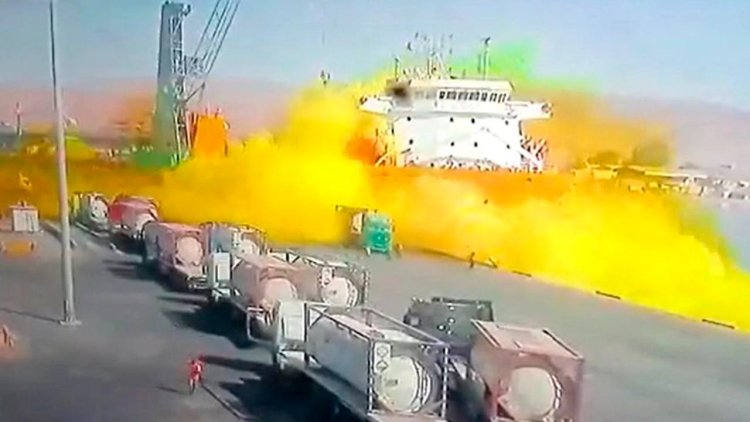
Authorities said a chemical storage container fell while being transported as a result of a crane malfunction.
CCTV footage showed the container being hoisted into the air and then suddenly dropping on to a ship and exploding.
A large cloud of bright yellow gas is seen spreading across the ground, sending people running for safety.
State media said on Monday night that 123 of the injured were still being treated at local hospitals for chemical exposure. Some were reportedly in a critical condition.
Chlorine is a chemical used in industry and in household cleaning products. It is a yellow-green gas at normal temperature and pressure, but is usually pressurised and cooled for storage and shipment.
When chlorine is inhaled, swallowed or comes into contact with skin, it reacts with water to produce acids that damage cells in the body. Inhaling high levels of chlorine causes fluid to build up in the lungs – a life-threatening condition known as pulmonary oedema.
Residents of Aqaba city, which is 16km (10 miles) north of the port, were advised to stay inside and close windows and doors following the leak, which happened at 15:15 (12:15 GMT) on Monday.
Aqaba’s southern beach, which is only 7km away and is a popular tourist destination, was also evacuated as a precaution, AFP news agency reported.
After several hours Minister of State for Media Affairs Faisal Shboul declared that there was no longer any risk to the city and its residents.
The Civil Defence Department sent specialist teams to the port to deal with the leak and clean-up operation.
Prime Minister Bisher al-Khasawneh flew to Aqaba and visited a hospital that was treating some of the injured.
He ordered Interior Minister Mazen Faraya to oversee a transparent investigation into the “regrettable” tragedy and to guarantee “all resources to ensure the total security of workers at the ports and all necessary precautions in relation to hazardous materials”.
The deputy director of Aqaba’s port told AlMamlaka TV that an “iron rope” carrying the container “broke” while it was being loaded on to a vessel.
The container was filled with between 25 and 30 tonnes of chlorine and was being exported to Djibouti.
The meeting aims to unite efforts of the 17 Signatory States to enhance regional maritime security and protect international trade routes
Dubai, UAE: In line with its commitment to support the security and safety of the maritime industry, the UAE hosted the 2022 high-level workshop of the amended Djibouti Code of Conduct (DCoC) concerning the Repression of Piracy and Armed Robbery in the Western Indian Ocean and the Gulf of Aden area.
The workshop was held between 28 to 30 June 2022, at the Intercontinental Festival City hotel in Dubai. With the presence of H.E. Eng. Suhail Al Mazrouei, the UAE Minister of Energy and Infrastructure. The workshop witnessed the presence of around 80 officials, including ministers, representing 17 countries. There were also representatives from ‘Friends of DCoC’ which includes international agencies and countries including France and the USA were present.
The latest amendment of the Djibouti Code of Conduct was adopted at the 2017 Jeddah meeting by countries in the Western Indian Ocean and the Gulf of Aden area.
This Code of Conduct is a major agreement in combating piracy and armed robbery against ships sailing in the region’s waters.
The Jeddah Amendment, which was developed from the initial version of the DCoC, covers measures to tackle a range of illicit activities, including piracy, arms trafficking, trafficking in narcotics, illegal trade in wildlife, illegal oil bunkering, crude oil theft, human trafficking, human smuggling, and illegal dumping of toxic waste in regional and international waters in the region.
Strategy to Support Maritime Security
Commenting on this significant meeting, H.E. Hassan Mohammed Juma Al-Mansouri, Undersecretary for Infrastructure and Transport Affairs at the Ministry of Energy and Infrastructure, said: “The UAE is a leading global maritime hub with the maritime economy exceeding AED 90 billion annually. Over 25,000 commercial ships call the UAE ports every year, making it a gate to the entire region. Maritime security is a key factor to sustain economic growth. Without it, the region’s countries will face major challenges. The UAE abides by all international initiatives that aim to enhance our maritime security and suppress all forms of illegal activities. We dedicate our maritime capabilities, resources and expertise to ensure that the region is free from criminal acts and abuses against humans, the environment and the wildlife.”
Al-Mansouri added: “Just as all oceans and seas around the world are connected as one large body of water, the security and the safety of ships and maritime routes are also connected, especially within the Arabian Gulf and the Western Indian Ocean region. This area has the largest energy reserves in the world as well as the most important straits and international trade routes. Affecting the maritime security of the region will have negative impacts on the global economy as a whole. That’s why, this meeting of the signatory states on the DCoC, which is hosted by us in the UAE, is significant for enhancing maritime safety worldwide.”
The Jeddah Amendment was signed by 17 countries. These are the UAE, Saudi Arabia, the Sultanate of Oman, Jordan, Yemen, Comoros, Djibouti, Ethiopia, Kenya, Madagascar, the Maldives, Mauritius, Mozambique, Seychelles, Somalia, South Africa and Tanzania.
Overarching regional framework
H.E. Sheikh Nasser Al Qasimi, Assistant Under-Secretary for Infrastructure and Transport Regulation at the Ministry of Energy and Infrastructure in the UAE, said: “Over the years, the emended DCoC has evolved from a piracy-centric cooperation framework into a comprehensive forum that addresses maritime security from a comprehensive perspective. Last year, the signatory states made great efforts to implement the planned Information Sharing Network and regionally prioritised Capacity Building Matrix to address the changing maritime security conditions in the Western Indian Ocean and the Gulf of Aden. The DCoC was further supported by the International Partners through the Friends of the Djibouti Code of Conduct to be able to collaborate in providing assistance based on the needs of the Signatory States. Today, we consolidate this cooperation, building on the previous efforts, in order to achieve the highest levels of maritime safety and security in this vital region of the world.”
Ship owners have sped up their newbuilding contracting activity, opting for more modern tonnage. In its latest weekly report, shipbroker Allied Shipbroking said that “the impressive performance of the newbuilding market continued for yet another week. A large part of the buying interest continues to focus for yet another week on gas carriers and more specifically LNG units, as we are still seeing a flow of orders being made on behalf of the major Qatar LNG Project that is in the works. It seems that the good feeling that exists for this sector, the positive freight rates as well as the desire to secure energy supply amidst the current global energy crisis that has emerged has increased investor appetite for these projects and in turn the number newbuilding projects that are taking shape. On the shipbuilders’ front, the lion share has been taken up by South Korean shipyards which traditionally have the higher expertise, know-how and track record for these type of vessels, though if appetite remains high for much longer, we are likely to see an overspill across to other shipbuilders as well. We have also seen a strong buying appetite hold for containership units, as earnings are still holding at record highs, while despite the lacklustre earnings performance noted in tankers, the recent freight market recovery has triggered an increase in buying interest and a fair flow of new orders this past week”
Source: Allied Shipbroking
Banchero Costa added in its report this week that “whilst still satisfactory there is a slowing of orders for larger tonnage. Big concern for the New buindings with delivery after 3 years. This week Capital Gas Greece ordered 2 x 174,000 cu.m LNG Carriers at Hyundai Samho for delivery Jan/March 2026 at a level of $240 mln per unit. These are nearly $8 mln more than 2 other greeks controlled orders done few weeks back.
Source: banchero costa &c s.p.a
Knutsen NYK Offshore OAS booker 1 firm Suezmax Shuttle Tanker 154,000 dwt at Cosco Zhoushan for delivery 2024. No price emerged. Thenamaris added 2 more Aframax LR2 Product Carriers at Hyundai Vietnam for dely mid-2025. Total 15 ships on order in Vietnam from Thenamaris, all product carriers except 4 Bulkers ordered recently”.
Meanwhile, in the S&P Market, Allied said that “on the dry bulk side, it was a rather mediocre week in terms of activity taking place, given the relatively fewer number of units changing hands. This, on the other hand, came slightly attuned with the recent downward pressure noted from the side of earnings, with many interested parties appearing to have held back interest for the time being, hoping to get a better perspective of the true market direction at play right now.
Source: Allied Shipbroking
Especially in the bigger size segments, SnP activity was sluggish, underlying the higher volatility noted. On the tanker side, the number of deals appeared stronger as of the past week. It is true that the recent incremental growth in freight rates has helped things heat up in the SnP market as well. However, given that it will take some time before any form of true market direction takes shape, we can not take this recent trend for granted. At this point, we see activity being skewed towards the MRs, relatively inline with the momentum noted in their freight rates”.
Source: banchero costa &c s.p.a
Banchero Costa commented that “after offers were invited the 16th of June Japanese controlled Panamax Lowlands Maine abt 77k blt 2005 Sasebo (SS: 03/2025 – DD: 01/2023, BWTS fitted) has been sold for $16 mln. Two weeks ago, Orient Prima and Beauty abt 76k blt 2005 Imabari were reported at $17 mln. Chinese buyers were behind purchase of Cardinal abt 55k blt 2004 Oshima (SS due July 2024 DD due June 2022 BWTS fitted) at $15.8 mln. Open hatch boxed handysize Ionian Spire abt 32k blt 2008 Kanda (SS due 2026 DD due 2024 BWTS fitted OHBS) has been sold at $17 mln to Turkish buyers. In the tanker market, Greek owners have sold their “Maran Sagitta” abt 105 k dwt blt 2009 Hyundai for $27.6 mln to c. of Performance Shipping. Furthermore, Suezmax Storviken abt 152k blt 2006 Samsung (CAP 1 SS due 2026 and BWTS fitted) was purchased by Greek buyers at $23.5 mln”, the shipbroker concluded.
Nikos Roussanoglou, Hellenic Shipping News Worldwide
NEW DELHI: National Security Advisor (NSA) Ajit Doval on Thursday referred to as for seamless coordination amongst numerous companies concerned in the nation’s maritime safety equipment.
In an handle on the first assembly of the MultiAgency Maritime Security Group (MAMSG), Doval mentioned the companies and stakeholders in the maritime sphere must coordinate in sync with India’s general strategy of progress and improvement.
In view of geopolitical developments, seas have develop into way more necessary, he mentioned.
The assembly was chaired by the National Maritime Security Coordinator Vice Admiral (retd) G Ashok Kumar.
Kumar assumed cost because the nation’s first National Maritime Security Coordinator on February 16 this yr.
The assembly was attended by senior officers from key central authorities ministries, companies and safety forces coping with maritime affairs.
Maritime safety coordinators from 13 coastal states and Union Territories additionally attended it.
In a serious determination to reform coordination of maritime safety affairs on the apex degree, the Union Cabinet in November final authorized creation of the put up of NMSC, underneath the NSA, on the National Security Council Secretariat.
This initiative was supposed to make sure a seamless strategy to India’s maritime safety chopping throughout geographical and purposeful domains.
At the inaugural assembly, a quantity of essential coverage points on maritime safety have been taken up, together with mapping of present orders and insurance policies on maritime safety to determine gaps, evaluate of customary working procedures for maritime contingencies, safety of ports and coastal infrastructure and creation of a nationwide maritime database, officers mentioned
The MAMSG is envisaged to offer a standing and efficient mechanism to make sure coordination of all facets of maritime safety together with coastal and offshore safety, in addition to fill the technological and operational gaps in assembly current and future safety challenges.
The assembly is anticipated to handle maritime contingencies requiring an pressing and coordinated response.
This website uses cookies to improve your experience. We'll assume you're ok with this, but you can opt-out if you wish. Cookie settingsACCEPT
Privacy & Cookies Policy
Privacy Overview
This website uses cookies to improve your experience while you navigate through the website. Out of these cookies, the cookies that are categorized as necessary are stored on your browser as they are essential for the working of basic functionalities of the website. We also use third-party cookies that help us analyze and understand how you use this website. These cookies will be stored in your browser only with your consent. You also have the option to opt-out of these cookies. But opting out of some of these cookies may have an effect on your browsing experience.
Necessary cookies are absolutely essential for the website to function properly. This category only includes cookies that ensures basic functionalities and security features of the website. These cookies do not store any personal information.
Any cookies that may not be particularly necessary for the website to function and is used specifically to collect user personal data via analytics, ads, other embedded contents are termed as non-necessary cookies. It is mandatory to procure user consent prior to running these cookies on your website.