But the EU Council and Parliament still need to decide who pays and where the money goes

council
File image courtesy European Council

PUBLISHED JUN 29, 2022 5:41 PM BY THE MARITIME EXECUTIVE


The European Parliament and the European Council have both finalized their negotiating positions on landmark reforms to the EU’s climate regulations, including – for the first time – the inclusion of the maritime sector in Europe’s Emissions Trading System (ETS).

The two bodies are in close agreement, except for two significant points: first, the use of the revenue from auctioning maritime emissions allowances; and second, who will have to pay the bill. The Council wants to ensure that “national budgets of member states will benefit” from the revenue (not shipping research), and it puts the shipmanager or shipowner on the hook for paying (not the charterer).

Both plans would extend the existing EU ETS to cover 100 percent of emissions on intra-European routes and 50 percent of emissions on overseas routes. Both agree that non-CO2 GHG emissions should be tracked, though the Council’s version would defer a final decision on whether to count methane in the ETS until a later date.

The Council would like to see:

  • Placement of compliance burden on the vessel owner/operator, who could optionally negotiate with the charterer on a contractual mechanism for sharing cost. By contrast, the European Parliament’s proposal makes a contractual cost pass-along mechanism mandatory.
  • Allocation of  all revenues from allowance auctions to the administering member state (the flag state for an EU ship, or the state where the shipowner calls most often for a foreign-flag ship).
  • Requiring shipping researchers to apply to the EU’s general-purpose Innovation Fund for green-transition financing, with “due consideration” assured for maritime-related projects
  • Redistribution of 3.5 percent of emissions allowances to member states that are heavily dependent on maritime transport
  • Transitional measures for small islands, winter navigation and voyages related to public service obligations
  • Measures to protect EU shipping from carbon leakage (businesses exporting operations to countries with less stringent regulations)

The Parliament would like to see:

  • Emissions from non-EU voyages covered 100 percent after 2027, with some exceptions under certain conditions
  • Non-CO2 greenhouse gases (methane) included in ETS calculations
  • 75 percent of all revenues from maritime allowances assigned to a dedicated “Ocean Fund” to support the industry’s green transition
  • “Polluter-pays” compliance cost allocation using mandatory contractual pass-through of the costs to the commercial operator (charterer)

Both versions omit lifecycle emissions from the calculation mechanism, leaving out emissions from fuel production and transport (notably methane leakage from natural gas infrastructure).

The two bodies will now meet and negotiate the text of a large-scale legislative package, including emissions measures for other sectors like road transport and aviation.

Source; https://www.maritime-executive.com/article/eu-council-and-parliament-set-to-negotiate-maritime-ghg-regulations


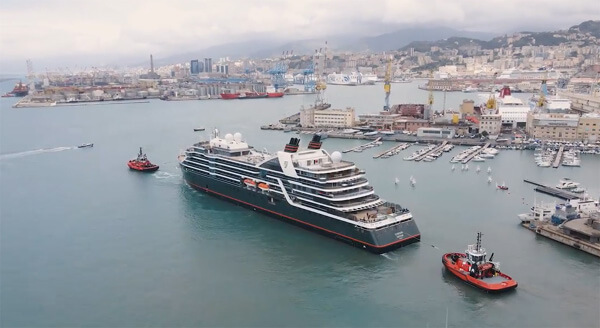
Seabourn Cruise Line took delivery of its first expedition cruise ship, Seabourn Venture, today during an official handover ceremony at the T. Mariotti shipyard in Genoa, Italy. Seabourn Venture is the first of the line’s two purpose-built, ultra-luxury expedition ships and is the first dedicated expedition ship in the Carnival Corporation fleet. The world’s largest cruise company, Carnival looks to expand into the rapidly growing expedition segment with ships focusing on cruises in the polar regions.

“Today is so incredibly special and important as we take ownership of our first ultra-luxury expedition ship and welcome Seabourn Venture to the Seabourn family,” said Josh Leibowitz President of Seabourn. “The Mariotti team has done a wonderful job in the building of the ship and bringing Adam Tihany’s designs to life. Seabourn Venture will raise the bar in ultra-luxury expedition travel.”

The 23,000 gross ton cruise ship, and a sister ship still under construction in Italy, were designed and built to PC6 Polar Class standards with the ability to operate in diverse environments. According to the shipyard, the design features advanced maneuvering technology and stability to operate in the harsh polar regions. Each of the cruise ships is 558 feet long with accommodations for up to 260 passengers in 132 oceanfront veranda suites.

Following the trend in expedition travel, amenities aboard the cruise ships are being enhanced to provide luxury travel to a segment that traditional was more focused on the destinations versus luxuries aboard its ships. The Seabourn Venture and her sister ship Seabourn Pursuit due to enter service in 2023, feature amenities including two gourmet restaurants, a bow lounge with large windows, an infinity swimming pool, and a spa and fitness center.

The expedition programming will be led by a 26-person team of scientists, scholars, and naturalists, who will conduct educational programs on the ships’ Discovery Center and Expedition Lounge as well as to guide Zodiac cruises, hikes, nature walks, scuba diving, and snorkeling, among the ship’s shore programs. Passenger amenities supporting the expedition program include a ready room on the ships to prepare for shore excursions as well as a landing zone to board the two custom-built submarines, kayaks, and 24 zodiacs each ship carries.


Seabourn announced plans to enter the expedition market in 2018 and construction began in December 2019. The hull for both of the cruise ships was built at the CIMAR shipyard in San Giorgio di Nogaro, Italy, and each was later transferred to the T. Mariotti yard in Genoa for completion. The Seabourn Venture is a year behind schedule due to delays in construction in part due to the pandemic. The maiden voyage was rescheduled from April to July 2022 and just recently delayed a further two weeks to late July. The ship will cruise in Norway and Iceland before repositioning to South America and ultimately to Antarctica for the 2022-2023 season.

The ships will expand both the cruise line and its parent company, Carnival Corporation, participating in the growing expedition market. In the past, Seabourn operated cruises to destinations such as the Antarctic, but lacked the purpose-built hardware. Their two new ships are part of a wave of new ships designed for this market segment. By 2023, 40 new cruise ships, with nearly 8,000 berths, are expected to enter service offering expedition cruises to exotic destinations.

Source: https://www.maritime-executive.com/article/seabourn-takes-delivery-of-carnival-s-first-expedition-cruise-ship


Sembcorp Marine has delivered what it describes as the world’s first eighth-generation drillship, the Deepwater Atlas.

The Deepwater Atlas is the first in a series of two high-spec vessels for Transocean. It has a hook-load capacity of three million pounds and can accommodate well control systems for 20,000 PSI-rated drilling, making it the first of its kind.

The rig is contracted for Chevron’s Anchor project in the Gulf of Mexico – the first deepwater high-pressure development to achieve FID. It will have dual 20,000 PSI blowout preventers for drilling in the extreme high pressure / high temperature conditions found tens of thousands of feet below the seabed, where no one has ever drilled for oil before. The design is capable of reaching a maximum depth of 40,000 feet, including up to 12,000 feet of water depth.

“We are very pleased to achieve the delivery of Deepwater Atlas and to set many record firsts in the process. It gives us great pride to have designed and built for Transocean, the world’s first eighth-generation drillship of the highest industry specification,” said Sembcorp Marine head of rigs William Gu.

It is not the first attempt at a “20K” rig, but it is the first to succeed. Maersk Drilling placed an order for BOP systems rated at 20,000 PSI in 2014 for BP’s Project 20K; little news has emerged from the project since the start of the offshore downturn in 2015.

The delivery is a milestone for Sembcorp Marine, which is in the home stretch of a merger deal with compatriot offshore yard Keppel O&M. Shareholders are set to vote on the proposal later this year.

Source: https://www.maritime-executive.com/article/sembcorp-marine-delivers-world-s-first-eighth-gen-drillship


The use of wind-assisted propulsion technology is growing with the partnership between BAR Technologies and Yara Marine Technologies reporting their second project with large bulk carriers in a week. Singapore-based Berge Bulk will install the WindWings technology on one of its dry bulk carriers. As an early adopter of wind-assisted propulsion technology, Berge will be evaluating what it is calling a pivotal technology to reduce the emissions of its bulker fleet.

“At Berge Bulk, we believe in the results that can be achieved by harnessing wind power. Evaluating this groundbreaking technology, the estimated impact on reducing emissions can be at least as significant as transitional fuels,” said James Marshall, CEO of Berge Bulk.

Berge Bulk has agreed to equip its Newcastlemax bulker Berge Olympus with BAR Tech WindWings supplied by Yara Marine Technologies. The four-year-old bulker that will be used to evaluate the technology is 984 feet long and 211,150 dwt. The vessel is registered in the UK. According to the companies, the WindWings will be installed on board Berge Bulk’s vessel in the second quarter of 2023.

“A successful transition to a lower-carbon future can only be achieved through an inclusive approach,” said Thomas Koniordos, CEO of Yara Marine Technologies. “Wind has been the most evident ship propulsion for centuries. We are excited that industry-leading companies like Berge Bulk have the vision and commitment to equip their vessels with wind-assisted propulsion technologies.”

To date, most of the shipping industry’s installations of wind-assisted propulsion have focused on wind rotor technology. Several companies have reported achieving meaningful fuel savings and reductions in emissions deploying the rotors while the solid wind sail technology has also been progressing in development. BAR Technologies is leveraging its experience in developed world-class racing sailboats to develop its technologies for the WindWings. Japan’s Mitsui O.S. K. Lines is partnered with Oshima Shipbuilding to commercialize a similar telescoping rigid wind sail that they plan to deploy on a bulker for the first time by the end of 2022.

Barr Technologies’ WindWings are large, solid wing sails that will measure up to 160 feet in height. The design calls for four of the sails to be installed on the Berge Olympus. According to the companies, the sail technology will be capable of reducing CO2 emissions by as much as 30 percent through a combination of wind propulsion and route optimization. The system is fully automated.


“By retrofitting WindWings technology to existing vessels, firms like Berge Bulk can begin to make an immediate impact on decarbonizing their fleets while at the same time seeing significant efficiencies in current fuel use,” said John Cooper, CEO of BAR Technologies. “With Berge Bulk joining a pipeline of WindWings installations through 2023, we look forward to working with our partners to make significant inroads into reducing vessel carbon emissions.”

BAR Technologies announced in November 2021 an Approval-in-Principle (AiP) by DNV for BAR Tech WindWings by Yara Marine Technologies. This AiP assessed the system’s design specifications, safety and usability considerations, and general applicability to sea-going vessels. The AiP also examined the deployment and functionality of WindWings in operation, use in extreme weather conditions, and system redundancy.

Last week, BAR and Yara announced their first agreement for the installation of the technology. Early in 2023, they will install two WindWings aboard the Singapore-flagged Pyxis Ocean, an 80,962 dwt bulk carrier. The five-year-old vessel, which is 751 feet in length, is owned by Mitsubishi and operates under a long-term charter to Cargill.

Source: https://www.maritime-executive.com/article/second-installation-of-windwings-set-for-berge-bulk-dry-bulk-vessel


Burntisland, Scotland, based Briggs Marine has placed an order for an ORC 121 pilot launch with Great Yarmouth, England, based Goodchild Marine Services. This will be the sixth Goodchild ORC in the Briggs Marine fleet and the company says that the order targets a market where demand is currently outstripping supply.

The investment will enable Briggs Marine to offer charter opportunities for pilot launches, a service which, the company believes, will continue to grow as many ports struggle with aging fleets.

The new pilot launch has been designed to be road transportable allowing Briggs Marine to be both highly reactive to customers’ timescales and more fuel efficient when transporting the vessel longer distances.

“We are delighted to be providing Briggs with an ORC 121 which is a 12 meter long vessel. We have previously supplied ORC 171s and ORC 136s but this vessel is shorter enabling it to be road transportable,” said Steven Pierce, of Goodchild Marine, which will be manufacturing and delivering the vessel to Briggs Marine in 2023.

“The other benefit to this vessel of course, is that the semi displacement hull design of the ORC is about 40% more fuel efficient than counterparts of similar size, helping to reduce emissions,” Pierce added.

In the lead up to celebrating its 50th anniversary, Briggs Marine is continuing to upgrade its assets and work towards reducing the environmental impact of the fleet.

“We are extremely pleased to confirm that Briggs Marine is continuing to invest in its fleet.” said general manager Rob Baker. “This latest project will enable current and future customers more modern and efficient pilot launch options.
This is the sixth pilot launch we’ve commissioned with Goodchild Marine in the last eight years. The first five vessels have enabled us to provide first-class pilot services in the port of Liverpool and this service is now extended to other customers through this charter opportunity.”

Other recent investments for Briggs Marine include a Crew Transfer Vessel in 2021, a new multipurpose workboat and three new line handling vessels to support a range of customers.

Family-owned Briggs Marine is a leading provider of marine and environmental services, specializing in port and marine operations, subsea and environmental support and vessel charter.

Source: https://www.marinelog.com/inland-coastal/coastal/briggs-marine-orders-new-pilot-launch/


Two sailings a week are planned for the Auckland/Tauranga to Lyttelton service and are expected to become operational mid-September this year.

The vessel will add 1,300 TEU extra capacity every week and will complement the existing coastal service provided by Pacifica Shipping’s MV Moana Chief, a 1,700 TEU ship operating since August 2019.

Country Manager for Pacifica Shipping and Swire Shipping New Zealand Brodie Stevens said the service coverage of the new vessel will improve the frequency for the core trade from Auckland/Tauranga to Lyttelton and offer a viable alternative to other transport modes on the inter-island trade.

He pointed out that coverage for the regional ports will also improve to weekly for Nelson and fortnightly for Timaru and Marsden Point. With international shipping lines reducing port calls into regional ports due to supply chain disruptions, the service could vital for regional exporters.

“As New Zealand’s domestic transport is forecast to grow substantially over the next two decades, we are determined to meet that demand by increasing the frequency and capacity of our inter-island domestic freight service, as well as international transshipment cargo demand,” Stevens said.

Stevens referenced Ministry of Transport data projections, showing freight volumes will increase a further 11 per cent in the next 10 years and 40 per cent by 2053.

Most recently, A.P. Moller Maersk announced it is launching a new dedicated New Zealand coastal service.

According to the carrier, the service will enable a more resilient New Zealand supply chain and improve vessel schedule reliability.

Source: https://www.porttechnology.org/news/pacifica-shipping-adds-sailings-to-meet-domestic-freight-demand/


As the shipping industry advances its investment in digital technologies, reaping the benefits of streamlined operations and superior business intelligence, it’s important to focus on the key role Marine Assurance plays in achieving corporate goals.

Marine Assurance underpins maritime safety, regulatory compliance and sustainability by defining the vetting and inspection regime that assesses the risks relating to a vessel’s operations and on compliance…. Therefore, Marine Assurance is a business-critical discipline, and should be considered the unsung hero of marine safety and environmental performance.

While the shipping industry continues a decades’ long improvement in the safety of its assets, the nature and magnitude of the risks it faces do not stand still. Today, digitalisation is revolutionising business processes, voyage planning, as well as the automation, remote monitoring and performance of machinery onboard ships.
The marine industry is now experiencing a shift in responsibilities as it adapts to new regulations and operating methods. As these interacting forces evolve, Marine Assurance systems must continue to progress in sophistication, not only to remain fit-for-purpose, but to constantly raise the bar on performance.

Enhancing the power of digitalisation
This is exactly what’s happening with OCIMF’s SIRE 2.0 tanker inspection regime. It will bring significant, in-depth and timely changes, built largely on advances in digitalisation, and as a result, OCIMF anticipates that the current average number of inspections per vessel per year (about 2.4) will drop due to the higher confidence it will bring.
SIRE 2.0 is an evolution of the original SIRE programme, launched in 1993, aimed at addressing facility, equipment and hardware standards. Next came the Tanker Management Self-assessment (TMSA), launched in 2004 to extend the focus to management systems. SIRE 2.0 now further extends the inspection process to cover the human factor, audit scope and rigour.
By asking more in-depth and insightful questions to encourage more transparency across these new areas, the aim is to reduce incident levels even further. In addition to increased data, photographic evidence will now be available, bringing a previously absent and undeniably visible element to the mix.
Artificial intelligence (AI) will start to become a necessity to enable this information to predict the likelihood of future incidents. However, AI will always require interpretation from experts that know maritime and all of its complexities and nuances.

The sanctions puzzle
The ongoing situation regarding sanctions on Russia is another evolving challenge for the industry. Approximately 1,600 sanctions against Russian entities have been introduced, and that number continues to grow. While the sanctions themselves are black and white, a traditional ‘traffic light system’ is not viable in the current scenario and could make decisions regarding when and how to react to specific sanctions more difficult.
In this climate, it is critical to empower ship owners, operators, charterers and energy companies by providing combined intelligence from multiple high-level data sources and detailed analyses to support their decision-making. And this is where Marine Assurance comes to the forefront, providing not just vetting but also compliance functions.
Automated systems can only do so much to help the maritime industry work through the sanctions. By taking data relating to vessel locations, voyage histories, vessel ownership and operation, as well as cargo and crew manifests, and combining it with human intelligence, MIS Marine is actively advising on the ever-changing scenarios. This includes safety risks around Ukrainian crew onboard vessels, and financial risks around payments for crew members where banking facilities may be restricted.

A common vision requires collaboration
MIS Marine has invested heavily in the development of advanced Marine Assurance solutions and has provided hands-on support to guide customers through change. This includes addressing the twin challenges of replacing outdated legacy systems with more technologically advanced solutions that unlock the power of marine data to support due diligence, whilst avoiding the risk of data overload.
MIS Marine is taking advantage of digitalisation to help shipping continuously improve safety, security, health and environmental performance. We believe that collaboration is key to meeting the challenges and achieving our industry’s common goals.
Source: http://hellenicshippingnews


A new report published by Inmarsat, the pioneer in global, mobile satellite communications, indicates that seafarers are largely in favour of greater digitalisation but that a sizeable proportion of those working at sea also fear shrinking job opportunities.

Compiled by maritime innovation consultancy Thetius, Seafarers in the Digital Age – Prioritising Human Element in Maritime Digital Transformation draws on the results of a survey of 200 maritime professionals.

Basic internet connectivity

After canvassing seagoing and shore-based shipping personnel for views on the impacts of digitalisation on their health and welfare, on training, careers, and job retention, and on performance, Thetius describes the relationship between seafarers and emerging maritime technologies as ‘broadly positive.’ However, responses also reveal that shipping companies and technology providers have work to do to change crew misgivings over digital transformation at sea.

The Seafarer Happiness Index (SHI) for Q1 2022 indicates crew well-being dropping to its lowest level

In a standout finding, the report informs that over 1 in 3 seafarers choose personal access to digital technology as the key factor when considering a new employer. In fact, as an inducement, internet access ranks higher than pay (chosen by fewer than 1 in 4). The Seafarer Happiness Index (SHI) for Q1 2022 indicates crew well-being dropping to its lowest level since the SHI was founded in 2015, with limited access to basic internet connectivity given as a primary cause, Thetius notes.

Expected job opportunities

Encouragingly, Seafarers in the Digital Age captures a shipping industry responding quickly to crew connectivity needs: 78% of ship operators surveyed report having installed internet connectivity on board for the personal use by crew in the last five years.

However, the report also highlights the way seafarers see risks in the wider deployment of digital technologies. Half of the seafarers responding expected job opportunities to decline by 25% within five years. “If half of our seafarers believe that traditional job opportunities at sea are disappearing, as this research suggests, more needs to be done to highlight how digitalisation will help jobs to evolve or create entirely new roles,” said Matthew Kenney, Head of Research and Intelligence, Thetius.

High-quality personnel

Digital tools and connectivity can create happier and more productive ships”

Digital tools and connectivity can create happier and more productive ships, while newer, better ways of working are possible. Instead of allowing maritime professionals to become distrustful or even fearful of digital and emerging technologies, the sector must recognise the continued importance of human capital and work hard to bring crews along on the journey.”

Ben Palmer, President, Inmarsat Maritime said: “The inclusion of mandatory internet access to the Maritime Labour Convention in May represents a paradigm shift for seafaring rights, putting into law what responsible owners already fully understand: high-quality onboard internet has become a key indicator of crew welfare and hence recruitment and retention of high-quality personnel. Today, it also provides the basis for new and exciting next-generation job roles at sea, as well as supporting safer operations, greater sustainability and productivity gains.”

Source: https://www.maritimeinformed.com/tags/security/news/inmarsat-thetius-report-states-seafarers-favour-co-1623940472-ga-co-1634910738-ga.1656390001.html


As early as autumn, Deutsche Post is to transport parcels along the River Spree in Berlin by solar powered boat.

The postal operator is in talks with the districts where this would take place, as infrastructure needs to be put in place at the landing stages where the ship would dock. In a statement, Deutsche Post said “We plan to initially deploy at least one solar-powered ship on the Spree,” it said. “The starting point will be Berlin’s Westhafen.”

Initially, “Measured against the total daily volume, however, it will be comparatively small quantities at the beginning,” Deutsche Post said in its statement. From the docks, parcels will be loaded onto land transport vehicles for final-yard delivery to addresses.

The project, if launched, would be part of a study with the Technische Universität Berlin (TU). Deutsche Post continued, “In metropolitan regions with an existing waterway infrastructure with low capacity utilisation, the transport mode ship usually offers massive free capacities for shifting freight traffic from the congested roads to the water.”

Ultimately, Deutsche Post would use unmanned, autonomous vessels for the deliveries, further reducing costs.

Source: https://apex-insight.com/deutsche-post-to-trial-solar-powered-boat-deliveries/


The maritime industry serves a critical role in the global supply chain. But the industry also relies on its own supply chain. In the part-3 of our cyber risk management series, we will take a look at how the maritime supply chain works and how cyber risks can arise from the imbalance of responsibilities, the ship operator’s lack of control and the disconnect in regulation.

The maritime industry serves a critical role in the global supply chain. But the industry also relies on its own supply chain. Everything from fuel for the engines to food for the crew needs to be delivered to ships around the world for the industry to function. This supply chain extends to the supply and maintenance of onboard computing equipment and applications that support vessel operations. The ship owner and operator frequently relies on the supply chain to ensure such equipment and applications are always up to date, well maintained and secure. Every software component onboard a vessel creates some cyber risk, but this research has identified specific areas of concern including the imbalance of responsibilities, the ship operator’s lack of control and the disconnect in regulation.

Every software component onboard a vessel creates some cyber risk, but this research has identified specific areas of concern including the imbalance of responsibilities, the ship operator’s lack of control and the disconnect in regulation.

RESPONSIBILITY

Under a charterparty, the ship owner has an express obligation to ensure the ship is seaworthy before, at the beginning of and throughout the voyage. The owner must demonstrate that they have exercised due diligence to ensure seaworthiness of the vessel.

The obligation on seaworthiness cannot be delegated to third parties. This means that the ship owner must demonstrate they have exercised the due diligence to ensure that any onboard systems must be secure enough not impact the seaworthiness of the vessel, even if the system is supplied, installed or maintained by a third party.

According to our industry survey, conducted as part of this research, 78% of shoreside employees at shipping companies have cyber risk management procedures in place for dealing with third parties such as suppliers. However, the same survey found that just 55% of industry suppliers are asked by customers to prove they have cyber risk management procedures in place. This statistic demonstrates a clear gap in the industry’s due diligence of managing supply cyber risk.

Cyber experts interviewed in compiling this report repeatedly pointed to significant risks that exist across the maritime supply chain caused by suppliers not working to an acceptable standard of security. This spans everything from developing systems that are vulnerable even to basic cyber intrusions in the first place, poor practices during installation to insecure practices when visiting the vessel for system maintenance.

The responsibility of the supply chain in relation to cyber risk management of vessel operations is not clear. Equipment or service supply contracts generally clarify responsibilities and obligations in relation to defects in the supplied equipment or deficiencies in the service. However, responsibilities requiring the supplier to ensure a reasonable level of cyber risk management are not explicitly stated in most cases. To make matters worse, shipping cyber emergency response plans are not often developed in cooperation with key suppliers. Where they are, it is rare that exercises or drills are performed involving the supply chain, so lessons on the critical actions that ship owners need their suppliers to perform during a cyber incident are never uncovered, tested and improved.

CONTROL

Though a ship’s hull and machinery may remain the same throughout its life, the average commercial vessel has at least 50 distinct systems that contain computing and software components. To the ship operator and their crew, these components are often “black boxes” and there is very little technical knowledge beyond the minimum necessary to operate them, identify a fault or make minor fixes. Certainly, the ship operator is not able to integrate any cybersecurity controls, such as deploying antivirus software or test for any existing defenses, without explicit permission from the equipment manufacturer. Any attempt to do so is generally considered to violate conditions for warranty.

Operators are not entirely powerless. There are actions they can take to regain some control of securing the supply chain of onboard systems.

Of those maritime organisations that reported being the subject of a cyber attack in the last three years, 3% said the attack resulted in them paying a ransom. The average ransom paid was US$3.1 million.

While a small number of system manufacturers have proactively taken steps to shore up the cyber protection of the equipment they manufacture and the applications that are provided alongside these, the vast majority of shipping equipment manufacturers have done very little to provide ship operators assurance around this.

This problem is exacerbated by integrators that are not sufficiently knowledgeable in cybersecurity, making decisions leading to insecure configurations and integrations that may undo the security designed into the equipment in the first place. The nature of shipping operations means that when equipment breaks down and needs replacing or repair, it must be dealt with quickly and efficiently as delays can be incredibly costly. Replacements are frequently bought on short order, and purchases are determined by convenience, not security.

This results in a major disconnect between the exposure for the ship operator and their ability to control the risks. However, operators are not entirely powerless. There are actions they can take to regain some control of securing the supply chain of onboard systems. Getting a clear understanding of the inventory of these computing systems and how they are connected is an excellent starting point.

According to data from CyberOwl, 54% of the ships monitored by CyberOwl have between 40 and 180 connected devices onboard. This includes expected devices such as business workstations, PCs, printers and company phones. Most alarming is that on many vessels monitored by the company, systems that were thought to be isolated, such as cargo computers and engine monitoring systems, were found to be connected to the onboard business IT network somehow.

REGULATION

The main regulation for cyber risk management in shipping relates to the IMO resolution MSC.428(98) on Maritime Cyber Risk Management in Safety Management System (SMS). The resolution gives effect to a requirement for an approved SMS to incorporate cyber risk management. Shipping administrations must ensure that cyber risks are appropriately addressed in the SMS no later than the first annual verification of the company’s Document of Compliance (DoC) after 1 January 2021.

Though a ship’s hull and machinery may remain the same throughout its life, the average commercial vessel has at least 50 distinct systems that contain computing and software components.

As this regulatory instrument is implemented via the DoC, it places the burden of regulatory compliance solely on the ship owner. This also follows in the majority of maritime cyber risk management guidelines, that are mainly focused on the actions ship owners can take to cyber secure their ships. For the manufacturer of onboard systems and provider of software based services for shipping systems, the requirements are a lot less clear.

Several Classification Societies have developed some type approvals specifically relating to incorporating minimum cyber security standards within the design of ship equipment and systems. However, unlike for equipment such as voyage or safety critical apparatus, these are voluntary and do not affect the certification of the ship. At the time of writing, based on a search of the public databases of the type approvals granted, there is minimal uptake of these voluntary type approvals.

Interviews conducted during this research suggest the lack of clarity and some level of prescription is creating confusion and frustration. It results in a level of subjectivity for the ship owner who is now required to ensure their SMS incorporates appropriate cyber risk management of their supply chain in order to be granted their DoC, but cannot point to any minimum standards that their supplier must comply with.

Download the full report here

CYBER SECURITY MANAGEMENT SERIES

In the last few years, the maritime industry has made great progress in improving its approach to cyber risk management, but significant gaps remain. This report developed in collaboration with CyberOwl and HFW explores the gaps that exist between the industry’s perceptions of cyber security and reality, taking into account the views of more than 200 stakeholders from across the industry, including cyber security experts, seafarers, shoreside managers, industry suppliers, and C-suite leaders.

Over the coming weeks, we will be sharing a series of articles on the state of cyber risk management in the maritime industry, and we will also uncover the great disconnects that exist across the industry where expectations and reality don’t match up, cyber risk management efforts are lacking, or risks that are unique to maritime exist.

Source: https://thetius.com/3-things-that-make-the-maritime-supply-chain-vulnerable-to-cyber-threats-and-what-to-do-about-them/

Company DETAILS

SHIP IP LTD
VAT:BG 202572176
Rakovski STR.145
Sofia,
Bulgaria
Phone ( +359) 24929284
E-mail: sales(at)shipip.com

ISO 9001:2015 CERTIFIED