HÀ NỘI — The eighth ocean dialogue was held on Wednesday in Hà Nội on the occasion of the 40th anniversary of UNCLOS with the theme of promoting maritime cooperation in Southeast Asia.

It drew the virtual and in-person participation of more than 250 domestic and foreign experts.

The event was jointly organised by the Diplomatic Academy of Vietnam (DAV), the Australian Embassy in Việt Nam and the Konrad Adenauer Stiftung Foundation (KAS).

In his opening speech, Deputy Minister of Foreign Affairs Phạm Quang Hiệu said the adoption of the 1982 United Nations Convention on the Law of the Sea (UNCLOS) 40 years ago is a historic milestone in the development of the international law of the sea. For the first time, a comprehensive legal framework, a “charter” of the sea was established.

The convention has laid a foundation for the development of the international law of the sea, promoting peace, security and cooperation among countries for sustainable development of seas and oceans.

He stressed that over the past 40 years, a legal order was set up following UNCLOS, contributing to maintaining international peace and stability. The settlement of sea disputes in line with international laws was promoted.

In the face of increasing sea-related challenges, Hiệu said the international community needs to abide by laws and legal obligations under the convention, particularly in making claims and carrying out activities on seas.

Countries need to boost cooperation at the regional and international level to preserve and sustainably use seas and oceans while ensuring the freedom of navigation and legal maritime activities, he said.

In 2021, Việt Nam was one of the 12 founding members of the Group of Friends on the UNCLOS. The group is expected to contribute to raising awareness and understanding of the convention and sharing good practices in applying the convention to maritime delimitation and peaceful settlement of disputes, according to Hiệu.

Professor Dr. Rüdiger Wolfrum, former Judge at the International Tribunal for the Law of the Sea, delivered a keynote speech in commemoration of the 40th anniversary of the UNCLOS. He reaffirmed the role of the convention in the development of the international law of the sea and in promoting peace, security and cooperation among nations as well as sustainable development of seas and oceans.

He said the UNCLOS needs to be applied comprehensively and it should not separate but closely link dispute settlement mechanisms with all legal regulations of the UNCLOS and international laws. Judgments of international courts do not simply bind the parties of disputes but also serve as a foundation for cooperation and have impacts on the region and international community.

The convention is an advanced mechanism in comparison with traditional ones but it will be continued to be improved to meet the requirements of the new situations, according to Wolfrum.

The dialogue consisted of four sessions. The first session focused on UNCLOS and the Southeast Asian region. It aimed to explore several under-researched maritime and legal issues related to the implementation of the UNCLOS in the Southeast Asia region, including the right of access of land-locked states and freedom of transit are provided under Part X of the convention and how the fact of not being a party to UNCLOS may affect the rights and obligations of coastal states in maritime delimitation and maritime cooperation.

The second session on emission reduction from shipping and net-zero shipping provided an overview of the negotiations at the International Maritime Organisation for the reduction of emissions from international shipping and the net-zero shipping initiative by the UK. Speakers recommended policies for regional countries towards a direction more consistent with the 2015 Paris Agreement.

The third session focused on obligations to cooperate between states bordering semi-enclosed seas. Article 123 of UNCLOS provides that states bordering semi-enclosed seas should cooperate with each other in the exercise of their rights and in the performance of their duties under this convention. In this session, speakers discussed how the obligation under Article 123 has been interpreted in case law and publications as well as best practices in other regions.

They also discussed how to enhance cooperation between Southeast Asia countries in maritime scientific research, exploration and exploitation of the living resources of the sea, and inviting other interested States or international organisations to cooperate in implementing the obligation under Article 123.

In the last session, scholars discussed conservation and sustainable use of marine biological diversity of areas beyond national jurisdiction, as well as explored future cooperation in Southeast Asia on these matters. — VNS

Source: https://vietnamnews.vn/society/1254534/ocean-dialogue-promotes-maritime-cooperation-in-southeast-asia.html

As at the end of May 2022, 247 vessels remain abandoned at multiple locations around the world – along with 3,623 seafarers cast adrift, unable to return home – with some of their cases open for more than a decade.


This is according to figures collected and released by our Marine Assurance team, in time for the International Day of the Seafarer (25 June). The numbers are startling – although they are in fact likely to be even higher in reality, as these figures take into account only those abandonments that have been officially recorded.

Seafarers are the lifeblood of the maritime industry and the global economy, with 90% of goods in the world moved by ships. There are around 1.6 million people working at sea – divided between approximately 770,000 officers and 870,000 crew.

Following amendments made to the Maritime Labour Convention (MLC) in 2017, RightShip began monitoring and gathering data on seafarer abandonment, looking back over two decades to build a comprehensive database mapping the incredible extent of the issue.

Information provided by the International Labour Organization (ILO) – including the vessel name, the IMO number and date of abandonment – is analysed alongside facts and figures including the Document of Compliance (DoC) company, the ship’s technical manager, commercial manager, and registered owner. RightShip also makes connections with entities involved with, or with knowledge of, an abandonment which did not help alleviate or resolve the issue.

Using these official sources, RightShip is charting patterns on the nationalities of crew, locations of abandonment, vessel type and age, as well as logging the length of time taken to resolve abandonment issues, among many other data points.

The majority of seafarers known to be abandoned are from India, with 724 seafarers stranded in various locations around the world, closely followed by 368 crew from Ukraine and 318 crew from the Philippines, all renowned nations of seafarers.

The highest number of vessels left adrift is in the United Arab Emirates waters’, with 26 abandoned vessels, and when the data is sorted by flag state, Panama heads the list. Vessels that are between 26 and 30 years of age see the highest number of abandonments, but surprisingly, 32 new ships sailing for fewer than five years have also been cut off.

Perhaps most worrying aspect is the time that it can take to ‘settle’ an abandonment – when a case is satisfactorily resolved, the crew are paid their outstanding wages and repatriated to their home port. According to RightShip’s statistics, since 2004, there are 30 vessels where abandonments have been in dispute for more than a decade, with more than 400 seafarers still waiting for their cases to be closed. On average, crew remained onboard ship for seven months before being repatriated, with the longest being a 39-month-long wait to go home.

Steen Lund, CEO for RightShip said: “The welfare of seafarers can no longer be ignored. When a ship is abandoned, if the crew leave the vessel it is far less likely that they will be paid, so they are forced to stay put, waiting, for months and sometimes years on end. The uncertainty of these circumstances is incredibly stressful for both the crew and their families left at home.”

In 2013, the IMO adopted the ILO Maritime Labour Convention. While the convention has been ratified by the equivalent of 95% of world tonnage, less than 60% of IMO’s 174 individual member states have ratified the convention. This, along with a lack of adequate and competent inspectorates across IMO member states to regularly inspect against MLC requirements and take necessary action are key challenges which compound the situation.

Therefore, it falls to the sector to show leadership on crew abandonment. In October 2021, RightShip worked with the Sustainable Shipping Initiative (SSI) and the Institute for Human Rights and Business (IHRB), in collaboration with the Rafto Foundation for Human Rights to launch a Code of Conduct that encourages a more effective implementation of seafarers’ rights.


RightShip has also released a crew welfare self-assessment tool, which has to date been completed by 160 organisations. This encourages organisations to engage with and improve crew welfare and – in conjunction with crew abandonment data – allows charterers to select vessel owners and managers which have made public commitments to high crew welfare standards.

Steen continues: “Though the majority of vessel owners and managers strive to do the right thing by their crews, there are those who will only act when the issue affects their bottom line. In the absence of rigorous international enforcement of seafarers’ rights, we help responsible organisations shine a spotlight on themselves so that best practice can be recognised and rewarded, and by extension those who abuse the rights of seafarers suffer competitively.”


View from the sector

Simon Grainge, CEO, ISWAN: “In the last four years, ISWAN has been approached by more than 1,100 seafarers who have found themselves on abandoned vessels. The painful ordeal suffered by these innocent seafarers is disgraceful. Not only must the seafarers endure a traumatic experience for often a considerable period of time – their loved ones at home find themselves in desperate need of support.

“Seafarers are often the sole earner in their families, and in cases of abandonment, the entire family has to suffer both an uncertain financial situation and great emotional stress. We are working with partners to the best of our ability to assist such seafarers and their families during this difficult time.”

Source: https://maritime-professionals.com/data-reveals-3623-seafarers-cant-go-home/

On June 13th, China’s Foreign Ministry spokesman Wang Wenbin held an extraordinary press conference in which he made a series of audacious statements about the sprawling reach of Beijing’s territorial sovereignty and administrative authority. Placed in the context of China’s other recent actions and statements, the incredible size and shape of its regional ambitions are brought into sharp relief.

In simple terms, Beijing is determined to thoroughly dominate its region.

Wang began by addressing Canada’s protests over China’s harassment of its reconnaissance aircraft, which were enforcing United Nations sanctions of North Korea. It was China, Wang countered, that had reason to be “threatened” by  “the Canadian military aircraft that flew thousands of miles to harass China at its doorstep.”

This is patent nonsense, of course. China voted for the U.N. sanctions in question, together with the “enhanced vigilance” against illicit petroleum transfers the unarmed Canadian plane was deployed to ensure. This wasn’t about threats to China. Rather, it was part of a brazen pattern designed to deter and intimidate foreign ships and aircraft from operating legally in China’s rapidly growing sphere of influence – specifically the international sea and airspace that China wants the world to accept as its own sovereign territory.

And make no mistake, that claimed territory is massive, including well over 3.5 million square miles of the maritime commons and the skies above it. Of course, China has not yet gained complete control over all this space, but its effective control is growing and its ambitions are increasingly clear.

Just ask the crew of the Australian P-8A Poseidon patrol aircraft that on May 26th was buzzed by a Chinese fighter jet near the Paracel Islands. The Chinese fighter also released flares near the Australian plane, followed by aluminum strips called chaff, some of which were dangerously ingested into the Poseidon’s engines.

Again, Beijing’s military spokesperson was quick to pin the “dangerous and provocative” label on the target of its aggression, declaring that the unarmed Australian plane “threatened China’s sovereignty” because it “approached China’s territorial airspace” over the Paracels. It is noteworthy that China did not claim the aircraft actually violated its (already exaggerated) territorial claims in the Paracels, but disinformation is central to its rhetorical strategy.

This strategy begins by effectively nullifying the U.N. Convention on the Law of the Sea, or UNCLOS, which China signed in 1996 and has never formally abrogated. While still giving occasional lip-service to this agreement, Beijing pivots to claim “historic rights” within the entirety of its baseless nine-dashed line around the South China Sea. Under this formulation, this vast maritime commons is unilaterally reclassified as China’s domestic territory, ostensibly marking it outside of UNCLOS’ purview.

China’s government then embarked on a bold campaign to back up its claim by sheer force of overwhelming presence. It did so by building out its occupied rocks and reefs into bases capable of sustaining both forward-deployed military assets and — more immediately — its rapidly expanding maritime militia.

Thus, when a U.N.-mandated tribunal ruled in 2016 that its claims were nonsense, Beijing could simply shrug its shoulders. Having already changed the facts on the reclaimed ground to ensure its smaller neighbors would dance to its tune, China has determined that might will eventually make right in the South China Sea.

Further north, China’s claims rely on a somewhat different obfuscation, as evidenced by Wang’s June 13 comments. Referring to the Canadian flights, he said that “none of the relevant Security Council resolutions mandated any country to deploy forces for surveillance operations in the sea or airspace under the jurisdiction of another country” (emphasis added).

Where specifically was this alleged violation of China’s “jurisdiction”? Wang didn’t elaborate, but we know that China has increasingly expansive views on this, and makes liberal use of smoke and mirrors to justify these claims as somehow consistent with international law.

We need only to look at another of Wang’s June 13 assertions to see this phenomenon in action: “According to UNCLOS and Chinese laws, the waters of the Taiwan Strait, extending from both shores toward the middle of the Strait, are divided into several zones including internal waters, territorial sea, contiguous zone, and the Exclusive Economic Zone. China has sovereignty, sovereign rights and jurisdiction over the Taiwan Strait.”

Wang’s device here is to conflate the definition of the territorial sea, which extends a mere 12 nautical miles from a nation’s coastline, with that of the 200 nautical mile exclusive economic zone. While UNCLOS does grant a degree of sovereignty over the former (and even that does not prohibit straight-line innocent passage), the latter grants the coastal state only the right to exploit maritime resources, while explicitly retaining the uninhibited freedom of navigation and overflight for “all nations.”

The bottom line here is that China is engaged in a long-term power play. Its mouthpieces will continue to muddy the rhetorical waters, believing that while Beijing cannot win the debate on the legal merits, it can keep its intimidated rivals off-balance while strengthening its military position until such time as it no longer matters what the law says.

Source: https://thediplomat.com/2022/06/chinas-vast-maritime-claims-are-becoming-reality/


raffic and revenue were up from the previous fiscal year for BC Ferries, but down from pre-COVID-19 pandemic levels, according to the British Columbia transportation agency, which released its year-end FY results Friday, June 24.

For the 2022 fiscal year ending March 31, 37% more passengers (17.9 million) and 26% more vehicles (8.5 million) rode BC Ferries than the year before. However, passenger traffic was down 20% and vehicle traffic down 5% compared to the pre-pandemic 2019 fiscal year.

Revenue was up 12% to $965.4 million, a $100.1 million increase, from the previous year due to higher traffic and net retail sales, which were helped in part by lower Safe Restart Funding, a federal effort to aid provinces and territories reignite their economies, BC Ferries data show.

However, BC Ferries saw a net loss of $68.2 million before recognizing Safe Restart Funding.

“As we emerge from the pandemic, we are grateful to our employees for their commitment to put safety first, operate in the public interest, and ensure reliable ferry travel,” BC Ferries’ President and CEO Mark Collins said. “We are excited to see people (traveling) with us again and are adding staff to meet the increase in demand for our service.”

Source: https://pacmar.com/covid-19-impacted-bc-ferries-year-end-results-says/


For the second year in a row, Denmark is at the top of the Paris MoU white list, which shows how flag states perform during inspections in European ports.

The Port State Control Regime Paris MoU has just published their latest whitelist, where Danish ships are once again performing well at the top of the list. Also within Tokyo MoU’s port state control regime, Danish ships are still on the white list. Denmark is also placed on the US Coast Guards Qualship 21 list, which covers port state controls in the USA.

The “White, Grey and Black (WGB) List” presents the full spectrum, from quality flags to flags with a poor performance that are considered high or very high risk. It is based on the total number of inspections and detentions during a 3-year rolling period for flags with at least 30 inspections in the period.

The “White List” represents quality flags with a consistently low detention record. Flags with an average performance are shown on the “Grey List”. Their appearance on this list may serve as an incentive to improve and move to the “White List”. At the same time flags at the lower end of the “Grey List” should be careful not to neglect control over their ships and risk ending up on the “Black List” next year.

The whitelists from Paris MoU (Europe) and Tokyo MoU (Asia) show how flag state ships perform when going through port state controls around the world.

Martin John, director of Ship Survey and Certification at the Danish Maritime Authority:

“The Danish flag stands for quality shipping and high standards. Maintaining a position at the top of the whitelists is a great achievement by both the shipping companies and the seafarers on the Danish ships. This indicates a high level of safety awareness and benefits the industry by marking Danish shipping as quality shipping.”

Port State controls are an important tool for ensuring that ships comply with international standards for safety, health and the environment, as well as proper working conditions for the seafarers.

Source: https://maritime-professionals.com/danish-shipping-remains-at-the-top-of-the-whitelists/


The MoU seeks to explore the use of low carbon fuels and develop green technologies to accelerate maritime decarbonisation. CMA CGM and MPA will work on the use of zero and low-carbon marine fuels such as e-methanol, e-methane, and biofuels for commercial shipping. Research on technologies such as carbon capture solutions is another objective of the MOU.

CMA CGM aims to be a net-zero carbon company by 2050; the company has ordered 10 dual-fuel liquefied natural gas-(LNG) powered vessels and 6 dual-fuel methanol-powered vessels to diversify its energy mix. The methanol-powered newbuilds are planned to join the CMA CGM fleet by the end of 2025. Three of these LNG vessels, which will also be e-methane-ready, will be registered under the Singapore flag. The firm’s e-methane-ready fleet currently counts 29 vessels in service and will have a total of 77 by 2026.

Some of the areas on which the signatories will focus include maritime cybersecurity and just-in-time shipping, achieved through data exchanges for port and cargo documentation and reporting, and innovations such as shipboard automation for more safety, efficiency, and smarter solutions onboard vessels.

Furthermore, CMA CGM and MPA will explore establishing and investing in Singapore-based incubators and accelerators to grow Singapore-based marine tech start-ups.

In line with its digitalisation agenda, CMA CGM has recently teamed up with PSA Corporation (PSA) to create and implement digital solutions relating to the company’s port and terminal handling activities in Singapore.

“Decarbonisation, digitalisation, and innovation are strategic priorities for CMA CGM and the entire shipping industry. Given Singapore’s key position in our global network, I am very pleased to sign this partnership with the Maritime and Port Authority. It will allow us to address the challenges ahead and strengthen our existing strong ties with Singapore,” Rodolphe Saadé, Chairman and Chief Executive Officer of the CMA CGM Group said.

“We are happy to work with a like-minded partner like CMA CGM who shares our bold ambitions to make international shipping more sustainable and resilient,” Quah Ley Hoon, Chief Executive, Maritime and Port Authority of Singapore added.

Source: https://www.seatrade-maritime.com/containers/cma-cgm-and-mpa-sign-mou-decarbonisation


The United Kingdom has once again achieved White List status under the Paris MoU Port State Control regime.

At its 55th meeting, the Paris MOU Committee approved the 2021 inspection results and adopted new performance lists for flag States and Recognised Organisations. The “White, Grey and Black Lists”, which represent the full spectrum of flags, will take effect from 1 July 2022.

The UK has maintained a spot on the White List, which represents quality flags with a consistently low detention record.

Ratings are based on the total number of inspections and detentions over a three-year rolling period for flags with at least 30 inspections in the period. There are 40 flags on the White List for 2021, an increase of 1 compared to 2020 and equal to the 2019 results.

Dan Vivian, Commercial Director for the UK Ship Register, said it was good news for all those who had worked hard to maintain UK standards.

Source: https://www.ukshipregister.co.uk/news/uk-retains-paris-mou-white-list-status/


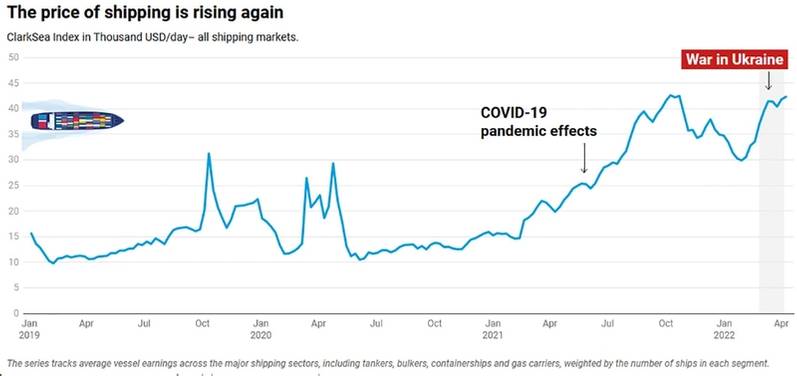
The war in the Ukraine is stifling trade and logistics of the country and the Black Sea region, increasing global vessel demand and the cost of shipping around the world, the UN Conference on Trade and Development (UNCTAD) said. Container shipping and global value chains have been disrupted and many countries have had to look further afield for suppliers of oil, gas and grain.

In a report entitled “Maritime trade disrupted: The war in Ukraine and its effects on maritime trade logistics” published on 28 June 28, UNCTAD said Ukraine’s trading partners now have to turn to other countries for the commodities they import.

It attributes the shipping and transport hurdles in the Black Sea region to disruptions in regional logistics, the halting of port operations in Ukraine, the destruction of important infrastructure, trade restrictions, increased insurance costs and higher fuel prices.

Shipping distances have increased, along with transit times and costs.

“Grains are of particular concern given the leading role of the Russian Federation and Ukraine in agrifood markets, and its nexus to food security and poverty reduction,” the report says.

Soaring shipping costs raise food prices
Fewer grain shipments over longer distances are leading to higher food prices.

Grain prices and shipping costs have been on the rise since 2020, but the war in Ukraine has exacerbated this trend and reversed a temporary decline in shipping prices.

The report says between February and May 2022, the price paid for the transport of dry bulk goods such as grains increased by nearly 60%.

The accompanying increase of grain prices and freight rates would lead to a 3.7% increase in consumer food prices globally.

(Source: UNCTAD)

The Russian Federation is a giant in the global market for fuel and fertilizer, which are key inputs for farmers worldwide.

Disruptions in their supply may lead to lower grain yields and higher prices, with serious consequences for global food security, particularly in vulnerable and food-import-dependent economies.

Higher energy prices exacerbate challenges for shippers
The Russian Federation is also a leading oil and gas exporter.

“Confronted with trade restrictions and logistical challenges, the cost of oil and gas has increased as alternative sources of supply, often at more distant locations, are called upon,” the report said.

Daily rates for smaller-size tankers, which are key for regional oil trading in the Black Sea, Baltic Sea and Mediterranean Sea regions, have dramatically increased.

The higher energy costs have also led to higher marine bunker prices, raising shipping costs for all maritime transport sectors.

According to the report, by the end of May 2022, the global average price for very low sulphur fuel oil had increased by 64% since the start of the year.

Taken altogether, these increased costs imply higher prices for consumers and threaten to widen the poverty gap.

Policy actions needed to keep global trade flowing
UNCTAD calls for urgent action to open Ukraine’s ports to international shipping so the country’s grain can reach overseas markets, at lower shipping costs.

The organization said continued collaboration is needed among vessel flag states, port states and other actors in the shipping industry to maintain all necessary services, including bunkering supplies, health services for sailors and certification of regulatory compliance.

This will help to keep to a minimum the negative impacts on costs, insurance premiums and operations.

UNCTAD also said alternative ways of transport must be pursued and that easing transit and the movement of transport workers – even temporarily – can reduce the pressure on cross-border trade and transit.

Also, UNCTAD calls for more investment in transport services and trade and transit facilitation.

And more international support for developing countries, especially the most vulnerable economies, as the war in Ukraine adds to the challenges posed by the COVID-19 pandemic and the climate crisis.

Source: UNCTAD


The Dr. Hank Kaplan, a versatile and powerful harbor tug, entered service in Alaska earlier this month in the Cook Inlet Tug & Barge fleet.

Delivered to its original owner in 2017 by the Diversified Marine shipyard in Portland, Oregon, the 5,350 hp Robert Allan Ltd designed RAmparts-2400 series tugboat was the first built in North America with a Caterpillar integrated propulsion system featuring CAT engines and Z-drives. CAT also supplied the vessel’s electrical generators.

A member of the Saltchuk Group, Cook Inlet Tug and Barge, LLC traces its Alaska heritage back to 1924 and continues to be committed to Alaska.

“We call ourselves ‘Alaska’s tug and barge company’, and we take seriously our 98-year commitment to the state. This vessel brings additional capability to the Cook Inlet region while further supporting Alaska’s economy”, said Jeff Johnson, president of Cook Inlet Tug & Barge. “We are based in Alaska, operated by Alaskans and acquiring the Dr. Hank Kaplan helps grow our fleet in our namesake’s region of Alaska.”

The 79-by-36-foot vessel is named in honor of the Chief of Medical Oncology at Swedish Cancer Institute in Seattle, Wash., who has worked throughout his entire career on cancer research and treatment.

“This tug is built well, extremely powerful and complements the incredibly capable tugs we have in our fleet. It will help us grow our business while meeting our expanding customer needs,” said Mike O’Shea, vice president business development and planning at Cook Inlet Tug & Barge.

Powered by CAT 3516C marine diesel engines paired to CAT MTA 24-TZ-drives, Dr. Hank Kaplan is Caterpillar equipped throughout. Her electrical service is provided by two, Tier III complaint CAT C7.1 generator sets.

The deck equipment consists of a Markey DEPC-46 towing winch, mounted on the bow, and a Markey DEPC-32 towing winch, mounted on the stern.

Capt. Mark Theriault, Cook Inlet Tug & Barge’s director of operations, is excited to see the Dr. Hank Kaplan join the fleet.

“The tug packs 30,000 gallons of fuel, 2,800 gallons of fresh water, and 370 gallons of lube oil—and not only opens up our operating window, but it is also just what our customers have been asking for,” he said.

Source: https://www.marinelog.com/inland-coastal/coastal/versatile-tractor-tug-joins-cook-inlet-tug-barge/


In 2021, international liner carriers’ onshore staff and crews managed 6,300 ships, successfully delivering vital supplies worth US$7 trillion to the people of the world, in approximately 241 million containers.

The World Shipping Council (WSC) Containers Lost at Sea Report covering 2020-2021 shows that containers lost overboard represent less than one thousandth of 1% (0.001%). However, the past two years have seen a worrying break in the downward trend for losses, with the average number of containers lost at sea per year since the start of the survey increasing by 18% to 1,629.

From a liner shipping industry perspective, every container overboard is one too many, and every day carriers work with the other parties in the supply chain to enhance safety. But even with proper packing of the cargo into the container, correct container weight, and proper stowage and securing aboard ship, several factors ranging from severe weather and rough seas to more catastrophic and rare events like ship groundings, structural failures, and collisions can result in containers being lost at sea.

The winter of 2020-21 saw an unusually high number of weather-related incidents, and the average losses for the two-year period 2020-2021 were 3,113 compared to 779 in the previous period.

Taking action to improve safety

Triggered by these events, maritime actors across the supply chain have initiated the MARIN Top Tier project to enhance container safety, with WSC and member lines among the founding partners. This project will run over three years and will use scientific analyses, studies, and desktop as well as real-life measurements and data collection to develop and publish specific, actionable recommendations to reduce the risk of containers lost overboard.

Initial results from the study show that parametric rolling in following seas is especially hazardous for container vessels, a phenomenon that is not well known and can develop unexpectedly with severe consequences. To help in preventing further incidents a Notice to Mariners has been developed, describing how container vessel crew and operational staff can plan, recognize and act to prevent parametric rolling in following seas.

Many more topics, tests and measurements will be undertaken by the project, which will continue reporting on progress and sharing insights on a regular basis through the IMO and other forums.

John Butler, President & CEO of WSC, says: “Container vessels are designed to transport containers safely and carriers operate with tight safety procedures, but when we see numbers going the wrong way, we need to make every effort to find out why and further increase safety.

“The liner shipping industry’s goal remains to keep the loss of containers as close to zero as possible. We will continue to explore and implement measures to make that happen and welcome continued cooperation from governments and other stakeholders to accomplish this goal.”

In addition to the MARIN TopTier project, WSC and member companies have actively contributed to and supported revision of the IMO’s guidelines for the inspection programs for cargo transport units. WSC also supports the creation of a mandatory reporting framework for all containers lost at sea – an issue that will be on IMO’s agenda in September (CCC 8).

Annual updates for improved data

Correct data plays an important part in the work to enhance container safety. The Containers Lost at Sea Report has until now been updated every three years. However, the unusually high number of incidents in the winter of 2020-21 caused great concern, so WSC has decided to increase the frequency of its Containers Lost at Sea report. Hence, this update covers 2020-2021, and in the future, a survey of members will be carried out each year.

Source: https://maritimefairtrade.org/world-shipping-council-urges-more-caution-to-prevent-containers-lost-at-sea/


Company DETAILS

SHIP IP LTD
VAT:BG 202572176
Rakovski STR.145
Sofia,
Bulgaria
Phone ( +359) 24929284
E-mail: sales(at)shipip.com

ISO 9001:2015 CERTIFIED