NYK Group’s company, NiMiC, an overseas ship management company based in Taipei, has appointed a local seafarer to the position of chief engineer for the very first time. On August 19, Lee Chia-Chu, whom NiMiC had trained as a cadet since he began his studies as a university student, was promoted to the rank of chief engineer of an LNG carrier being managed by NiMiC.

Chief Engineer Lee Chia-Chu.

Lee participated in training on board an NYK carrier for six months in 2011 and graduated from university in 2012. He started his carrier as third engineer in 2014 and currently has 10 years of experience working on LNG carriers.

Over the past decade, Lee took part in training conducted by the NYK Maritime College, which is original training provided by NYK Shipmanagement, a group company of NYK, in addition to onboard training on an LNG carrier. Lee joined the vessel at dry dock on August 19, and after completing turnover procedures while at dry dock with his predecessor, Lee began his duties as the vessel’s chief engineer from September 9.

Most of the seafarers serving on LNG carriers under NiMiC management were Filipino or Indian in 2009. But Taiwan decided to train more local seafarers and NiMiC and NYK established a training scheme for local university students to become cadets with the cooperation of National Taiwan Ocean University and National Kaohsiung University of Science and Technology.

Since then, 24 cadets from the two universities have received training. NYK will continue to train local seafarers and contribute to the development of local maritime industries.

Lee Chia-Chu said: “It’s my honor to be the first Chief engineer and the pioneer of all local seafarer on board LNG carrier. I appreciate all the support I received from everyone for building local seafarer training program.

“Since I was a cadet, I received solid training on board and ashore established by NYK. Sincerely appreciate all the colleagues who have guided me all the way up to my current position and NiMiC ship management providing me valuable experience attending several dry docking and modifications.

“As a chief engineer in NYK group I will continue contributing my effort to make sure the safety on board and business of (operating the) vessel (are) intact.”

Source: https://maritimefairtrade.org/in-a-first-nyk-promotes-taiwanese-to-chief-engineer/


CREWEXPRESS STCW REST HOURS SOFTWARE - Paris and Tokyo MoU have announced that they will jointly launch a new Concentrated Inspection Campaign (CIC) on Standards of Training, Certification and Watchkeeping for Seafarers (STCW) from 1st September 2022 to 30th November 2022


As part of its ambitious strategy for instant and frictionless transactions, SWIFT September 1 announces a new capability that uses its global intelligence on past cross-border flows to predict potential problems before new international payments are sent.

The new service analyses previous flows on the SWIFT network to identify accounts that have been credited successfully and uses this information to detect potential errors in payee information – the most common cause of cross-border delays.

This centralized verification, based on aggregated and anonymized data from nine billion transaction messages between four billion accounts each year, provides a level of insight no single financial institution has on its own. It also gives real-time confidence that a payment will go through, regardless of whether the parties or banks in a transaction have transacted with each other before.

“Think of it as the ultimate payment pre-check” said Thomas Zschach, Chief Innovation Officer, SWIFT. “When someone wants to make an international payment, we can instantly predict the likelihood of success based on whether the account has been credited successfully in the past, and then present this information directly to the customer so that they can fix any errors or typos before the payment even starts its processing.”

“We are able to do this because of the unique perspective SWIFT has at the heart of the financial community, and our strategic commitment to make international payments as seamless as the fastest domestic ones,” he added.

The new capability is an expanded feature of SWIFT’s Payment Pre-validation service and is available to banks via an API, meaning their customers can immediately benefit to send and receive international payments around the world even faster.

It marks another bold step forward as SWIFT evolves its platform to enable banks to drive a new era of instant, frictionless and interoperable cross-border transactions to create new value for their customers. As part of this commitment, SWIFT is also significantly expanding its capabilities in areas including low value payments through SWIFT Go and is partnering with industry players to explore the capabilities and potential use of CBDCs, tokenization and AI.

Source: https://maritimefairtrade.org/predictive-data-intelligence-removes-hurdles-to-instant-cross-border-transactions-over-swift/


CREWEXPRESS STCW REST HOURS SOFTWARE - Paris and Tokyo MoU have announced that they will jointly launch a new Concentrated Inspection Campaign (CIC) on Standards of Training, Certification and Watchkeeping for Seafarers (STCW) from 1st September 2022 to 30th November 2022


At the moment, LNG as a fuel is dominating the orderbook of larger ships. Data from DNV shows that of the 1,046 ships on order with alternative fuels, 167 are LNG-fuelled LNG carriers, and 367 are LNG-fuelled ships of other types.

The challenge with LNG lies in the occurrence of the ‘methane slip’, the unburned fuel emitted from dual fuel internal combustion engines on ships, as well as the methane leakage that happens throughout the LNG supply chain. Various studies have pointed out that these spillages result in higher well-to-wake (WTW) CO2e emissions from ships using LNG compared with conventional marine fuels.

Therefore, the uptake of LNG as a ‘climate-friendly’ fuel for the maritime industry hinges on the assumption that ships can switch to bio and e-LNG (renewable LNG) in the future, cutting greenhouse gas (GHG) emissions.

However, for this to happen, there must be enough renewable LNG to meet future demand and using it must result in a substantial reduction in GHG emissions on a life-cycle basis compared to fossil LNG, as indicated in the recent report by the International Council on Clean Transportation (ICCT).

ICCT’s report focuses on ships trading within the European Union. It predicts a tripling demand for LNG as marine fuel between 2019 and 2030, based on trends in fuel consumption. It also estimates that renewable LNG will cost seven times more than fossil LNG in 2030 and, therefore, subsidies or other policies would be needed to encourage its use.

It dives into three possible scenarios until 2030 in the EU with governmental subsidies supporting the use of renewable LNG.

Offering no subsidy means that 2030 LNG demand would be met using 100% fossil LNG, which would result in a tripling of WTW GHG emissions from LNG-fueled ships compared to the 2019 level.

With a subsidy of 25 euros per gigajoule (€25/GJ), which is the current midrange level of EU policy support for grid-injected biomethane and is equivalent to €1,200 per tonne of LNG, only 4% of LNG demand would be met with renewable LNG and WTW GHG emissions would approximately triple from 2019 levels.

Only LNG made using inexpensive landfill gas would be cost-competitive with fossil LNG in 2030 and this feedstock is in limited supply, the study shows.

Doubling the subsidy to €50/GJ would enable the use of 100% renewable LNG because it would create price parity between more expensive LNG biofuels made from agricultural residues as well as e-LNG. This level of price support would require annual public expenditures of €17.8 billion in 2030, the council noted.
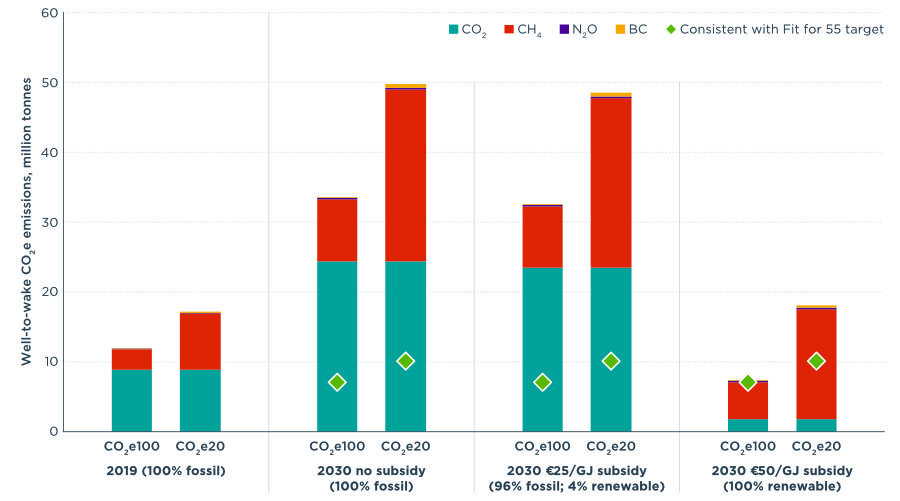
The figure below compares a scenario in which ships use 100% renewable LNG in 2030 (far right, representing a €50 per gigajoule subsidy) to emissions from using 100% fossil in 2019 (far left).

“For renewable LNG to significantly contribute to achieving climate goals, methane slip from marine engines needs to be virtually eliminated and methane leaks upstream need to be greatly reduced. Additionally, methane leaks from onboard fuel tanks and cargo tanks, which researchers are still working to adequately quantify, would need to be near zero. It is important for policymakers and stakeholders to understand that other fuels, including synthetic diesel and green methanol, could offer low life-cycle emissions without the methane problem,” ICCT said.

Synthetic diesel and green methanol have production costs and technical constraints similar to renewable LNG, but these liquid fuels are easier to store onboard than LNG and could be supplied using existing distribution networks. Synthetic diesel can be used in conventional marine engines or dual fuel engines, including those on existing LNG-fueled ships, and methanol can be used in new or modified dual fuel engines.”

What is more, at the moment there are no globally recognised methods for measuring methane slip – with a lack of available data and tools contributing to the issue.

To address the problem, ICCT launched the FUgitive Methane Emissions from Ships (FUMES) project to quantify methane emissions from LNG-fueled ships. Using in-stack continuous emissions monitoring, drones, and helicopters, the project will examine and quantify methane emissions from ships fueled by LNG under a variety of real-world operating conditions.

Industry majors who have been vocal proponents of LNG for their own ships, including Shell and Mediterranean Shipping Company (MSC), have launched a coalition targeting technology solutions for the maritime industry to measure and manage methane emissions.

In its first year, the Methane Abatement in Maritime (MAM) Innovation Initiative plans to identify and pilot new technologies to monitor and reduce ‘methane slip’ from vessels fuelled by LNG.

The initiative will also look into the ways of encouraging ship owners and operators to adopt proven abatement technology at scale.

Source: https://www.offshore-energy.biz/icct-for-renewable-lng-to-make-climate-sense-methane-slip-must-be-eliminated/

 

CREWEXPRESS STCW REST HOURS SOFTWARE - Paris and Tokyo MoU have announced that they will jointly launch a new Concentrated Inspection Campaign (CIC) on Standards of Training, Certification and Watchkeeping for Seafarers (STCW) from 1st September 2022 to 30th November 2022


GF Piping Systems presented solutions to make the maritime industry more sustainable through the use of plastic piping systems at the SMM 2022 in Hamburg recently, according to a press release.

The company introduced metal alternatives such as the Butterfly Valve 565, HEAT-FIT, and COOL-FIT, all of which aim to make maritime piping applications more intelligent, efficient, and sustainable, under the motto “Future Horizons,” according to a statement.

“With more than 30 years of experience in this industry, we are very aware of the current challenges. We believe that complete piping solutions consisting of corrosion-free, long-lasting, and cost-effective plastic components can be part of a holistic strategy that makes the maritime sector more sustainable. Therefore, we will continue to focus on future horizons,” said Roberto Chiesa, head of business development marine, GF Piping Systems.

The Butterfly Valve 565 with digital functionality, which was recently certified by DNV and Bureau Veritas, is a new addition to the company’s portfolio. It includes a fiber-reinforced polyamide housing, a polyvinylidene difluoride (PVDF) valve disc, and is pressure and temperature resistant, allowing it to easily replace metal alternatives.

HEAT-FIT, a fire-retardant pipe jacket system that introduces efficient plastic piping systems into L3 applications, was also displayed at the fair. It employs materials from the aerospace and building technology industries and can withstand fire with a temperature of up to 1000°C for 30 minutes at 3 bar. HEAT-FIT is certified by DNV, Bureau Veritas, ABS, and Lloyds Register, and it meets IMO Res, among other safety standards.

In addition, the company displayed COOL-FIT, a pre-insulated system designed to optimize commercial and industrial refrigeration applications. It is up to 60% lighter and 30% more efficient than metal due to its design, for less energy-intensive and more cost-effective operations.

Source: https://www.cruiseindustrynews.com/cruise-news/28239-gf-piping-systems-introduces-plastic-piping-systems.html


CREWEXPRESS STCW REST HOURS SOFTWARE - Paris and Tokyo MoU have announced that they will jointly launch a new Concentrated Inspection Campaign (CIC) on Standards of Training, Certification and Watchkeeping for Seafarers (STCW) from 1st September 2022 to 30th November 2022


Korean Register (KR) and Daewoo Shipbuilding & Marine Engineering (DSME) will be developing a new 40,000 m3 LCO2 carrier featuring a next generation cargo handling system. The two Korean firms signed an MOU at Gastech 2022 in Milan, Italy 7 September to help meet the growing demand for vessels capable of transporting carbon dioxide at scale from emissions sources to storage sites.

Carbon Capture, Utilization and Storage (CCUS) technologies are fast growing as the world seeks to achieve carbon neutrality and build an international carbon capture infrastructure.

However, carbon dioxide is a complex cargo to handle, having a triple point which is higher than atmospheric pressure, meaning that it can liquefy only at low temperatures and high pressures.

Even a small environmental change can see CO2 transform into a gas, liquid or solid state. The new design will feature a reliable Ship and Cargo Containment System (CCS) using its accumulated technologies in the field of liquefied gas carriers, such as LNG and LPG carriers.

DSME will also develop a Cargo Handling System (CHS) using the latest technology to prevent CO2 emissions and ensure navigational stability.

KR plans to verify compliance with its own Rules and The International Code of the Construction and Equipment of Ships Carrying Liquefied Gases in Bulk (IGC Code) for the cargo containment and handling systems developed by DSME.

Jun-Lyoung Seo, CTO of DSME, said: “Responding to climate change will be a new opportunity for the shipbuilding industry. To further enhance our competitiveness in the future green shipbuilding market, we will develop an efficient and safe LCO2 carrier through this collaboration and hope to obtain an Approval in Principle from KR within this year.”

Kyu-jin Yeon, Head of KR’s Plan Approval Center, said: “This collaboration with DSME is significant at a time when the demand for safer LCO2 carrier technology is increasing. Through this joint development project, we will continue to support DSME’s CO2-related technology and decarbonization projects.”

According to a report by the International Energy Agency (IEA) in 2020, up to 40 million tons of CO2 is captured annually, and most of which is permanently stored in geological formations or re-injected into oil wells to promote oil recovery.

In particular, as CCUS technology is expected to contribute a significant portion of the global total carbon dioxide reduction, the demand for LCO2 carriers to transport CO2 to storage facilities is expected to increase.

Source: https://maritimefairtrade.org/korean-register-daewoo-shipbuilding-collaborate-on-large-scale-liquefied-co2-carrier-technology/


CREWEXPRESS STCW REST HOURS SOFTWARE - Paris and Tokyo MoU have announced that they will jointly launch a new Concentrated Inspection Campaign (CIC) on Standards of Training, Certification and Watchkeeping for Seafarers (STCW) from 1st September 2022 to 30th November 2022


The Port of San Diego’s new cruise season is about to start and this season is poised to be the Port’s busiest since 2010 with 140 cruises scheduled, up 45 percent from last year, with all sailings at or near full capacity, bringing approximately 460,000 passengers, according to a press release.

“The Port of San Diego’s cruise business is definitely experiencing a rebound and we expect continued growth,” said Port of San Diego Chairman Dan Malcolm. “We’re pleased to be welcoming our cruise customers back to San Diego and to share how wonderful our port is to our cruise passengers. This season’s business will be a great boost to our regional economy.”

The Port’s new cruise season officially begins September 19, 2022 with the arrival of Silversea Cruises’ Star Breeze. Star Breeze will be cruising to Papeete, Tahiti on a 13-day voyage. It will be followed by the Disney Wonder arriving on September 23. Disney Cruise Line is more than doubling its sailings from San Diego this season, moving from 16 to 24 per season to 51. Princess Cruises is also adding new business to San Diego with 13 sailings and will be homeporting here for the first time ever.

The full schedule features long-term Port of San Diego partners Holland America Line and Disney Cruise Line, as well as Princess Cruises, Silversea Cruises, Celebrity Cruises, and Norwegian Cruise Line.

Voyages from MSC Cruises, Fred Olsen Cruise Lines, Scenic Luxury Cruises, Oceania Cruises, and American Queen Voyages are also on the calendar.

Itineraries featured include voyages to the Mexican Riviera, Hawaii, the Panama Canal, and the California Coast.

The Port is making some major repairs and improvements to the B Street Cruise Ship Terminal. A project to install a new curtain wall to extend the life and long-term stability of the pier structure is underway. Additionally, shore power capacity is being doubled and the Port will begin connecting two cruise ships simultaneously this fall. Also, in 2024, the Port will begin construction on a $5 million project to make interior improvements to the B Street Cruise Ship Terminal.

Source: https://www.cruiseindustrynews.com/cruise-news/28249-port-of-san-diego-to-begin-its-busiest-cruise-season-since-2010.html


CREWEXPRESS STCW REST HOURS SOFTWARE - Paris and Tokyo MoU have announced that they will jointly launch a new Concentrated Inspection Campaign (CIC) on Standards of Training, Certification and Watchkeeping for Seafarers (STCW) from 1st September 2022 to 30th November 2022


Japanese institutions are laying down new frameworks for green ship financing. Development Bank of Japan (DBJ) and ClassNK have established the Zero-Emission Accelerating Ship Finance Program to evaluate the asset value of environmentally friendly ships.

ClassNK will evaluate ships based on a comprehensive scoring model jointly developed by DBJ from the perspective of decarbonisation, environmentally friendly performance, and innovativeness, and DBJ will then provide investment and financing.

As the first project under the program, ClassNK evaluated the LPG dual-fuelled large LPG carrier, Crystal Oasis, owned by Kumiai Navigation, which DBJ then provided a loan to Kumiai to finance its acquisition of the ship which delivered from a Japanese yard three months ago.


CREWEXPRESS STCW REST HOURS SOFTWARE - Paris and Tokyo MoU have announced that they will jointly launch a new Concentrated Inspection Campaign (CIC) on Standards of Training, Certification and Watchkeeping for Seafarers (STCW) from 1st September 2022 to 30th November 2022


In partnership with West Coast Clean Fuels, LLC (WCCF), Stabilis provided project development, management, engineering, technical and operational services.

“Pasha’s leadership in lowering shipping emissions on West Coast shipping routes is a significant step toward the improvement of the air quality in the region,” commented Westy Ballard, President & CEO of Stabilis, “and we are delighted to have partnered with WCCF to play a part.”

Ballard further commented, “The Port of Long Beach is an important international trading hub for the U.S., and we look forward to working diligently with the Port and our customers to further advance the lowering of emissions in ocean shipping.”

Pasha Hawaii’s MV George III is a 774-foot container ship operating between Long Beach, CA, Honolulu, HI, and Oakland CA and is currently scheduled to bunker every second week at the Port of Long Beach. The vessel is the first of three LNG-powered ships that Pasha is putting into service with the second, the Janet Marie, expected in late 2022 and the third expected to be deployed in mid-2023.

Source: https://www.vesselfinder.com/news/24388-Stabilis-Solutions-Provides-Technical–Operational-LNG-Bunkering-Services-for-First-LNG-Powered-Ship-in-Long-Beach-CA


CREWEXPRESS STCW REST HOURS SOFTWARE - Paris and Tokyo MoU have announced that they will jointly launch a new Concentrated Inspection Campaign (CIC) on Standards of Training, Certification and Watchkeeping for Seafarers (STCW) from 1st September 2022 to 30th November 2022


Ship owners are always looking for indicators, both from the market but also technical, in order to evaluate and determine the future strategy in the market, whether it’s chartering or buying and selling their vessels.

In its latest weekly report, shipbroker Allied Shipbroking said that “in an attempt to clarify the prevailing momentum and trend shifts in the dry bulk market for both asset price levels and freight rates since the onset of the previous year, we have once again turned to utilizing a technical analysis approach. As noted in the graph below, we have used the TRIX (triple exponential average) metric for the freight TCA figures, alongside the RSI (Relative Strength Index) for asset price levels of a 5- year-old units, with both indicators being derived (and equally weighted) from all main size segments (Capesize, Panamax, Supramax, Handysize)”.

“As a quick and small introduction, the TRIX shows the rate of change in a 15-period moving average that has been smoothed exponentially 3 times (with signals given when the line crosses zero), while the RSI measures the velocity and magnitude of price movements (with theoretical “overbought” and “oversold” levels being marked at 70 and 30, respectively)”, Allied said.

Source: Allied Shipbroking

According to Allied’s, Thomas Chasapis, Quantitative Analyst said that “it is beyond the scope of this market view to go into depth as to how good signaling these indicators provide individually in terms of market direction, but rather to show whether the movement of one can potentially give an early incline as to the direction of the other and, at the same time how well both used in tandem can give a clearer view of the market’s overall trajectory. It seems that the TRIX indicator has given several “correct” early signals for the RSI. Looking at the graph, most of the zero-line crossovers of the TRIX were noted within a time frame just prior to the RSI following this same trend”.

He added that “at this point though, I would focus on the shifts noted during the summer period, which at that time, adequately reflected the current prevailing sentiment amongst market participants. The TRIX gave a bearish sign roughly at the midpoint of the summer period, while for the parties more focused on the SnP market, there was a time lag of around 3-weeks before the RSI line crosses the overbought line marker (in green color), indicating that an exit strategy from an asset would an optimal choice at that point. The explanatory “power” of the combination of these two technical oscillators proves to be robust within this market regime. The above analysis is not exhaustive as to how bearish the overall dry bulk market tone is at this point. It is a mere approach using a different angle to analyze one view of the market’s state and risk, showcasing potential hedging opportunities and strategies, while “smoothing out” the excessive noise and contrasting signals that tend to appear in such a volatile market”, Mr. Chasapis concluded.
Nikos Roussanoglou, Hellenic Shipping News Worldwide


CREWEXPRESS STCW REST HOURS SOFTWARE - Paris and Tokyo MoU have announced that they will jointly launch a new Concentrated Inspection Campaign (CIC) on Standards of Training, Certification and Watchkeeping for Seafarers (STCW) from 1st September 2022 to 30th November 2022


Container volumes in head-haul and regional trades are the key drivers of container vessel demand, average container rates, liner operator profits, and, since 2020, port congestion. According to Container Trade Statistics, combined head-haul and regional trade volumes fell 0.4% y/y in the first half of 2022. Head-haul volumes were 1.3% lower than a year ago while regional volumes were 0.6% higher. Under normal market circumstances the peak season in key head-haul trades should lift Q3 volumes. However, recently released volume statistics indicate that there may be no peak season in 2022 but it is very likely that volumes will slow in Q4.

In July, the combined head-haul and regional trade volumes fell 1.5% m/m but were up 1.5% y/y. While this initially seems to be a relative improvement in volumes, compared to first half results, the figure appears in a different light when historical seasonality is considered.

As an example, in the Far East to North America trade lane, volumes in July have historically been on average 7.0% higher than June volumes due to the beginning of the peak season. However, this year volumes were 3.3% lower in July than in June. Applying historical seasonality, volumes should have been nearly 200,000 TEU and 10.6% higher than actual volumes.

Using the same principle for all head-haul and regional trade lanes, the combined July volumes should under normal circumstances have been 3.3% higher; 4.3% higher in head-haul trades and 1.9% in regional trades. Overall, volumes would then have been 4.9% higher than July 2021 instead of 1.5%. This is partly because it in 2021 was the first time in recent years that volumes in July were lower than in June.

Applying the same seasonality-based calculation to the rest of 2022, the full year volume estimate ends at 77.8 million TEU and 63.7 million TEU for head-haul and regional trades respectively. In total, that would leave the combined volumes at 141.5 million TEU and 1.3 million TEU lower than in 2021 (a reduction of 0.9%). Head-haul volumes would be down 3.3% y/y while regional volumes would be up 2.3% y/y.

Focusing on the rest-of-year period from August to December, the calculation indicates that combined head-haul and regional trade volumes will be down by 1.9% y/y. From a congestion perspective it is interesting to note a 10.7% y/y and 8.2% y/y fall in import volumes to the Europe and Mediterranean region and North America respectively.

“Considering the risk of energy shortages in Europe during winter and that conditions for consumers and businesses are likely to get worse before they get better as the year progresses, it is possible that volumes could end even lower,” says BIMCO’s Chief Shipping Analyst, Niels Rasmussen.

“Though we appreciate that this approach to forecasting rest-of-year volumes may be somewhat simplistic, the overall forecast does tally with the economy-based forecasts in our recently published Container Market Overview and Outlook report. The prediction will most likely not end up 100% accurate, but we do believe the overall trend will end up correct, confirming a very muted peak season in key head-haul trades and lower Q4 volumes in line with normal seasonality,” Rasmussen says.
Source: BIMCO, By Neils Rasmussen, Chief Shipping Analyst


CREWEXPRESS STCW REST HOURS SOFTWARE - Paris and Tokyo MoU have announced that they will jointly launch a new Concentrated Inspection Campaign (CIC) on Standards of Training, Certification and Watchkeeping for Seafarers (STCW) from 1st September 2022 to 30th November 2022


Company DETAILS

SHIP IP LTD
VAT:BG 202572176
Rakovski STR.145
Sofia,
Bulgaria
Phone ( +359) 24929284
E-mail: sales(at)shipip.com

ISO 9001:2015 CERTIFIED