Container volumes in head-haul and regional trades are the key drivers of container vessel demand, average container rates, liner operator profits, and, since 2020, port congestion. According to Container Trade Statistics, combined head-haul and regional trade volumes fell 0.4% y/y in the first half of 2022. Head-haul volumes were 1.3% lower than a year ago while regional volumes were 0.6% higher. Under normal market circumstances the peak season in key head-haul trades should lift Q3 volumes. However, recently released volume statistics indicate that there may be no peak season in 2022 but it is very likely that volumes will slow in Q4.

In July, the combined head-haul and regional trade volumes fell 1.5% m/m but were up 1.5% y/y. While this initially seems to be a relative improvement in volumes, compared to first half results, the figure appears in a different light when historical seasonality is considered.

As an example, in the Far East to North America trade lane, volumes in July have historically been on average 7.0% higher than June volumes due to the beginning of the peak season. However, this year volumes were 3.3% lower in July than in June. Applying historical seasonality, volumes should have been nearly 200,000 TEU and 10.6% higher than actual volumes.

Using the same principle for all head-haul and regional trade lanes, the combined July volumes should under normal circumstances have been 3.3% higher; 4.3% higher in head-haul trades and 1.9% in regional trades. Overall, volumes would then have been 4.9% higher than July 2021 instead of 1.5%. This is partly because it in 2021 was the first time in recent years that volumes in July were lower than in June.

Applying the same seasonality-based calculation to the rest of 2022, the full year volume estimate ends at 77.8 million TEU and 63.7 million TEU for head-haul and regional trades respectively. In total, that would leave the combined volumes at 141.5 million TEU and 1.3 million TEU lower than in 2021 (a reduction of 0.9%). Head-haul volumes would be down 3.3% y/y while regional volumes would be up 2.3% y/y.

Focusing on the rest-of-year period from August to December, the calculation indicates that combined head-haul and regional trade volumes will be down by 1.9% y/y. From a congestion perspective it is interesting to note a 10.7% y/y and 8.2% y/y fall in import volumes to the Europe and Mediterranean region and North America respectively.

“Considering the risk of energy shortages in Europe during winter and that conditions for consumers and businesses are likely to get worse before they get better as the year progresses, it is possible that volumes could end even lower,” says BIMCO’s Chief Shipping Analyst, Niels Rasmussen.

“Though we appreciate that this approach to forecasting rest-of-year volumes may be somewhat simplistic, the overall forecast does tally with the economy-based forecasts in our recently published Container Market Overview and Outlook report. The prediction will most likely not end up 100% accurate, but we do believe the overall trend will end up correct, confirming a very muted peak season in key head-haul trades and lower Q4 volumes in line with normal seasonality,” Rasmussen says.
Source: BIMCO, By Neils Rasmussen, Chief Shipping Analyst


CREWEXPRESS STCW REST HOURS SOFTWARE - Paris and Tokyo MoU have announced that they will jointly launch a new Concentrated Inspection Campaign (CIC) on Standards of Training, Certification and Watchkeeping for Seafarers (STCW) from 1st September 2022 to 30th November 2022


Global container shipping turned a corner in the second quarter of 2022 according to the findings of the latest Quarterly Review of the market produced by MDS Transmodal and Global Shippers Forum.

Covid lockdowns in China, suppressing supply of manufactured goods and demand for raw materials, and plummeting sentiment in consuming countries, due to rising interest rates and energy prices, contributed to a fall in average earnings per container carried for the first time since 2020. (Graph 4.1)*

While total container carryings were up on Q1, this volume remained below the level recorded in the same period a year ago (Graph 1.2). This was despite traffic that had switched to other modes or to bulk shipping earlier in the year returning to the more traditional containerised mode.

The reliability and consistency of port calls showed a small improvement in Q2, but this was seemingly made by intermediate port calls being missed altogether. The capacity lost to ‘skipped’ ports remains high (Graph 7.2).

A reshaping of container shipping service patterns seems to be underway with a further increase in Q2 of the number of services connecting no more than two regions, together with a reduction in those linking more than two regions (Graph 2.2). In practical terms this means long, multi-port ‘loop’ schedules are being replaced by ‘shuttle’ services with transhipments required at hub ports in order for containers to reach their ultimate destinations.

Graph 4.1

Mike Garratt, Chairman of MDS Transmodal commented, “In the last quarter we have seen global network capacity grow marginally but underlying demand stay flat. Spot freight rates are now falling steadily and it will be interesting to see as a consequence the share of the minor bulks trade that returns to the major lines. The direct connectivity and reliability of making port calls offered to shippers continues to deteriorate.

Graph 1.2

In welcoming the Quarterly report James Hookham, Director of GSF, said, “This is the first time the GSF/MDS Transmodal Quarterly Review is showing a significant change in the direction of travel. This is just one set of data points, but shippers are telling us the world economy, international trade and the global shipping market have entered a new phase, with different factors at work compared to the past two years.”

Graph 7.2

Over the coming months, GSF and MDS Transmodal will continue monitoring whether the opportunistic gains made by shipping lines since 2020 are consolidated into a strategic shift in rates and service patterns imposed on shippers, or whether different carriers will respond instinctively and distinctively to the changing conditions.

Graph 2.2

James Hookham continued, “This change in market dynamics could provide a context for the use of freedoms granted to shipping lines under anti-trust immunity and Block Exemption legislation to re-engineer an industry-wide shift in capacity deployment, service patterns, port call frequency and market share concentration. Recent experience has shown this is not a market where regulators can ‘legislate and forget’ hoping expected behaviours are observed.

The number of parameters needed to monitor the market are many and complex and GSF and MDS Transmodal invite competition regulators around the world to ‘watch this space’ with us over the coming months”.
Source: MDS Transmodal


CREWEXPRESS STCW REST HOURS SOFTWARE - Paris and Tokyo MoU have announced that they will jointly launch a new Concentrated Inspection Campaign (CIC) on Standards of Training, Certification and Watchkeeping for Seafarers (STCW) from 1st September 2022 to 30th November 2022


Lockport, La., headquartered Bordelon Marine LLC has signed a one-year term charter agreement, starting in July 2022, with Subsea 7 i-Tech US Inc. for the M/V Connor Bordelon.

Built by Bordelon Marine Shipbuilders in 2013, M/V Connor Bordelon was designed and constructed on the premise that not all subsea tasks requires a large subsea vessel and that here are a range of missions that can be accomplished with two ROVs, a small crane, and smaller high spec. vessel.

The 260-foot DP2 Jones Act compliant Ultra-Light Intervention Vessel (ULIV) is mobilized with two Schilling 150 HD Work Class ROVs with high spec survey capabilities, operated by Subsea 7.

The vessel is configured to support Inspection, Repair & Maintenance (IRM) operations for clients operating in U.S. waters and regional international locations.

“We look forward to working with Subsea 7 in support of their U.S. and international IMR and light intervention scopes,” said Bordelon Marine President & CEO Wes Bordelon. “Our companies have developed a strong working relationship over the past few years which has laid a solid foundation for safe and consistent vessel operations.”

Source: https://www.marinelog.com/offshore/bordelon-marine-signs-uliv-charter-agreement-with-subsea-7/


CREWEXPRESS STCW REST HOURS SOFTWARE - Paris and Tokyo MoU have announced that they will jointly launch a new Concentrated Inspection Campaign (CIC) on Standards of Training, Certification and Watchkeeping for Seafarers (STCW) from 1st September 2022 to 30th November 2022


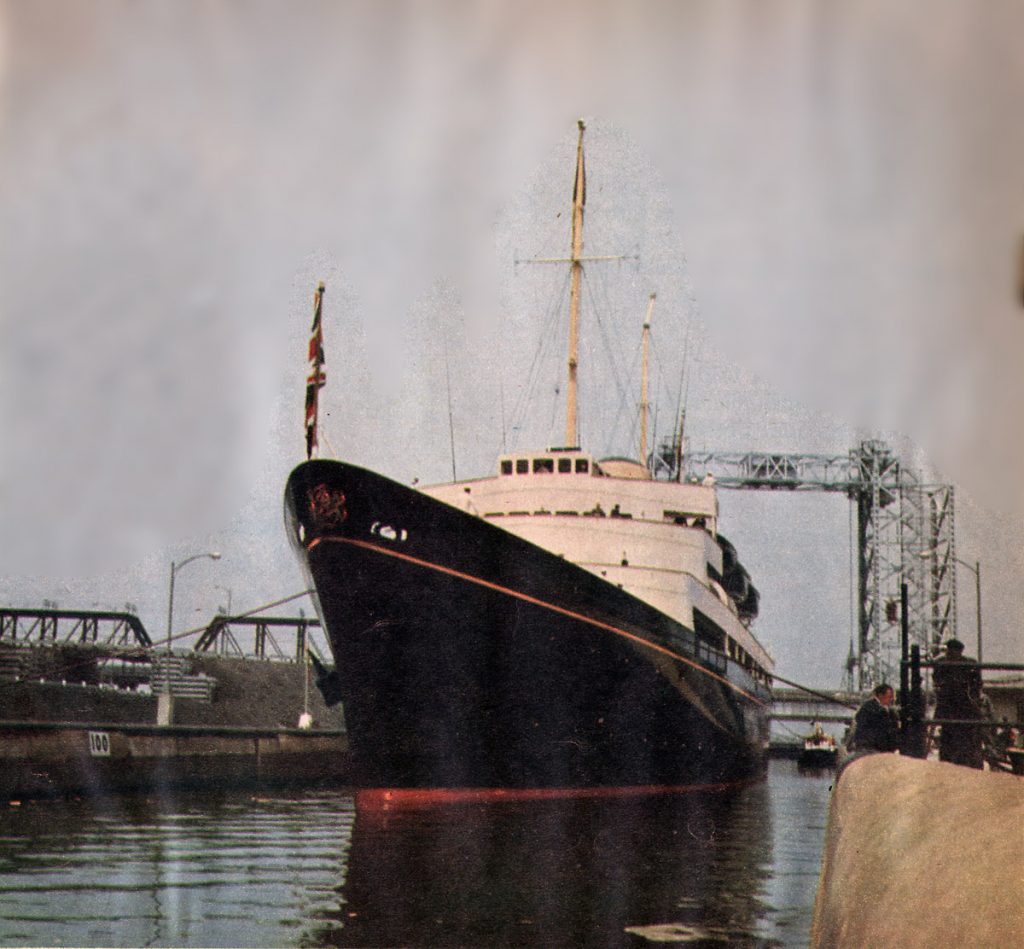
Larger at the time than either the Suez or Panama canals, the St. Lawrence Seaway was officially inaugurated on June 26, 1959 by young Queen Elizabeth II and U.S. President Dwight Eisenhower. The latter had overcome initial strong opposition in Congress to the colossal project.

Widely regarded as one of the engineering marvels of the 20th century, the marine highway’s 13 Canadian and two American locks have so far facilitated the movement of 3 billion tons of cargo.

The Seaway notably allows ocean vessels to deliver general and bulk cargo into the industrial heartland of North America.  The Great Lakes-Seaway waterway connects more than 110 commercial ports in Canada and the United States. Photos Seaway archives

Source: https://maritimemag.com/en/queen-elizabeth-ii-inaugurated-st-lawrence-seaway/


CREWEXPRESS STCW REST HOURS SOFTWARE - Paris and Tokyo MoU have announced that they will jointly launch a new Concentrated Inspection Campaign (CIC) on Standards of Training, Certification and Watchkeeping for Seafarers (STCW) from 1st September 2022 to 30th November 2022


Scrubber manufacturers are increasingly adapting their technologies to move into the broader carbon capture domain. To that effect, South Korean HMM has just signed a memorandum of understanding (MoU) with compatriot Panasia to collaborate on developing onboard carbon capture systems.

Under the terms of MoU, HMM and Panasia will perform a feasibility study, economic analysis and risk assessment. In addition, the handling process of captured CO2 is one of the vital areas of study. Based on research findings, HMM is expected to install the carbon capture system and perform an operational test on its vessels.

Kim Gyou-bong, HMM Chief Maritime Officer, said, “Carbon capture technologies are one of the alternatives in support of the net-zero ambitions of the global community” and added, “We will continue to participate in collaborative partnerships to develop onboard carbon capture solutions on our pathway to carbon neutrality.”

As an environmental initiative, HMM unveiled its target of reaching net-zero carbon emissions across its entire fleet by 2050. HMM explores various sustainable energy sources to achieve the target, including biofuels, LNG, hydrogen, and green ammonia. 

Source: HHM


CREWEXPRESS STCW REST HOURS SOFTWARE - Paris and Tokyo MoU have announced that they will jointly launch a new Concentrated Inspection Campaign (CIC) on Standards of Training, Certification and Watchkeeping for Seafarers (STCW) from 1st September 2022 to 30th November 2022


ICCT (International Council on Clean Transportation) published a report, focusing on ships trading with the European Union, predicts a tripling of demand for LNG as marine fuel between 2019 and 2030, based on trends in fuel consumption.

The idea that liquefied natural gas (LNG) can help mitigate the climate impacts of the maritime shipping sector rests on the assumptions that ships can switch to bio and e-LNG (“renewable” LNG) in the future and that switching would result in low greenhouse gas (GHG) emissions. For this to happen, there must be enough renewable LNG to meet future demand and using it must result in a substantial reduction in GHG emissions on a life-cycle basis compared to fossil LNG. Understanding whether these assumptions are realistic is important for policymakers, including in the European Union, which has committed to reducing its GHG emissions by at least 55% below 1990 levels by 2030 (that is equivalent to a 41% reduction from 2019 levels).

The report also estimates that renewable LNG will cost seven times more than fossil LNG in 2030 and, therefore, subsidies or other policies would be needed to encourage its use.

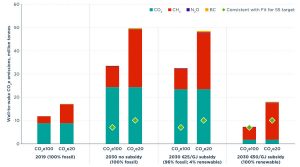
The well-to-wake (WTW) carbon dioxide equivalent (CO2e) emissions associated with three 2030 scenarios in the European Union are shown in the figure above. Compare the scenario in which ships use 100% renewable LNG in 2030 (far right, representing a €50 per gigajoule subsidy) to emissions from using 100% fossil in 2019 (far left). As shown, using renewable LNG could cut WTW CO2e emissions by 38% based on 100-year global warming potentials (GWP, labeled as CO2e100) but raise emissions 6% based on 20-year GWP (CO2e20) because of methane’s strong near-term warming effects. Focusing on the orange portions of the bars, even using 100% renewable LNG doubles methane emissions compared to 2019; this is primarily because of methane slip from marine engines.

For renewable LNG to significantly contribute to achieving climate goals, methane slip from marine engines needs to be virtually eliminated and methane leaks upstream need to be greatly reduced. Additionally, methane leaks from onboard fuel tanks and cargo tanks, which researchers are still working to adequately quantify, would need to be near zero. It is important for policymakers and stakeholders to understand that other fuels, including synthetic diesel and green methanol, could offer low life-cycle emissions without the methane problem.

Source ICCT


CREWEXPRESS STCW REST HOURS SOFTWARE - Paris and Tokyo MoU have announced that they will jointly launch a new Concentrated Inspection Campaign (CIC) on Standards of Training, Certification and Watchkeeping for Seafarers (STCW) from 1st September 2022 to 30th November 2022


After two years of travel restriction, Indonesia is finally going to welcome back cruise ships.  On September 17, for the first time in two years, Laperouse, a 130 meters long cruise ship with 70 tourists onboard travelling from Australia, will dock at Bali.  Before Bali, the ship was at the Port of Kalabahi, East Nusa Tenggara.

Since the Covid-19 outbreak in March 2020, the Indonesian government has closed the borders and barred foreign tourists in a bid to stop the virus from spreading.  In recent months, however, with Covid-19 turning endemic and infection rate going down, the authority has reopened the borders to tourist to rejuvenate the tourism sector.

Indonesia welcomes first cruise ship since lockdown
Laperouse ship. Photo credit: Wolfgang Berthe, IMO department of public information.

Prasetyo, director of Indonesian port strategy, Pelindo, said: “Indonesia is going to again welcome large-scale foreign tourist arrivals. The arrival of Laperouse is very important for us, considering that we just opened up tourism and this is the first cruise ship we have in two years. Hopefully, more cruise ships will arrive soon.”

Pelindo, the state-owned port operator, has engaged actively with all stakeholders, seeking feedback and suggestions, to boost maritime tourism. For 2022, Pelindo has confirmed 39 cruise ship visits and for 2023, 125 confirmed visits.

For Laperouse’s arrival, Pelindo has, since two weeks ago, coordinated closely with Benline Shipping Agents and Tour Operators Cruise Asia, to ensure a smooth docking and arrival.  Pelindo wanted all the tourists to feel safe and welcomed.

Benline thinks Indonesia can be at the forefront of maritime tourism.  Matt Joly from Benline said: “On the occasion of the arrival of Laperouse, this is a milestone for Indonesia and we will do our best to make sure everything is running ok.  We want to make Indonesia the number one for cruise ship visit in Asia.”

The Cruise Ship Tourism Program, under the Ministry of Tourism and Creative Economy, runs from July to the end of the year.  Minister Sandiaga Uno said beside Bali, the program, with all new rules and regulations in place to help facilitate cruise ship tourism, will be extended to Batam, Bintan Island, Surabaya, Belitung, Labuan Bajo, and Bau-Bau (Southeast Sulawesi).

Sandiaga exhorted all stakeholders to make sure all related infrastructure is ready to receive foreign tourists. In the meantime, Pelindo is working to improve inter-island connectivity to attract tourists to stay longer and visit more islands.  Arif Suhartono, president director of Pelindo, said it is a priority to invest in the development of more port infrastructure and connectivity so that Indonesia can compete in the global stage.

Suhartono added that as an archipelagic country, the maritime and port sectors are key to Indonesia’s economic growth and it makes sense to invest in developing all related infrastructure.  Indonesia is an important maritime hub in the region and Pelindo, moving ahead, will invest in occupational safety and health, sustainability, latest technology, and world-class training, Suhartono said.

Source: https://maritimefairtrade.org/indonesia-welcomes-first-cruise-ship-since-lockdown/


CREWEXPRESS STCW REST HOURS SOFTWARE - Paris and Tokyo MoU have announced that they will jointly launch a new Concentrated Inspection Campaign (CIC) on Standards of Training, Certification and Watchkeeping for Seafarers (STCW) from 1st September 2022 to 30th November 2022


Australian hydrogen shipping start-up Provaris Energy has teamed up with French renewable energy developers Total Eren to transport green hydrogen to Asia and Europe, where the application of Provaris’ compressed hydrogen storage and transport supply chain can be applied. Provaris is developing a 26,000 cu m compressed hydrogen carrier dubbed H2Neo, which it hopes will be constructed in mid-2023, pending approval. 

Total Eren is specialized in the development, financing, construction, operation and maintenance over the long-term of renewable energy power plants (mainly solar and wind) worldwide. In particular, Total Eren is working on several large-scale green hydrogen projects globally, including Latin America (Chile, Argentina, Brazil, Colombia), in Australia, and in Africa (Morocco, Egypt and Mauritania). 

A memorandum of understanding will provide a framework for Provaris and Total Eren to work together on the identification and assessment of green hydrogen projects currently developed by Total Eren that can utilize Provaris’ GH2 Carriers for bulk transport of compressed hydrogen in markets that require to import volumes of pure gaseous green hydrogen.  

The agreement includes the development of solutions that will meet the requirements of off-takers, port authorities, shipyards, and ship operators.

It also provides Provaris with a key partner to facilitate and accelerate the delivery of the first pure gaseous hydrogen (GH2) carrier, including investigation of a future financing scheme, as well as opportunities for an in-house developed compressed floating hydrogen storage solution (pictured below).

“Our discussions with Total Eren over time have identified a strong alignment on the commercial and technical benefits of compression for the storage and transport of hydrogen,” Provaris managing director Martin Carolan said. “We look forward to a closer relationship to facilitate and accelerate the delivery of the first fleet of GH2 carriers.”

Source: Provaris


CREWEXPRESS STCW REST HOURS SOFTWARE - Paris and Tokyo MoU have announced that they will jointly launch a new Concentrated Inspection Campaign (CIC) on Standards of Training, Certification and Watchkeeping for Seafarers (STCW) from 1st September 2022 to 30th November 2022


Mitsui O.S.K. Lines, Ltd. (MOL; President & CEO: Takeshi Hashimoto; Headquarters: Minato-ku, Tokyo) and Ferry Sunflower Limited (President: Mitsujiro Akasaka; Headquarters: Oita-shi, Oita Prefecture) today announced their intent to conduct a trial use of the “Berthing Aid System,” which is under development by Furuno Electric Co., Ltd. (President: Yukio Furuno; Headquarters: Nishinomiya-shi, Hyogo Prefecture) using the large-scale car ferry Sunflower Gold, which plies the Kobe-Oita route.

The “Berthing Aid System” measures the exact distance and angle between the hull and the pier, based on information obtained from LiDAR and satellite compasses, and displays the results on multiple screens. This system was developed to improve the safety and efficiency of berthing operations, which were conventionally conducted visually by crewmembers based on their experience.

In this trial use, MOL and Ferry Sunflower will verify the usability of the system, such as the ease with which crewmembers can understand the displayed measurement results when looking at the system screen. The two MOL Group companies also aim to support developing and commercialize a system considering safety from crewmembers’ point of view by exchanging opinions with the ferry captain and crewmembers.

The MOL Group continually develops and applies technologies and systems that reduce the risk of accidents and enhances vessel operating safety not only within the group but also throughout the ocean shipping industry.

MOL also conducted a sea trial of the “Berthing Aid System” in the MOL-led “sea trial of autonomous sailing on a commercial containership and car ferry” (January-February 2022) (*), as part of the unmanned ship project MEGURI2040, backed by The Nippon Foundation. In this trial, based on the results obtained from the “MEGURI2040” demonstration, the two MOL Group companies are simplifying the system installation on the vessel to improve the usability of the system in advance of its commercial implementation.

Reference: MOL


CREWEXPRESS STCW REST HOURS SOFTWARE - Paris and Tokyo MoU have announced that they will jointly launch a new Concentrated Inspection Campaign (CIC) on Standards of Training, Certification and Watchkeeping for Seafarers (STCW) from 1st September 2022 to 30th November 2022


The CMA CGM Group announced September 4 that it is creating a Special Fund for Energies, backed by a five-year, US$1.5 billion budget, to accelerate its energy transition and achieve net-zero carbon by 2050.

The Fund will invest to support the industrial production of new fuels, as well as low-emission mobility solutions across the Group’s business base (maritime, overland and air freight shipping; port and logistics services; offices). It will help to support a global innovation platform developed alongside large corporations, SMEs, start-ups, and the academic and scientific community.

Rodolphe Saadé, Chairman and CEO of the CMA CGM Group, said: “The CMA CGM Group has been acting to protect the environment for many years. It is at the heart of my convictions and of our strategy. However, in the face of the climate emergency it is our duty to do more and accelerate our actions.

“This fund will enable us to make substantial investments in innovative projects to decarbonize our business. We have allocated the resources needed to accelerate our energy transition and that of the entire shipping and logistics industry.”

The Special Fund for Energies will invest in innovative projects to secure the supply of renewable energies and explore new solutions and prototypes to meet the ambitious decarbonization targets being pursued across the CMA CGM organization.

First focus: Supporting the development and production of renewable fuels

The CMA CGM Group has already begun to respond to climate change by using liquefied natural gas (LNG) as a transitional maritime fuel.

The Fund has been tasked with (a) driving forward the emergence of industrial-scale production facilities for biofuels, biomethane, e-methane, carbon-free methanol, and other alternative fuels, and (b) increasing and securing volumes in line with Group needs, in partnership with other major industrial groups with expertise in these technologies, or with investment funds or promising start-ups.

Second focus: Accelerating the decarbonization of port terminals, warehouses and truck fleets

The CMA CGM Group operates more than 700 warehouses and around 50 port terminals worldwide. It is committed to enabling these facilities to generate enough carbon-free electricity (wind, solar, biomass-fueled, hydrogen-fueled) to become energy self-sufficient.

Port equipment in use will be electrified more quickly wherever feasible and effective. CEVA Logistics, a CMA CGM subsidiary, aims to meet all its electricity needs through carbon-free power generation by 2025. The subsidiary has plans to install 1.8 million sqm of photovoltaic panels and expand the use of LED lighting.

A transition plan for the truck fleets will also be implemented, with a particular focus on electrifying CEVA Logistics trucks.

Third focus: Supporting, trialing and launching projects at the cutting edge of innovation

CMA CGM has long been involved in supporting the development of projects, prototypes and trials.

In February 2020, the Group joined forces with Energy Observer to make hydrogen one of the energy sources of tomorrow. With the Energy Observer 2 project, the partners have taken a new step forward by working together on a prototype intra-regional container ship fueled by liquid hydrogen and designed to meet the latest technical and logistical standards. The project is focused on developing practical applications for this new technology, to enable carbon-free maritime shipping on a larger scale, in particular for short distances.

The Group has also decided to acquire a stake in Neoline, a prototype sail-powered cargo ship set to serve transatlantic routes by the end of 2024. It is also supporting SeaOrbiter, a prototype marine research vessel and floating oceanographic laboratory designed by French architect Jacques Rougerie that is exploring pathways to the emerging blue economy.

The CMA CGM Group’s R&D team will continue to optimize the design and propulsion of large container ships to reduce their fuel use, while developing increasingly effective solutions to help make maritime, overland and air freight shipping more energy efficient.

Fourth focus: Pursuing energy savings and improving the energy efficiency of CMA CGM employee working methods and daily mobility

This fourth focus has three main objectives:

  • A building energy management plan for CMA CGM Group office buildings that will reduce energy use (investment in insulation, automation, energy renovation) and diversify their energy mix (solar panels, sea water loop).
  • Encouraging and incentivizing employee use of soft mobility solutions for both commuting and business travel, while improving the work-from-home systems used to avoid unnecessary travel.
  • Engaging the Group’s 150,000 employees through a holistic environmental approach that rewards innovative environmental protection and energy efficiency initiatives.

The Fund will be backed by a US$1.5 billion budget and managed, starting in October 2022, by a dedicated team bringing together some of the Group’s most talented engineers, energy experts, financial analysts and project managers. Operating as a cross-functional organization covering all the Group’s operations and divisions, it will guide the Group’s overall strategy towards developing low-carbon energy solutions and accelerating their implementation.

Source: https://maritimefairtrade.org/cma-cgm-budgets-us1-5-billion-for-shipping-energy-transition/


CREWEXPRESS STCW REST HOURS SOFTWARE - Paris and Tokyo MoU have announced that they will jointly launch a new Concentrated Inspection Campaign (CIC) on Standards of Training, Certification and Watchkeeping for Seafarers (STCW) from 1st September 2022 to 30th November 2022


Company DETAILS

SHIP IP LTD
VAT:BG 202572176
Rakovski STR.145
Sofia,
Bulgaria
Phone ( +359) 24929284
E-mail: sales(at)shipip.com

ISO 9001:2015 CERTIFIED