The Port of South Louisiana was awarded $955,339 in Port Security grant funding from the Department of Homeland Security Federal Emergency Management Agency. The funding will go toward the enhancement of the Port of South Louisiana’s cyber security framework, as well as support enhancements to its Geographic Information System (GIS) that will provide up-to-date spatial information to port security personnel and public safety agencies in the Port’s 54-miles of jurisdiction along the lower Mississippi River.

As the nation’s leading grain exporter and one of the Western Hemisphere’s largest tonnage ports, the safety and security of the Port of South Louisiana, its personnel, and its tenants is critical during these challenging times. The cyber and terrorist threat landscape is evolving rapidly and protecting against potential external threats requires rapid monitoring and response.

“The commerce that happens along the Lower Mississippi River at the Port of South Louisiana is intertwined with the national security of the United States,” said Paul Matthews, Chief Executive Officer. “We are grateful to our federal partners for awarding these funds, which will go directly toward solidifying the sustainment of cyber security protection and assist in preventing an outside threat of causing human loss of life, structural devastation, or economic catastrophe.”

The Port of Louisiana received $695,389 for enhanced cyber security. This project is for the enhancement of the Port of South Louisiana’s cyber security framework.  It includes the following integrated layers of cyber security technologies: installation, configuration, initial and continuous assessment, 24/7 monitoring, management and vulnerability scanning, real-time detection, network remediation, quarterly penetration testing, advanced training, troubleshooting, decryption of ransomware encryption, and related functions to protect against technology advancement of cyber terrorist threats. The Port of South Louisiana will make a 25% match for a total project cost of $927,186.

The Port also received $259,950 for GIS Acquisition Phase 1. GIS is currently used by the Port as a tool for business development, to depict available sites within the district along with adjacent and/or proximate transportation infrastructure such as rail lines, pipelines, water lines, etc. The investment supports the improvement of the GIS that will provide up-to-date spatial information via a web viewer to port security personnel and public safety agencies in the Port’s 54-miles of jurisdiction along the lower Mississippi River, thus improving maritime domain awareness significantly; also the project will provide up-to-date information to maintain port-wide risk management for critical infrastructure, transportation and utility networks, and the location of hazardous materials. The Port of South Louisiana will make a 25% match for a total project cost of $346,600.


CREWEXPRESS STCW REST HOURS SOFTWARE - Paris and Tokyo MoU have announced that they will jointly launch a new Concentrated Inspection Campaign (CIC) on Standards of Training, Certification and Watchkeeping for Seafarers (STCW) from 1st September 2022 to 30th November 2022


Speaking at the launch of the DNV publication Maritime Forecast to 2050 at SMM in Hamburg, Chairman Global Shipping, Logistics & Offshore, Citi and Chairman Poseidon Principles, Michael Parker, said that increased regulatory demands will change the profile of the shipping industry to the detriment of smaller shipowners.

“The bigger transition will lead to more consolidation because of the whole scale of net zero and the technology required. There is no god-given right to be a shipower, whatever size you are. Many small shipping companies were big shipping companies at one point,” said Parker

The panel was focussed and the industry’s transition to zero carbon over the coming decades, an undertaking that will require huge amounts of capital and capacity for data gathering, reporting and analysis. All of that investment will inherently involve risk, said Parker.

“The financial sector is going to look for a return, and I’m afraid it’s not going to get a return ultimately from smaller shipowners; the economics of capital and investing are not going to work.”

Cargo owners and financiers alike will oush the industry to decarbonise as they begin to account for and report on their scope three emissions.

Parker gave one example of the changing relationship between cargo owners and shipowners: Cargill said in the past it was willing to pay upfront the investment in energy saving and emissions-cutting retrofits for smaller bulker owners if banks would lend to Cargill to finance the retrofit. The charterer’s size and offer of employment for the vessels helped to reduce risk to financiers, and both charterer and environment benefit from a more efficient vessel.

“I think that’s probably the future model; if you can show that through retrofit you will extend the life of the vessel and reduce emissions, money will be made available.”

Sveining Oftedal, Specialist Director, Norwegian Ministry of Climate and Environment, said: “There will always be operators in the lower end of the market. It is happening today and it will happen in the future, in all types of industries. We can’t change that, it’s how business is.”

Rolf Habben Jansen, CEO, Hapag-Lloyd and Co-Chairman of the World Shipping Council, said: “If you are a really innovative player focused on a certain niche you can create a scale in a smaller market, but looking at the deepsea market for container shipping, over time it is going to be more difficult for smaller players to survive.”

Source: https://www.seatrade-maritime.com/sustainability-green-technology/no-god-given-right-be-shipowner-michael-parker
 

CREWEXPRESS STCW REST HOURS SOFTWARE - Paris and Tokyo MoU have announced that they will jointly launch a new Concentrated Inspection Campaign (CIC) on Standards of Training, Certification and Watchkeeping for Seafarers (STCW) from 1st September 2022 to 30th November 2022


According to Clarkson Research alternative fuel features in a record 37% of newbuildings orders by number, and 60% by tonnage, year-to-date. Leading the way are orders for LNG dual-fuel numbering 298 or 38% of all tonnage ordered so far in 2022.

There are lower numbers of orders for methanol and battery-powered newbuilds, the latter on smaller vessels. Some 71 newbuilds ordered are described as ammonia-ready, some LNG dual-fuel vessels, such as those ordered by Pacific International Lines (PIL) are also ammonia-ready.

Looking at the current fleet DNV in its Maritime Forecast 2050, launched at SMM 2022 on Tuesday, said there 1,349 alternative fuelled vessels currently in operation – just 1.2% of the world fleet – with LNG fuelled accounting for 923 of these vessels. In gross tonnage terms the alternative fuelled vessels account for 5.5% of the global fleet in current operation, with LNG fuelled 5.39% of the fleet.

Of newbuildings on order there are 1,046 with alternative fuel – including 543 with LNG and 417 battery/hybrid. In gross tonnage terms alternative fuelled vessels account for 33.2% of the newbuild orderbook, with 30.2% of all orders placed by tonnage for LNG-fuelled ships. Methanol, which is attracting increasing interest, accounts for 1.45% in tonnage terms, and battery/hybrid just 0.02% of tonnage given the small size of vessels.

LNG dominates despite the fact in its current form it can only offer a reduction in carbon emissions, and controversy remains around methane slip. Just this week a new initiative – Methane Abatement in Maritime – was launched that includes backing Shell, Lloyd’s Register and MSC is seeking to develop solutions to address methane slip.

While LNG remains a fossil fuel bio-LNG provides a potential pathway to carbon neutral or zero carbon operations for vessels fitted with LNG propulsion. Promoting industrial scale production of bio-methane and e-methane is one of the focus areas of a $1.5bn special energies fund also launched this week by shipowner CMA CGM, one of the pioneers in using LNG as marine fuel on very large vessels.

In a modelling of 24 different scenarios for shipping’s energy mix DNV’s Maritime Forecast to 2050 sees bio-LNG featuring significantly in all scenarios.

“It is hard to identify clear winners among the many different carbon-neutral fuel options given the uncertainties on price and availability, but we can outline under what conditions each will proliferate. Bio-LNG, bio-MGO and bio-methanol, which are relatively energy-dense hydrocarbons, would be the preferred fuels, given sufficient availability of sustainable biomass.”

Looking at bio-methanol, which would provide a zero-carbon option for methanol fuelled vessels, DNV said it was very sensitive to the cost of production compared to bio-MGO and bio-LNG.

The use of electro-fuels such as e-LNG, e-NH3 (ammonia), and e-methanol also require zero carbon electricity generation. “The availability of electrofuels depends firstly on the availability of renewable electricity to produce hydrogen by electrolysis. This requires the phasing out of fossil energy from power generation, which is still a long way off in most regions.”

While such fuels remain a long way off there is an urgent need to develop carbon neutral fuels at scale within the next few years. Some 2,000 ships are expected to be ordered annually between now and 2030.

“Carbon-neutral fuels must be made available for ships already within this decade, in decarbonization pathways assessed. By no later than 2030, 5% of the energy for shipping should come from carbon-neutral fuels. This will require substantial investments in both onboard technologies and onshore infrastructure,” said DNV Maritime CEO Knut Ørbeck-Nilssen.

The onboard technologies will require huge investments. DNV estimates investment ranging from $8bn to $28bn a year depending on which pathway the industry takes to achieve its goals. Much greater investments will be required in landside infrastructure and onshore supply chains estimated at between $30bn – $90bn.

Source: https://www.seatrade-maritime.com/sustainability-green-technology/alternative-fuelled-vessels-current-numbers-and-forecasts

CREWEXPRESS STCW REST HOURS SOFTWARE - Paris and Tokyo MoU have announced that they will jointly launch a new Concentrated Inspection Campaign (CIC) on Standards of Training, Certification and Watchkeeping for Seafarers (STCW) from 1st September 2022 to 30th November 2022


As a curtain-raiser to the opening today of SMM, the world’s largest shipping exhibition, class society DNV has unveiled the sixth edition of its Maritime Forecast to 2050 report with a new focus on how to overcome the “ultimate hurdle” of fuel availability.

“No industry can decarbonise in isolation so global industries need to make the right choices together, and sustainable energy should be directed to where it has the biggest impact on reducing GHG emissions. The ultimate hurdle is fuel availability and to overcome it, supply chains must be built through cross-industry alliances,” commented DNV Maritime CEO Knut Ørbeck-Nilssen.

“Carbon-neutral fuels must be made available for ships already within this decade, in decarbonisation pathways assessed. By no later than 2030, 5% of the energy for shipping should come from carbon-neutral fuels. This will require substantial investments in both onboard technologies and onshore infrastructure,” he continued.

In terms of fuel choice, the authors of the DNV report wrote that uncertainties around future price and availability means that a clear winner among the many options – ammonia, methanol, diesel or methane, produced from sustainable biomass, renewable electricity or fossil fuels with carbon capture and storage – cannot be identified yet or in the near future.

The fuel transition has already started, with 5.5% of ships in gross tonnage terms in operation and 33% of gross tonnage on order today able to operate on alternative fuel, largely dominated by LNG.

DNV forecasts that onboard technology investments required for the decarbonisation by 2050 pathway scenarios will range from $8bn to $28bn per year depending on which fuel type has the largest uptake between 2022 and 2050. The largest investments come in scenarios with high uptake of ammonia or methanol, which require more expensive fuel systems, according to DNV analysis.

Investments of between $30bn and $90bn per year to 2050 are needed for the onshore fuel supply chains, DNV forecast.

“Two thousand ships are expected to be ordered annually to 2030 but there is still no silver-bullet fuel solution available,” said Ørbeck-Nilssen. “Against this uncertainty, the new Maritime Forecast to 2050 report can serve as a beacon of expert advice and smart solutions to ensure vessels stay commercially competitive and compliant over their lifetimes, underpinned throughout by the enduring need for safety,” he concluded.

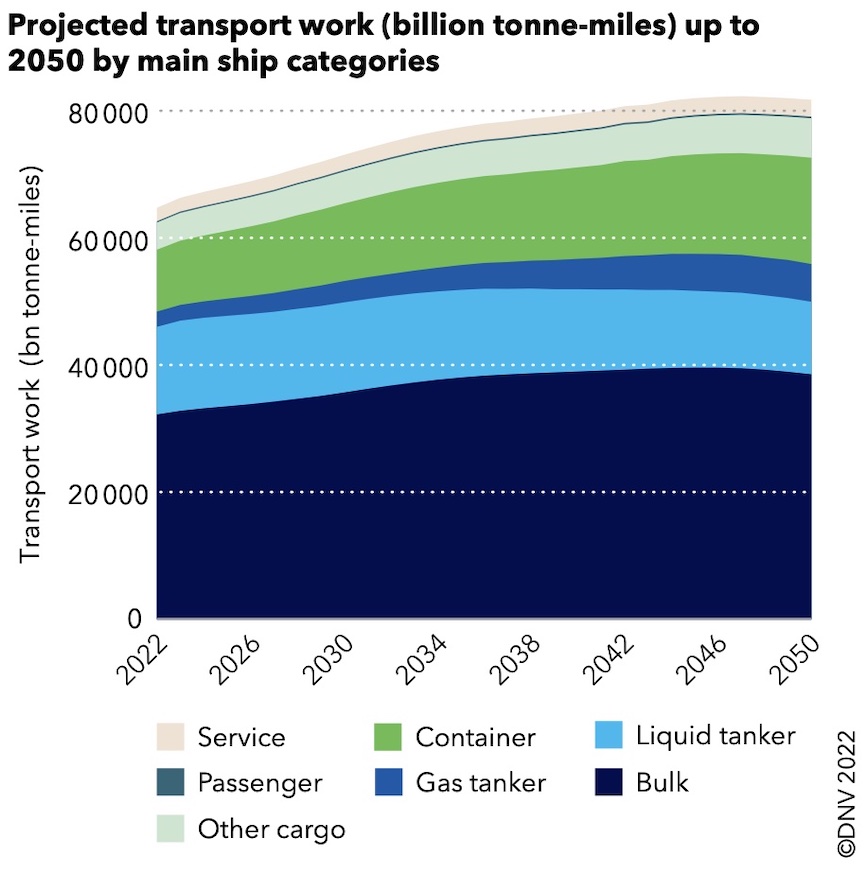
DNV’s updated projections for global trade predict an overall 29.55% growth between 2022 and 2050 in seaborne trade in tonne-miles. Most of the growth will come before 2030, after which DNV reckons global seaborne trade will stabilise.

“Growth in certain segments, especially gas and the container trade, will outpace the average rate. However, as the global demand for coal and oil peak, so will their trade, reducing their seaborne trade by more than two-thirds and one-third, respectively,” the report states.


CREWEXPRESS STCW REST HOURS SOFTWARE - Paris and Tokyo MoU have announced that they will jointly launch a new Concentrated Inspection Campaign (CIC) on Standards of Training, Certification and Watchkeeping for Seafarers (STCW) from 1st September 2022 to 30th November 2022


In his keynote address at the opening of SMM 2022, ICS Secretary General Guy Platten said that shipping uses around 4% of global oil production and will need to look outside of itself during the transition to zero carbon.

“As we move forward, we are going to need to focus on the remaining 96%, as these will be the same type of fuels that we are looking to use… when we look at all these new systems on display, we must not miss the 96% by just focusing on the 4%,” said Platten.

Supplying shipping with renewable fuels would take around 100% of current global renewable energy capacity, and providing zero carbon fuels for the world will take an 18-fold increase in renewable energy, said Platten, a huge undertaking.

“As we consider the current issues with constraints to supply and rising prices. We can no longer remain on the sidelines as a world takes decisions that will have fundamental impact on our industry.”

Platten repeated warnings on the availability of seafarers, and on the need to train crews to use the types of new technology on display at SMM and handle future fuels both to power vessels and as cargo.

“Here we have a challenge on our hands. We are currently facing a shortage of seafarers, and given the growing demand for STCW officers, we will need an additional 90,000 officers by 2026 to operate the world’s merchant fleet. And this is calculated before we take into effect the fact that 14% of our workforce is made up of Ukrainian and Russian seafarers.”

The war in Ukraine has complicated crewing calculations, but Platten did note one recent improvement.

“We welcomed the announcement last week that Ukrainian seafarers can now apply to be made exempt from the travel ban. All men aged between 18 and 60 will now be able to apply to leave the country to work under contract on vessels speeding up the pace at which we can transport grain back to the Ukrainian ports to where it is needed most,” said Platten.

The secretary general’s three takeaways from his speech were:

“Firstly, we must not underestimate the importance of people in any new technological developments. Our seafarers will be the ones using new technology, we must make sure that they are trained appropriately.

“Second, shipping is not on its own. We must not work in silos. We must instead look beyond our industry for opportunities to achieve our decarbonisation goals.

“And thirdly, remember that the supply chain is interconnected. What happens in one part of the world can cause the length and another understanding this means we can be better equipped for when things don’t go to plan,” said Platten.

Source: https://www.seatrade-maritime.com/regulation/shipping-can-no-longer-remain-sidelines-says-ics


CREWEXPRESS STCW REST HOURS SOFTWARE - Paris and Tokyo MoU have announced that they will jointly launch a new Concentrated Inspection Campaign (CIC) on Standards of Training, Certification and Watchkeeping for Seafarers (STCW) from 1st September 2022 to 30th November 2022


Korean Register (KR) will be closely collaborating with HHI and its subsidiary Avikus as well as the Liberian Registry (LISCR) to commercialise autonomous navigation technology.

The four parties signed a Memorandum of Understanding (MoU) at HHI’s headquarters in Ulsan, Korea to collaborate on bringing the Hyundai Intelligent Navigation Assistant System (HiNAS 2.0) to market.

HiNAS 2.0 will be installed on KR classed and LISCR registered ships in July of next year.

HiNAS 2.0 uses artificial intelligence (AI) to recognise the surrounding environment, such as weather and wave heights, and nearby ships, and then goes beyond providing simple information and controls the vessel’s steering commands and speed in real-time to avoid collision risk. The system uses augmented reality (AR) to guide optimal routes. The solution was developed for increasing fuel efficiency and to ease the operational burden on bridge teams.

The International Maritime Organization (IMO) categorises autonomous ship operations into four levels. A ship with automated process and decision support is referred to as the Level 1. Level 2 autonomous operations is described as a remote-controlled ship with seafarers on board. At Level 3, the ship is remotely controlled without any seafarers on board, and with Level 4, the ship is fully autonomous.

Most commercialised autonomous navigation systems are currently at Level 1, but HiNAS 2.0 is aiming to be the most advanced solution of the existing autonomous navigation systems at Level 2.

“We are focusing on research and development for autonomous navigation, and some of our technologies have already been commercialised, taking the lead in the global market. As a pioneer in the autonomous ship sector, we will advance our technologies through various collaborations with other market leaders,” said Won-ho Joo, HHI Senior Executive Vice President & Chief Technical Officer

“This collaboration is quite significant with the participation of different sectors, including a shipyard, an autonomous navigation solution developing company, a Classification Society and a flag registry. Based on the results of the collaboration, we will successfully commercialise the HiNAS 2.0 and enhance the safety and economic operation of ships,” explained Do-hyeong Lim, Avikus CEO.

Source: https://www.seatrade-maritime.com/technology/kr-hhi-and-liberian-registry-joint-autonomous-navigation-system


CREWEXPRESS STCW REST HOURS SOFTWARE - Paris and Tokyo MoU have announced that they will jointly launch a new Concentrated Inspection Campaign (CIC) on Standards of Training, Certification and Watchkeeping for Seafarers (STCW) from 1st September 2022 to 30th November 2022


The latest donation means the UN is still some $14m shy of its $80m target required to avert a catastrophe experts have warned would be five times worse than the Exxon Valdez disaster in 1989.

The proposed salvage operation consists of two processes occurring at the same time. One is the temporary ship-to-ship transfer of the FSO Safer’s cargo of crude oil into a replacement tanker and the other involves finding a permanent solution for replacing the abandoned FSO Safer.

“Canada is supporting UN-led efforts to prevent a catastrophic spill. The potential consequences would be devastating not only environmentally, but would also destroy livelihoods and force closures of ports Hodeidah and Saleef in Yemen, which support the delivery of critical humanitarian assistance including shelter, food, water and health care,” commented Harjit Sajjan, Canada’s minister of international development.

Source: https://splash247.com/canada-aids-fso-safer-salvage-fund/


Gothenburg Port Authority is collaborating with Stena Line, DFDS, Ørsted and Liquid Wind to establish Europe’s first electromethanol (e-fuels) hub with a planned launch date of 2025.

“We are very pleased to have been able to get to this point. This is a prime example of companies committed to the decarbonisation of the shipping industry lining up their green agendas towards a common goal that is working in the favor of all involved,” said Elvir Dzanic, CEO at the Gothenburg Port Authority.

Liquid Wind and Ørsted’s emethanol production facility FlagshipONE is in late-stage development and approaching a final investment decision. It will be the largest e-fuels facility in the world, producing 50,000 tonnes of emethanol annually.

In April this year, the Gothenburg Port Authority published general methanol operating regulations for ship-to-ship bunkering.

Source: https://splash247.com/gothenburg-port-sets-2025-date-for-europes-first-electromethanol-hub/


CREWEXPRESS STCW REST HOURS SOFTWARE - Paris and Tokyo MoU have announced that they will jointly launch a new Concentrated Inspection Campaign (CIC) on Standards of Training, Certification and Watchkeeping for Seafarers (STCW) from 1st September 2022 to 30th November 2022


Freight rates on the primary ocean trade channels are sinking during a time typically identified as the peak season in the industry after cargo owners reportedly shipped their holiday goods early and inflation dented consumer demands.

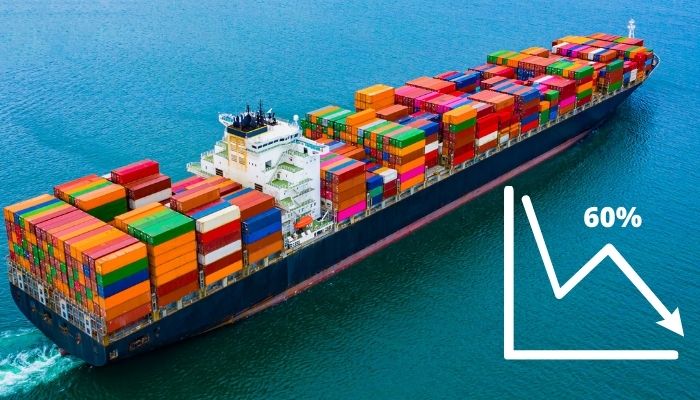
The cost incurred to ship a 40-foot container to the West Coast in the US from China is now about $5,400 per box, a drop of 60% from January 2022, per Freightos Baltic Index.

Each container shipped to Europe from Asia now costs $9,000, which is about 42% lower than observed early in 2022. At the same time, above pre-pandemic levels, the rate for both routes peaked at over $20,000 in September 2021.

Ocean Shipping Rates
Image for representation purpose only

Market conditions have made a sharp reversal from earlier in the pandemic. Freight rates jumped almost 10-fold during the previous year owing to port backlogs, surges in cargo, and supply chain disruptions. As a result, importers were found scrambling for space on the box ships. Retailers like Walmart -1.10%▼ chartered personal vessels to overcome the bottlenecks in 2021.

In 2022, Walmart and other major retailers ended up with excess inventory after they almost raced to import their goods earlier than usual, anticipating delays in shipping and demand that did not eventually materialize.

Manufacturers, too, moved goods earlier than usual. Some popular apparel majors like Gap GPS 0.32%▲ and toy makers like Hasbro, HAS -0.67%▼ have reported spring surges in their inventory levels that typically are observed when the holidays are closer.

Regarding spot rates, the party is officially over, mentioned Jonathan Roach, a container shipping analyst associated with a London-based firm named Braemar. The backdrop of a possible global recession, enhanced by surging energy prices and rapid inflation, is driving down the market. The COVID-19 pandemic boom in demand for consumer products has calmed, and spending on travel, leisure, and services has reportedly made its revival since 2021.

Shipping rates are set to further ease for the remainder of the year and in 2023, per shipowners and analysts. A series of new vessels will hit the water over the next two years, with net fleet growth expected to be over 9% in 2023 and 2024. Comparatively, per Braemar, container volume growth will marginally be negative next year and could rise about 2% in 2024.

The Chief Executive of Best Buy Co. BBY, Corie Barry, mentioned during an earnings call held on last Tuesday that cost pressures related to freight transportation are easing.

She added that the electronics retailer, whose sales have been shrinking, is finding it relatively easier to find freight space on trucks and ships.

This is a non-peak season as, for the first time, volumes that moved in the second half are noticeably lower than what moved during the first, clarified Peter Sand, the chief analyst at Xeneta, a maritime-data provider. He added that there are a lot of uncertainties given the ongoing war in Ukraine coupled with the massive global economic downturn.

Spot-market container shipping rates have dropped so rapidly that Xeneta highlighted in one of its reports in August that the prices have now come closer to long-term contract prices. These typically would come at a discount and even be below contract rates in some markets. Even major importers like Walmart move cargo via long-term contracts instead of paying for spot prices.

The ten largest liners have been enjoying bumper profits for the last two years. Recent quarterly earnings at Maersk MAERSK.B -0.27%▼ A/S were seen to be $8.59 billion, surpassing what it usually makes in a year. But many firms have warned about the weakening market conditions in the current year’s second half.

We ought to pay attention to the impact of inflation on consumer behaviour and demands, said China Cosco Shipping Corp., a firm that operates the fourth largest box ship fleet in the world. The industry’s supply side will likely encounter a unique situation with the changes in new vessels’ delivery.

Shipping analysts and executives have said that they do not expect freight rates to return to what was prevalent in the pre-pandemic levels. Part of the reason would be higher fuel costs. In 2019, the average price to send a container across the Pacific to the West Coast in the US was about $1,500.

Some ocean carriers are also investing billions in new and advanced technologies and fuels to reduce carbon emissions substantially. The additional cost of cleaner shipping will not go away. Instead, Roach said it would be a crucial factor in elevating rates in the long term.

References: Live Mint, The Wall Street Journal


CREWEXPRESS STCW REST HOURS SOFTWARE - Paris and Tokyo MoU have announced that they will jointly launch a new Concentrated Inspection Campaign (CIC) on Standards of Training, Certification and Watchkeeping for Seafarers (STCW) from 1st September 2022 to 30th November 2022


Wärtsilä Voyage today took the SMM event in Hamburg as the occasion to unveil its new demonstrator and innovation vessel, Ahti. The former German Government fishery patrol vessel was chosen as a target for retrofit technology installations to prove what is already technologically possible for the current fleet, and to create a platform for further innovation and development.

With AhtiWärtsilä Voyage has created a seaborne environment where customers can test Wärtsilä Voyage’s own technologies, as well as its technology partners’ solutions. These trials will be conducted in changeable real-life sea conditions that can be difficult and expensive to recreate in a laboratory environment.

The creation of a floating R&D facility also helps Wärtsilä Voyage to cut down the cost and time barriers associated with real-life tests, returning meaningful results on a much lower risk and cost basis than going into full-scale testing directly. Ahti also creates a resource where customers and technology partners can collaborate.

In the first half of 2022, Ahti’s bridge was upgraded with a number of products from Wärtsilä Voyage’s portfolio including NACOS Platinum, SPECS and RS24. The demonstrator vessel has also been fitted with on-the-market partner technology products from machine vision specialist Oscar Navigation and communications specialist Drynet. Soon, further tech will be onboard, making Ahti a bridge to the highly automated, connected, situationally aware and data-enabled future for maritime that Wärtsilä Voyage is aiming to create.

“Technology designed to solve the industry’s biggest challenges must be tested in situations that come as close as possible to real life scenarios,” said Hendrik Bußhoff, head of product – autonomous systems, Wärtsilä Voyage, at the demonstrator vessel. “However, we understand that real world testing is costly and time consuming. Trialing new equipment almost always means testing it on a customer ship which can often bring with it a lot of obligations and questions about documentation, schedules, data ownership and compliance. This is why we invested in Ahti. We now have a resource that will shorten time-to-market, enable us to fail fast and innovate quicker, and compare and understand different technologies outside of controlled environments.”

Sean Fernback, president, Wärtsilä Voyage commented: “In the last few years, the maritime industry has recognized the benefits of digitalization, and how it can help organizations tackle the very biggest challenges that the sector faces. Ahti provides a powerful tool for testing the capabilities and benefits of a tech-enabled vessel and provides us with an environment in which we can see the future, today, on our terms.”

Source: https://www.marinelog.com/technology/smm-wartsila-voyage-unveils-new-demonstrator-vessel/


CREWEXPRESS STCW REST HOURS SOFTWARE - Paris and Tokyo MoU have announced that they will jointly launch a new Concentrated Inspection Campaign (CIC) on Standards of Training, Certification and Watchkeeping for Seafarers (STCW) from 1st September 2022 to 30th November 2022


Company DETAILS

SHIP IP LTD
VAT:BG 202572176
Rakovski STR.145
Sofia,
Bulgaria
Phone ( +359) 24929284
E-mail: sales(at)shipip.com

ISO 9001:2015 CERTIFIED