The Australian Maritime Safety Authority (AMSA) is highlighting to vessel operators the importance of planned maintenance in ensuring safe operation of ships, and says it will increase its focus on planned maintenance during Port State Control inspections.
Recent incidents have demonstrated the potentially serious consequences of a lack of effective maintenance of main engines and power generation systems that can pose serious risks to the safe and pollution-free operation of vessels.
In response to this, AMSA will immediately increase focus on planned maintenance during routine Port State Control inspections. During Port State Control inspections, AMSA will place a greater focus on planned maintenance of propulsion and auxiliary equipment and associated systems and will take necessary compliance actions to address any identified areas of concern. This may include the physical attendance of classification society surveyors to verify the condition of critical equipment and its suitability to continue to function under all voyage conditions to maintain safe operations.
Operators should note that this is not a Focused Inspection Campaign (FIC) or Concentrated Inspection Campaign (CIC) of limited duration. It is a sustained focus on an identified area of concern that is part of AMSA’s data driven and risk-based approach to our PSC inspection regime.
ISM Code
Maintenance of the ship and equipment is a requirement of the ISM Code, including that:
– Maintenance inspections are held at appropriate intervals;
– Any non-conformity is reported, with its possible cause, if known;
– Appropriate corrective action is taken;
– Records of these activities are maintained.
In relation to maintenance, the ISM Code specifically states that the vessel’s Safety Management System (SMS) should:
– Identify equipment and technical systems that would cause hazardous situations if they were to suddenly fail;
– Provide for specific measures (i.e. regular testing of all equipment including stand-by equipment or systems that are not in continuous use) to ensure the continued reliability of such equipment or systems.
Finally, maintenance activities need to be properly resourced, and procedures must be documented.
The international shipping industry is responsible for the carriage of around 90% of world trade so vessel safety is critical. During the early 1990s, the global fleet was losing 200+ vessels a year. This has dropped to around 50 to 75 a year over the past four years — a statistic made more impressive by the fact that there are an estimated 130,000 ships in the global fleet today (over 100 gross tonnage [GT]) compared with some 80,000 30 years ago.
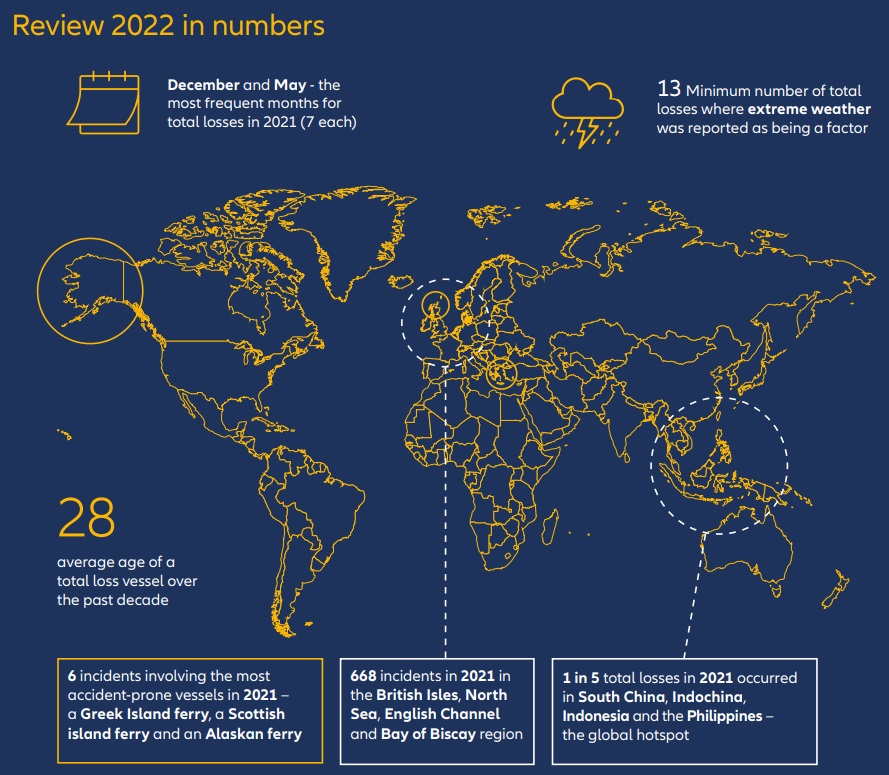
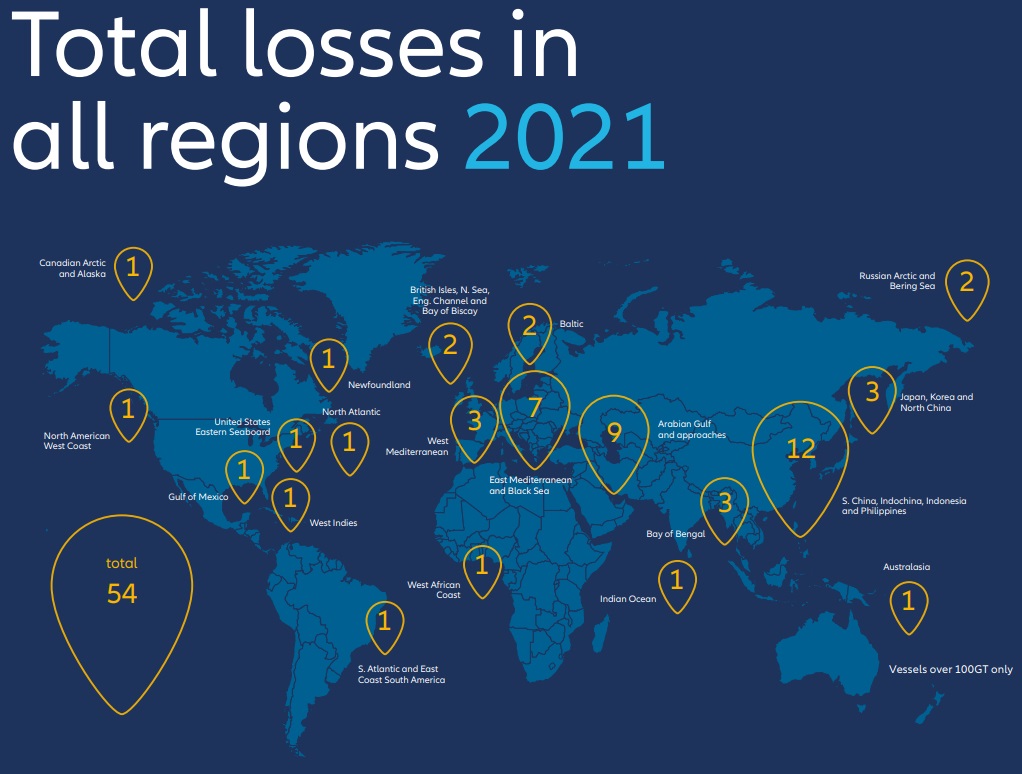
The sector continued its long-term positive safety trend in 2021 with 54 reported total losses compared with 65 a year earlier. Annual shipping losses have declined by 57% over the past decade since 2012 (127), while 2021 represents a significant improvement on the rolling 10-year loss average (89), reflecting the increased focus on safety measures over time, such as regulation, improved ship design and technology and risk management advances.
South China, Indochina, Indonesia and the Philippines is the main global loss hotspot, accounting for one in-five losses (12), although activity declined year-on-year. The Arabian
Gulf (9) saw a significant increase in loss activity to rank second ahead of the East Mediterranean and Black Sea region in third (7). South East Asian waters are also the major loss location of the past decade (225 out of 892), driven by factors such as high
levels of local and international trade, congested ports, older fleets and extreme weather.
Cargo vessels accounted for half of all vessels lost in 2021 (27). Foundered (sunk) was the main cause of total losses across all vessel types during 2021, accounting for around 60%
(32). Fire/explosion ranked second (15%, 8), with machinery damage/failure third (11%, 6). Extreme weather was reported as being a factor in at least 13 losses during 2021, while December and May were the most frequent months for losses with seven each respectively.
Collectively, foundered (52%), wrecked/stranded (grounded) (18%) and fire/explosion (13%) are the top three causes of total losses over the past decade, accounting for more than 80% of 892 reported losses.
While the number of total losses declined over the past year, the number of reported shipping casualties or incidents increased. The British Isles saw the highest number of reported incidents (668 out of 3,000). Machinery damage/failure accounted for over one-in-three incidents globally (1,311).
Fire/explosion (178) is the third top cause (after collision [222]), with the number of fires increasing by almost 10% annually.
The East Mediterranean and Black Sea region is the location of the most shipping incidents over the past decade (4,763), accounting for 18%.
Globally, most incidents have been caused by machinery damage or failure (9,968), followed by collision (3,134), contact (2,029), piracy (1,995) and fire/explosion (1,747).
Last year, union ship inspectors recovered US$$37.6 million in unpaid wages owed to seafarers, the International Transport Workers’ Federation (ITF) has revealed in figures published August 19.
The ITF’s 125 inspectors and coordinators completed 7,265 inspections in 2021 to support thousands of seafarers with wage claims and repatriation cases, despite Covid-19 restrictions preventing inspectors’ ability to board ships for much of the year.
ITF Inspectors get their name because they board and ‘inspect’ ships. They educate seafarers about their rights and support crew to enforce these rights. The officials cover more than 100 ports across 50 countries.
Inspectors are trained to look for exploitation, overwork – even for signs of forced labor and modern slavery. On many vessels, Inspectors have the right to examine wage accounts, employment contracts, and to review recorded hours of work and rest.
“It’s not uncommon for crew to be paid the wrong rate by a shipowner, or less than the rate set out in the employment agreement covering the ship,” said Steve Trowsdale, the ITF’s Inspectorate Coordinator.
“Crew can generally work out when they’re being underpaid. And that’s when they contact us. ITF inspectors help seafarers recover what’s owed to them.”
Altogether, the ITF clawed back US$37,591,331 in unpaid wages and entitlements from shipowners in 2021.
Trowsdale said the makeup of seafarers’ wage claims was changing: “Concerningly, we’re seeing a rise in the number of seafarers reporting non-payment of wages for periods of two months or longer, which actually meets the ILO’s definition of abandonment.”
“Seafarers might think it’s normal to go unpaid for a couple of months, waiting for a shipowner to sort out financing, but they need to be aware that non-payment can also be a sign that a shipowner is about to cut them loose and leave them abandoned.”
The ITF reported 85 cases of abandonment to the International Labor Organization (ILO) last year, an historic high. In many of those cases, abandoned crew had already been waiting on several weeks’ or months’ of unpaid wages – including those aboard the storm-hit MV Lidia.
ITF inspector based in Hong Kong, Jason Lam, helped eight Burmese seafarers who were crewing the MV Lidia recover almost US$30,000 in unpaid wages after they ran aground in October 2021, thanks to a typhoon that left them close to shipwrecked. The shipowner refused to pay the two months’ wages he owed them, abandoning them and ruling out any assistance to get them home.
Weeks of campaigning by Lam on behalf of the seafarers had an impact, and on 2 November 2021, the crew flew home – full wages in hand.
Photo credit: ITF. Burmese seafarers who were left near shipwrecked after a typhoon are pictured on their way home from Hong Kong, after ITF Inspector Jason Lam helped them recover almost US$30,000 in unpaid wages.
Amidst crew change crisis, ITF inspectors got thousands of seafarers home
Trowsdale said Inspectors did not let Covid-19 barriers stop them from supporting seafarers in need, instead adapting and finding new ways of working.
“I’m extremely proud of the work of our inspectors have done to support seafarers in the last year, often working in the face of incredibly difficult circumstances,” he said.
“It’s always been incredibly important for our team to be able to physically get to seafarers – to board ships and educate crew on their rights. So, when Covid-19 restrictions presented a challenge to inspectors to board vessels, there was a real question: ‘What will happen to the seafarers who need us?’”
As the crew change crisis worsened in early 2021, a flood of requests filled the ITF’s inboxes from crew desperate to sign off and get home. Covid-related border restrictions were the underlying reason for the crew change crisis, which impacted an estimated 400,000 seafarers at the worst point of the crisis. But on some ships, other more sinister factors were at play in keeping crew from their families.
“There is evidence that some shipowners were using Covid-19 as an excuse to keep seafarers working beyond their initial contracts and in complete violation of those seafarers’ human and labour rights,” said Trowsdale. “Thankfully, our team was wise to what was going on and despite everything we got thousands of seafarers home.”
“Keeping crew onboard while pretending their hands were tied may have saved those employers a few dollars in flight fares, but in today’s society that kind of conduct gets noticed. There are no shadows to hide in anymore when it comes to global supply chain accountability,” he said.
IMO has conducted a needs assessment mission to Malawi (22-26 August) to assess and support the country’s maritime sector.
As well as identifying gaps in the Malawian maritime administration, the objectives of the mission were to make recommendations on the enactment of regulations to support and provide an oversight function to the marine college by the relevant government ministry – in line with the provisions of IMO’s International Convention on Standards of Training, Certification and Watchkeeping for Seafarers (STCW Convention).
The IMO team met senior government officials from the Ministries of Transport and Public Works; Foreign Affairs; and various key stakeholders including the marine college and other related government bodies. The visit followed a request by the Malawian government for IMO to assist the country’s fledgling maritime sector with the necessary human and institutional capacity building to support the country in enhancing the operational efficiency of its maritime administration.
Malawi is a landlocked country in southeastern Africa with no direct access to the sea but linked through land and rail corridors to Dar Es Salaam Port in the United Republic of Tanzania and Nacala Corridor in Mozambique. However, Malawi has a navigable Lake Malawi stretching some 570 kilometers from the North to the South and some rivers on which both cargo and passenger vessels travel.
In line with IMO’s programme on Women in Maritime, the IMO team met with women from Malawi’s maritime sector with a view to encouraging and supporting them to establish a so-called ‘national chapter’. This national chapter would then feed into the regional association of Women in Maritime in Eastern and Southern Africa (WOMESA) as an important platform for synergy and cross fertilization of ideas on issues relating to women in the maritime sector in the member countries.
Merchant sailors will be allowed to leave Ukraine if they receive approval from their local military administrative body, the Ukrainian prime minister said on Saturday, a move that could ease the process of shipping grain from the country’s ports.
Premier Denys Shmyhal said the decision had been approved by the cabinet on Saturday. The change would cover male crew members of sea and river vessels, as well as students who need to undertake practical training aboard ships, he added.
The decision is likely to ease a shortage of sailors able and willing to crew ships coming into and out of Ukraine to export grain via an internationally brokered corridor.
Ukrainian men aged 18-60 have largely been barred from leaving Ukraine under a state of martial law imposed as the country battles the Russian invasion. Women of all ages have been free to leave throughout the war.
A newly built wood chip carrier vessel recently delivered to Japanese shipping company NYK is equipped to collect ocean microplatics for researchers to study.
The Stellar Harmony, built by Imabari’s Iwagi Zosen Co., Ltd shipyard, was officially handed over on August 23. The vessel will transport wood chips mainly from New Zealand, Australia, North America and South America under a long-term contract between NYK and Marusumi Paper Co., Ltd.
Once in operation, the ship will pump in seawater along its routes to collect microplastics floating in the ocean. The collected microplastics will be unloaded and analyzed by the Chiba Institute of Technology and used for research to clarify the actual distribution of microplastics in the ocean.
Stellar Harmony also comes equipped with hybrid fins (energy-saving equipment installed on the rudder to improve propulsion efficiency) and an energy-saving governor (equipment that saves fuel and reduces the load during main engine operation), as well as an eco-friendly main engine with specifications that improve fuel efficiency during low-load operation.
A Texas oil company agreed to plead guilty to criminal negligence charges and pay nearly $13 million for a crude oil spill that killed wildlife and fouled southern California beaches, federal prosecutors said on Friday.
Amplify Energy Corp repeatedly turned off and on a 17-mile-long subsea pipeline when it could not determine the location of the leak, according to plea agreements filed in U.S. District Court, Central District of California.
The Houston-based company and two subsidiaries each agreed to plead guilty to one count of negligently discharging oil during the October 2021, incident. The pipeline was struck by a ship’s anchor.
The three firms “are required to make significant improvements that will help prevent future oil spills,” Acting United States Attorney Stephanie S. Christensen said in a statement.
The plea “reflects the commitments we made immediately following the incident to impacted parties and is in the best interest of Amplify and its stakeholders,” said Chief Executive Martyn Willsher.
The spill released some 558 barrels (25,000 gallons) of crude oil into the Pacific Ocean, killing wildlife, blackening the coastline and forcing the closure of beaches south of Los Angeles.
A judge must still accept the plea agreement. The companies will serve probation for four years, be required to conduct semiannual pipeline inspections, and revise and submit an oil spill plan to state wildlife officials, the court filing showed.
Amplify has said it incurred $17.3 million in cleanup costs in the immediate aftermath of the spill.
The company this week said it reached an agreement in principle with plaintiffs to resolve civil claims.
Ticonderoga-class guided-missile cruisers USS Antietam (CG 54) and USS Chancellorsville (CG 62) are conducting a routine Taiwan Strait transit August 28 (local time) through waters where high seas freedoms of navigation and overflight apply in accordance with international law.
These ships transited through a corridor in the Strait that is beyond the territorial sea of any coastal State. The ship’s transit through the Taiwan Strait demonstrates the United States’ commitment to a free and open Indo-Pacific. The United States military flies, sails, and operates anywhere international law allows.
Maersk Group global towage operator Svitzer reports that its Aim for 8 speed initiative has successfully prevented 1,000 tonnes of CO2 from being emitted into the atmosphere.
The initiative asks tug crews to navigate at a maximum speed of eight knots during mobilization and demobilization.
A pilot of the Aim for 8 initiative started in late 2021 across Svitzer’s U.K. operations and is part of the company’s multi-faceted decarbonization strategy that was launched in May 2022. The initiative proves that small behavioral changes, when implemented alongside more ambitious and long-term shifts such as fuel and tug design, can have an immediate and measurable impact on the CO2 emissions of the global fleet.
Svitzer’s global fleet of 400 vessels emits the same every year as 100,000 diesel-powered cars, so any immediate CO2 saving can have a big impact. The speed target of eight knots was chosen based on analysis of Svitzer’s tug fleet while mobilizing to and from a job and asks and incentivizes crews to try to achieve the “sweet spot” of potential fuel efficiency that the company’s analysis identified.
There is a huge potential for speed optimization during mobilization and demobilization, compared to more operationally sensitive moments during a towage job. This is because there is less power demand and more predictable conditions. For some individual tugs, optimizing speed to eight knots during mobilization and demobilization has improved their efficiency by around 20%.
“We’re extremely proud to share that our Aim for 8 initiative has reached a milestone of 1,000 tonnes of CO2 saved after less than a year of pilot implementation in the U.K.,” said Kasper Karlsen, regional COO, Svitzer Europe. “We have been able to make this tangible impact at no cost to our operations and with very little disruption to our way of working, simply by asking our crews to make a small change in behavior and stay below eight knots before and after the towage job.
“We think that this is real proof of the impact that simple adjustments can make on the industry’s sustainability journey. We’re looking forward to implementing Aim for 8 more widely across Svitzer’s global operations and making an even greater impact on our carbon emissions.”
Following its success in the U.K., Aim for 8 will now be implemented across Svitzer’s global operations. This will considerably increase the potential CO2 saving from Svitzer’s operations, contributing to the company’s decarbonization strategy through to 2040. Meanwhile, Svitzer is also continuing to pursue advances in tug design and future fuels that will help propel itself to a carbon neutral future.
IMO Secretary-General Kitack Lim is scheduled to visit the port of Odesa on Monday (29 August), to see at first-hand the implementation of the Black Sea Grain Initiative and hear how ship safety and port management is being implemented. IMO Secretary-General Lim is expected to board a ship and speak to seafarers. The IMO Secretary-General will be hosted by the Ministry of Infrastructure of Ukraine.
This website uses cookies to improve your experience. We'll assume you're ok with this, but you can opt-out if you wish. Cookie settingsACCEPT
Privacy & Cookies Policy
Privacy Overview
This website uses cookies to improve your experience while you navigate through the website. Out of these cookies, the cookies that are categorized as necessary are stored on your browser as they are essential for the working of basic functionalities of the website. We also use third-party cookies that help us analyze and understand how you use this website. These cookies will be stored in your browser only with your consent. You also have the option to opt-out of these cookies. But opting out of some of these cookies may have an effect on your browsing experience.
Necessary cookies are absolutely essential for the website to function properly. This category only includes cookies that ensures basic functionalities and security features of the website. These cookies do not store any personal information.
Any cookies that may not be particularly necessary for the website to function and is used specifically to collect user personal data via analytics, ads, other embedded contents are termed as non-necessary cookies. It is mandatory to procure user consent prior to running these cookies on your website.