Wärtsilä Voyage, part of the technology group Wärtsilä, has signed a contract for a five-year framework agreement with Associated British Ports (ABP), the UK’s leading ports group, to digitalise operations at its 21 ports. The project aims to accelerate the digital transformation of port calls and operations, making them as efficient, sustainable and safe as possible. The Wärtsilä Voyage technologies chosen for the project; Navi-Port, Navi-Harbour Vessel Traffic Services, and Port Management Information System (PMIS), will help ABP employees meet their targets, complement the company’s safety culture during port operations and optimise vessel planning and movements, which can have a positive impact on local, national and global supply chains.

Sean Fernback, President Wärtsilä Voyage, commented: “ABP truly understands how impactful technology can be in the maritime industry and its innovative approach has cemented its position as the UK’s leading ports group. This new agreement will help ABP maintain its competitive advantage now and into the future.

“Holistic and seamless technological solutions are critical to ensuring that ports, and the maritime industry more broadly, are ahead of the curve in terms of supply chain modernisation, that operations are future-proofed, and that data underpins decisions. The scope and scale of what we can achieve with ABP is very exciting, and we’re pleased to be working together.”

After a thorough international procurement process where all major suppliers of port optimisation solutions were invited to tender, ABP chose to collaborate with Wärtsilä Voyage, a cutting-edge technology developer accelerating the digital transformation of the maritime industry. Wärtsilä Voyage has a clear vision on how to enable ABP to become an early adopter of state-of-the-art port management solutions, while also ensuring a strong return on investment aligned with the goals and ambitions of ABP.,

The project, which began in June, will span multiple phases across all of ABP’s ports. Wärtsilä’s Vessel Traffic Services system and Port Management Information System are expected to be integrated into the Port of Southampton before April 2023, with other solutions subsequently being deployed across ABP’s other 20 ports. The agreement with ABP includes an ongoing human factor review to ensure the existing control room environment is optimised for people’s needs and is fully compliant with all national and international standards and guidelines.

The framework agreement, valid for at least the next five years, formalises a shared vision and commitment from both organisations to develop modern smart port applications through extensive and long-term collaboration.

Harm Van Weezel, Chief Information Officer at ABP, said: “We are delighted to be working with Wärtsilä on a programme that really delivers towards our vision of a modern, digital port. Wärtsilä’s approach – forming a deep and long-term partnership that is mutually beneficial to both organisations – really stood out to everyone at ABP. We are looking forward to the vast benefits this programme will bring.”

Håkan Agnevall, President and CEO, Wärtsilä Corporation, added: “This is a landmark contract that will have a profound impact on the sustainability, resilience and efficiency of global supply chains. Digitalisation offers great potential for the maritime industry to reach its ambitious emissions reductions targets. That is why the expertise within Wärtsilä Voyage plays such an important role in the pathway to zero emissions and continues to be integral to Wärtsilä’s strategy to generate genuine and long-term change for our sector.”

Source: https://www.drybulkmagazine.com/ports-terminals/24082022/wrtsil-to-digitalise-associated-british-ports-maritime-operations/

 

CREWEXPRESS STCW REST HOURS SOFTWARE - Paris and Tokyo MoU have announced that they will jointly launch a new Concentrated Inspection Campaign (CIC) on Standards of Training, Certification and Watchkeeping for Seafarers (STCW) from 1st September 2022 to 30th November 2022


The nascent seaborne hydrogen trades are set to cross the Atlantic. Germany, which has been scouring the globe for new sources of energy in the six months since Russia invaded Ukraine, has signed a hydrogen supply deal with Canada.

Canadian prime minister Justin Trudeau and German chancellor Olaf Scholz signed a five-year hydrogen accord on Tuesday in Newfoundland and Labrador on Canada’s east coast. The two countries will create a transatlantic supply chain for green hydrogen this decade, with first deliveries aiming for 2025.

Scholz said Canada “has almost boundless potential to become a superpower in sustainable energy and sustainable resource production.”

To date, Japan’s Kawasaki Heavy Industries has been the only company to develop and operate liquefied hydrogen carriers, with a new route taking the gas from Australia to Kobe. Kawasaki Heavy is working on developing larger hydrogen carriers as are many other shipbuilders in Asia.

Source: https://splash247.com/germany-to-import-hydrogen-from-canada/

CREWEXPRESS STCW REST HOURS SOFTWARE - Paris and Tokyo MoU have announced that they will jointly launch a new Concentrated Inspection Campaign (CIC) on Standards of Training, Certification and Watchkeeping for Seafarers (STCW) from 1st September 2022 to 30th November 2022


The project will address challenges to adopting new reactor technology in commercial maritime applications. ABS will develop models of different advanced reactor technologies for maritime applications and develop an industry advisory on the commercial use of modern nuclear power.

The contract was awarded by the DOE’s Office of Nuclear Energy last year and formally contracted through its U.S. Industry Opportunities for Advanced Nuclear Technology Development funding opportunity.

Support will be provided by the Department of Energy’s National Reactor Innovation Centre (NRIC), based at Idaho National Laboratory. NRIC will provide the advanced reactor framework to help propose how a maritime nuclear demonstration could take place.

In a separate, smaller award, the DOE has also contracted ABS to support research into molten salt reactors being carried out by the University of Texas.

“Modern nuclear technologies are increasingly suggested as a potential solution to shipping’s decarbonisation challenge. The technology certainly has potential both in terms of its contribution to emissions reduction and for U.S. shipyards and their supply chains to leverage national investment in terrestrial nuclear energy development. Nevertheless, many questions need to be answered and it is critical the industry is able to evaluate these technologies with a laser focus on safety. ABS is up to the challenge to support the DOE in these efforts,” said Patrick Ryan, ABS senior vice president, global engineering and technology.

“The national lab system has powerful capabilities – when we partner with industry, we can jointly apply those to our energy challenges, and NRIC was created to make that happen faster,” said NRIC director Ashley Finan. “There’s a tremendous opportunity to reduce emissions in shipping, as well as growing interest from both the maritime and advanced nuclear sectors, and we’re pleased to be a part of this important work.”

Source: https://maritime-professionals.com/research-nuclear-power-for-ships/


CREWEXPRESS STCW REST HOURS SOFTWARE - Paris and Tokyo MoU have announced that they will jointly launch a new Concentrated Inspection Campaign (CIC) on Standards of Training, Certification and Watchkeeping for Seafarers (STCW) from 1st September 2022 to 30th November 2022


Speedcast has signed a reseller agreement with Algérie Télécom Satellite (ATS), an Algerian satellite services provider.

The agreement will provision Speedcast’s experience and expertise for ATS’ resell, expanding its business in VSAT solutions and services.

ATS has provided satellite services in Algeria for more than four decades and currently operates fixed and mobile satellite networks for cellular, banking, government and other industries across the country. Headquartered in Algiers, ATS operates a teleport at Lakhdaria and offices around Algeria.

“By bringing Speedcast’s world-class technology and services to the Algerian market, ATS has positioned itself to take advantage of positive trends,” said James Trevelyan, senior vice president of enterprise and emerging markets at Speedcast. “The company conducted a thorough RFI process before selecting us as their global services partner, and we’re pleased to engage in a mutually beneficial opportunity to deliver critical connectivity solutions to customers in this region. We look forward to widening the collective business portfolio in this key North African nation,” Trevelyan added.

Source: https://www.thedigitalship.com/news/maritime-satellite-communications/item/8010-ats-signs-reseller-agreement-with-speedcast

CREWEXPRESS STCW REST HOURS SOFTWARE - Paris and Tokyo MoU have announced that they will jointly launch a new Concentrated Inspection Campaign (CIC) on Standards of Training, Certification and Watchkeeping for Seafarers (STCW) from 1st September 2022 to 30th November 2022


Wärtsilä Voyage has signed a contract for a five-year framework agreement with Associated British Ports (ABP), the UK’s ports group, to digitalise operations at its 21 ports.

The project aims to accelerate the digital transformation of port calls and operations, making them as efficient, sustainable and safe as possible.

The Wärtsilä Voyage technologies chosen for the project; Navi-Port, Navi-Harbour Vessel Traffic Services, and Port Management Information System (PMIS) will help ABP employees meet their targets, complement the company’s safety culture during port operations and optimise vessel planning and movements, which can have a positive impact on local, national and global supply chains.

Sean Fernback, president, Wärtsilä Voyage said: “ABP truly understands how impactful technology can be in the maritime industry and its innovative approach has cemented its position as the UK’s leading ports group. This new agreement will help ABP maintain its competitive advantage now and into the future.

Holistic and seamless technological solutions are critical to ensuring that ports, and the maritime industry more broadly, are ahead of the curve in terms of supply chain modernisation, that operations are future-proofed, and that data underpins decisions. The scope and scale of what we can achieve with ABP is very exciting, and we’re pleased to be working together.”

After a thorough international procurement process where all major suppliers of port optimisation solutions were invited to tender, ABP chose to collaborate with Wärtsilä Voyage, the cutting-edge technology developer accelerating the digital transformation of the maritime industry. Wärtsilä Voyage’s clear vision on how to enable ABP to become an early adopter of state-of-the-art port management solutions, while also ensuring a strong return on investment aligned with the goals and ambitions of ABP.

The project, which began in June, will span multiple phases across all of ABP’s ports. Wärtsilä’s Vessel Traffic Services system and Port Management Information System are expected to be integrated into the Port of Southampton before April 2023, with other solutions subsequently being deployed across ABP’s other 20 ports. The agreement with ABP includes an ongoing human factor review to ensure the existing control room environment is optimised for people’s needs and is fully compliant with all national and international standards and guidelines.

The framework agreement, valid for at least the next five years, formalises a shared vision and commitment from both organisations to develop modern smart port applications through extensive and long-term collaboration.

Harm Van Weezel, chief information officer at ABP said: “We are delighted to be working with Wärtsilä on a programme that really delivers towards our vision of a modern, digital port. Wärtsilä’s approach – forming a deep and long-term partnership that is mutually beneficial to both organisations – really stood out to everyone at ABP. We are looking forward to the vast benefits this programme will bring.”

Håkan Agnevall, president & CEO, Wärtsilä Corporation added: “This is a landmark contract that will have a profound impact on the sustainability, resilience and efficiency of global supply chains. Digitalisation offers great potential for the maritime industry to reach its ambitious emissions reductions targets. That is why the expertise within Wärtsilä Voyage plays such an important role in the pathway to zero emissions and continues to be integral to Wärtsilä’s strategy to generate genuine and long-term change for our sector.”

Source: https://www.thedigitalship.com/news/maritime-software/item/8007-waertsilae-to-digitalise-associated-british-ports-operations

CREWEXPRESS STCW REST HOURS SOFTWARE - Paris and Tokyo MoU have announced that they will jointly launch a new Concentrated Inspection Campaign (CIC) on Standards of Training, Certification and Watchkeeping for Seafarers (STCW) from 1st September 2022 to 30th November 2022


Kalmar, part of Cargotec, will supply 11 Kalmar Hybrid Shuttle Carriers to The Port of Virginia, a deepwater port in the U.S. East Coast.

All of the new units will be delivered to Virginia International Gateway (VIG), one of the port’s primary container terminals and is capable of handling the biggest vessels in the Atlantic trade, with deliveries scheduled to be completed in Q3 2023.

A next step in the Port’s commitment to net-zero carbon emissions by 2040, the new units will directly replace the Kalmar diesel-hydraulic shuttle carriers that were delivered during the terminal’s grand opening in 2007.

The order is the sixth consecutive order of hybrid shuttle carriers from The Port of Virginia following previous corresponding orders dating back to 2017. The Port has been using Kalmar Hybrid Shuttle Carriers since August 2015. With this order delivered, the customer will have altogether 103 Kalmar Hybrid Shuttle Carriers in operation between their two terminals.

Kalmar also provides the port with support and servicing through a local team of technicians and local parts inventory.

Rich Ceci, Sr. Vice President of Technology and Projects, Port of Virginia, said, “The Port of Virginia has already surpassed a 32% reduction in CO2 emissions since 2017, which is largely due to the long term strategic decision to transition the shuttle carrier fleet to Kalmar hybrids. We are pleased with Kalmar’s continued commitment to delivering on-time quality products to us. Their local support team continues to work together with our management and ILA-partners to keep things moving consistently.”

Troy Thompson, Vice President, Sales, Kalmar Americas, said, “We are all faced with challenging times. Our customers, our suppliers and our factories continue to be burdened with shortages. However, we have remained steadfast in our journey and committed to our deliveries. We continue to invest in our local resources to be the world’s best intelligent horizontal transport supplier. Our hybrid straddle/shuttle carrier fleet has now surpassed some 250 units just in the USA, largely due to the partnership with The Port of Virginia.”

Source:
https://www.maritimeprofessional.com

CREWEXPRESS STCW REST HOURS SOFTWARE - Paris and Tokyo MoU have announced that they will jointly launch a new Concentrated Inspection Campaign (CIC) on Standards of Training, Certification and Watchkeeping for Seafarers (STCW) from 1st September 2022 to 30th November 2022


In June, President Joe Biden spoke by phone to several traders and farmers highlighting the impact of rising shipping costs and how they were affecting businesses. Biden went on to castigate shipping companies for hiking prices and promised to take an action, aimed at reducing the cost of inflation.

Biden was only the latest in a growing number of critics citing the staggering profits of the large shipping companies over the past two years. With companies such as Maersk reporting the largest profit ever in 2021 for any Danish company the focus on profits has continued. While most of the focus was on how the companies were making staggering profits as long-term contracts and spot freight rates jumped to exorbitant levels, some commentators started to focus on the taxes paid by the shipping companies.

For a long time, shipping companies have enjoyed favorable tax terms. The carriers are taxed based on their tonnage, referred to as tonnage tax, which is different from the normal corporate tax system.

Thus, in most instances, many shipping carriers pay no corporate income tax. But even in situations where the corporate is charged, it is still way below that of other sectors. For example, the average corporate income tax of bulk carriers is 6 percent and just 3 percent for the tanker sector, which if contrasted with the 27 percent charged to freight forwarders appears outrageous.

However, since the pandemic began, the shipping industry has become lucrative. The ocean carriers are now moving massive volumes of cargo while at the same time posting eye-watering profits. Estimates for 2021 set the profits for the industry anywhere between a low of $110 billion to $150 billion or even $200 billion.

As a result, the discourse to reappraise the carriers’ tax regime is growing. Taking note of the matter, Sea-Intelligence in its weekly report said the present tonnage tax system creates a risk for big shipping players.

“The problem for the carriers right now is that the disparity between their present profits and their low tax rates has become extreme,” wrote the analysts at Sea-Intelligence. “Add into the mix that the carriers are politically seen as being part of driving inflation, even though not to the degree that some might believe. Add on top of that the very real emotional impact…that in the middle of a continuing supply chain crisis, the providers of exceedingly unreliable services are seen to profit like never before.”

With Maersk posting a profit of $8.6 billion and Hapag Lloyd $4.4 billion for Q2 2022, Sea-Intelligence goes further to predict that the political headwind against the carriers is poised to increase.

In the case of Maersk, they are going to pay $164 million in taxes for the second quarter of 2022. This is a rate of 1.8 percent. Hapag Lloyd is going to pay $20.9 million, meaning an effective tax rate of 0.5 percent.

Confronted by a sagging economy and soaring inflation rates, some French politicians were the first to take on the issue proposing a 25 percent windfall tax on the “super profits” earned by the domestic carrier CMA CGM, along with other French giants including TotalEnergies and Engie. According to the lawmakers, the windfall tax money would have helped to fund measures aimed at protecting consumers’ purchasing power.

CMA CGM’s CEO Rodolphe Saade argued with the politicians saying they needed to look at the company’s competition and the financial disadvantage they would be placed under with the windfall tax. In the end, CMA CGM and Total, both agreed to reduce prices for French customers to avoid the tax.

Globally politicians in the developed world have pushed for the first global minimum tax on multinational corporations. While some analysts agree that there is a need for a global minimum corporate tax, especially applicable to the big ocean carriers, some caution that a wrong political answer to the tax question could have a devastating outcome.

Unlike other industries, ocean carriers’ business model is quite volatile and depends on a range of factors spread across the world. Further, there is global pressure on the shipping industry to invest large sums to address emissions and achieve decarbonization of a sector that many considered one of the most difficult to decarbonize. There are already reports showing the shipping market may start to contract in 2023, meaning the revenues might fall before a consensus on the tax issue is reached.


CREWEXPRESS STCW REST HOURS SOFTWARE - Paris and Tokyo MoU have announced that they will jointly launch a new Concentrated Inspection Campaign (CIC) on Standards of Training, Certification and Watchkeeping for Seafarers (STCW) from 1st September 2022 to 30th November 2022


The NTSB has released its final report on the allision of a bulker with a decommissioned offshore platform off the coast of Louisiana last year. Its investigators determined that poor bridge resource management and a charting error were the root causes of the casualty.

On Jan. 7, 2021, the bulker Ocean Princess struck the oil and gas platform SP-83A some 24 miles south of Pilottown, Louisiana. No pollution or injuries were reported, and damage to the vessel and platform came to about $1.5 million.

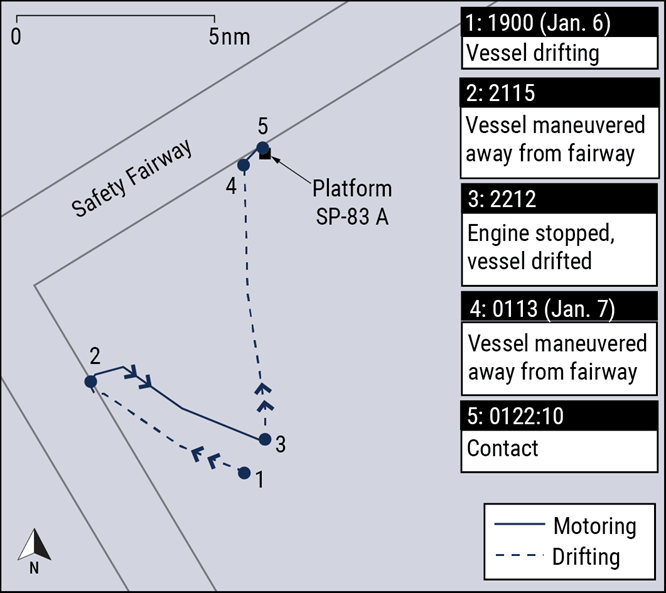
The Ocean Princess offloaded a cargo of ore and steel in New Orleans in late December. On January 6, she was drifting in the Gulf of Mexico before heading back up river to load a cargo of grain. The master planned to drift through the night with the engine on 15-minute standby, keeping clear of traffic and the three platforms located in the area.

In order to give the crewmembers some rest time after a long day of cleaning cargo holds, the master scheduled himself on the bridge, joining the second officer. The vessel was drifting at about 2-3 knots in a northerly direction, with on and off rain showers periodically limiting visibility.

As the watch went on into the early hours of January 7, the master and second officer worked on administrative tasks on the bridge. At about 0100 hours, the vessel drifted towards a fairway, and they called the engine room to prepare to maneuver. With the master at the helm, they headed away from the fairway at a slow bell. At 0113, as he maneuvered away, the master saw a dim yellow light and checked the radar, which was set at a range of about 1.5-3 miles. The second officer had a look and confirmed that the contact was a platform, but could not determine the range visually. It looked like an ENC-charted platform some 5-6 miles away, and they concluded that it was not a hazard.

They were mistaken, and the master only fully appreciated the risk about 40 seconds before contact. Last-minute maneuvers were not successful and the bulker allided with the platform at four knots. The starboard anchor lodged in the platform structure, and the bulker swung on the anchor chain until morning when it could be safely cut free.

Ocean Princess’ trackline in the hours leading up to the allision (NTSB)

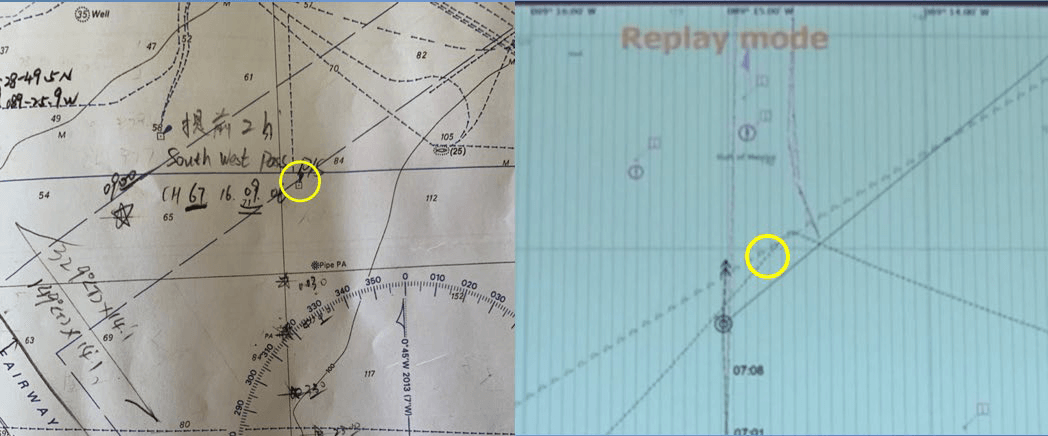
The master and second officer told NTSB that they never saw SP-83A on the radar. After the contact, they found that the platform was properly marked on the paper chart (an Admiralty product) – but SP-83A did not appear on their ECDIS ENC (a NOAA product).

NTSB verified that platform SP-83A was not charted on the official U.S. charts that fed Ocean Princess’ ECDIS. It had been charted correctly at platform commissioning in 1990 but was removed from the NOAA charts in 2010 for unknown reasons. Its absence went unnoticed and uncorrected until the allision. (After the accident, NOAA added it back in.)

A photo of the British Admiralty chart 3857 (left) and ECDIS screenshot from the Ocean Princess fed by NOAA ENCs (right), which were up to date at the time of the casualty. The British Admiralty chart shows SP-83A, but the ECDIS image shows nothing at that position. (NTSB)

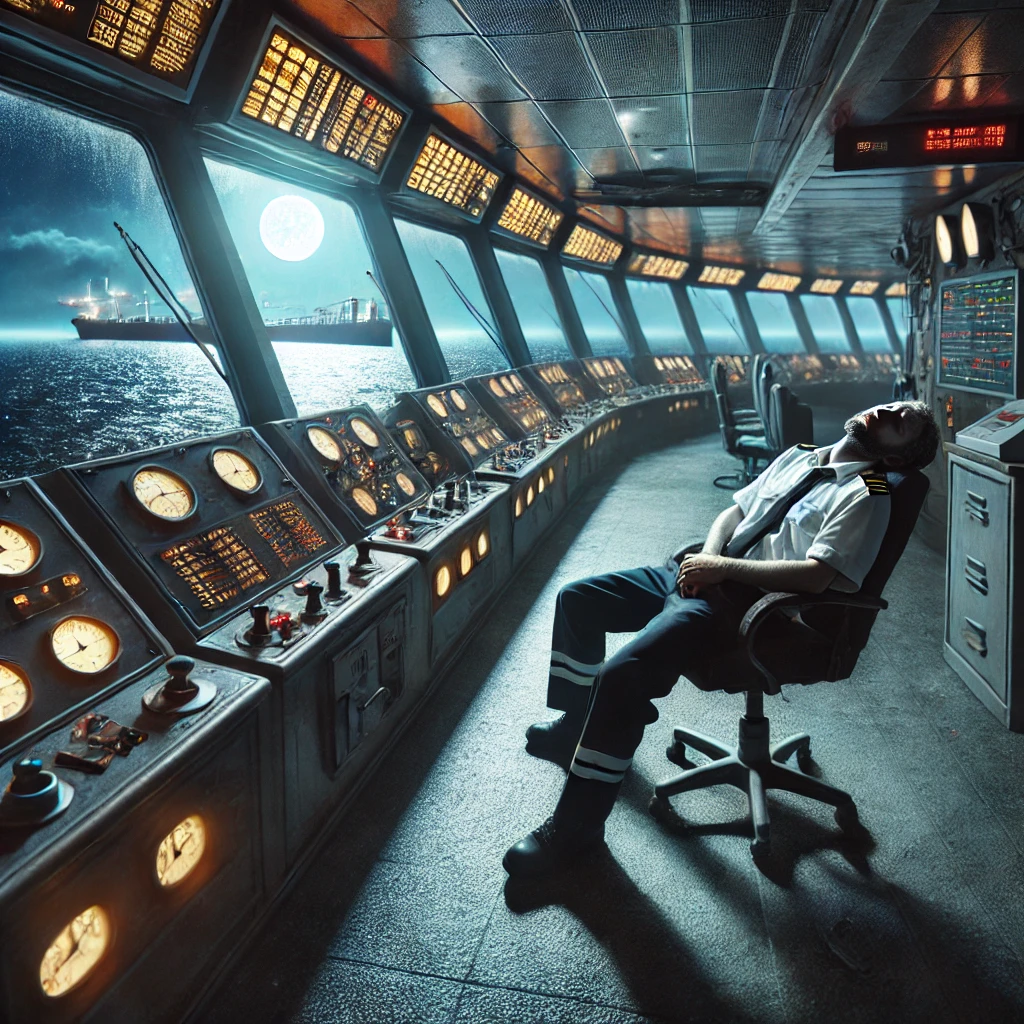
NTSB determined that poor BRM was the probable cause of the casualty, since the bridge team noticed the platform’s lights 10 minutes in advance but failed to take timely and effective action. The platform’s absence from the ENC was a contributing factor.

“Technology, such as an ECDIS, can result in operator overreliance and overconfidence that degrades sound navigation practices and negatively affects situational awareness,” advised NTSB. “When identifying hazards, bridge teams should avoid overreliance on a single data source.”

Source: https://www.maritime-executive.com/article/ntsb-poor-brm-caused-allision-with-uncharted-offshore-platform


CREWEXPRESS STCW REST HOURS SOFTWARE - Paris and Tokyo MoU have announced that they will jointly launch a new Concentrated Inspection Campaign (CIC) on Standards of Training, Certification and Watchkeeping for Seafarers (STCW) from 1st September 2022 to 30th November 2022


Environment management regulators in Turkey have advised that a new inventory of hazardous materials (IHM) must be conducted prior to the export of a Brazilian aircraft carrier to a Turkish shipbreaking yard, AllAboutShipping reported on August 23.

Reports indicate, however, that the six-decade-old carrier, the Sao Paulo, has already set sail for Turkey.

The trade news site reported that the Brazilian government and ship recycler Sok Denizcilik Tic.Ve Ltd.Sti (SOK) of Aliaga, Turkey, the buyer of the Sao Paulo, were sent scrambling when the regulators sent a letter to the Brazilian agency IBAMA, the competent authority for the Basel Convention, requiring the new IHM.

“… As a result of the [Turkish] Supreme Court’s interim injunction, news in the press, and the hazardous materials notices made to our [Turkish Environment] Ministry, it has emerged that a new Inventory of Hazardous Materials for the ex-naval vessel in question should be prepared while the vessel is in Brazilian territorial waters before it comes to our country,” the regulators wrote.

Environmental and labour rights groups working on the matter in Turkey, Brazil, and internationally have claimed for weeks that the export of the ship from Brazil to Turkey was illegal under the Basel and Barcelona Conventions and that the current IHM was not credible.

“Turkey is to be applauded for asking for a true and accurate survey and inventory,” Nicola Mulinaris of the NGO Shipbreaking Platform was cited as saying. “The current one is simply not believable based on what we know about older aircraft carriers.  We have real concerns that the provided inventory grossly underestimates the hazardous and radioactive materials on board the Sao Paulo.”

AllAboutShipping said it must be noted that Grieg Green, the survey company that issued the IHM for SOK, among other things:

admitted they had access to only 12% of the ship;

did not have access to the IHM prepared by the Brazilian Navy;

concluded that there might be more asbestos onboard the aircraft carrier than the estimated nine tons;

and

recommended further sampling during dismantling operations.

The Sao Paulo’s sister ship Clemenceau was estimated to have at least 760 tonnes of asbestos, a figure later confirmed by Bureau Veritas upon its dismantling at scrap yard Able UK, the news outlet added.

Jim Puckett, executive director of the Basel Action Network, was reported as saying. “The rush by the Brazilian government to get out to sea without checking to see if Turkey has laws against such import, to alert transit countries, and before a court injunction can be properly served, is not an excuse for Turkey to ever allow this ship into our territory.”

The Sao Paulo was first commissioned by the French Navy as Foch in 1963 and was sold to Brazil in 2000 for around $30mn, where she became the new flagship of the Brazilian Navy. The ship was demobilised and decommissioned in 2017.

Source: https://www.intellinews.com/toxic-materials-warning-as-brazilian-aircraft-carrier-sets-sail-for-date-with-turkish-shipbreaker-254373/?source=turkey


CREWEXPRESS STCW REST HOURS SOFTWARE - Paris and Tokyo MoU have announced that they will jointly launch a new Concentrated Inspection Campaign (CIC) on Standards of Training, Certification and Watchkeeping for Seafarers (STCW) from 1st September 2022 to 30th November 2022


Shell and unions representing workers at its Prelude floating liquefied natural gas (FLNG) facility have reached a wage deal to end a long-running strike and restart production at the site off northwest Australia, they said on Wednesday.

Shell shut the 3.6 million-tonnes-a-year Prelude facility in July and told customers it would be unable to supply LNG for the duration of the protected industrial action, or strikes approved by Australia’s Fair Work Commission, over a wage dispute.

“Shell is pleased to confirm an in-principle Enterprise Agreement has been reached with the Australian Workers’ Union and Electrical Trades Union in relation to the Prelude FLNG facility,” the company said in an emailed statement.

“The process to formally lift the work bans in place under the Protected Industrial Actions is expected to be completed shortly, which will enable the facility to commence the process to prepare for a hydrocarbon restart,” it said.

A Shell spokesperson was not immediately available to comment on how soon the company would be able to resume LNG shipments.

The Offshore Alliance, which combines the Australian Workers’ Union and Maritime Union of Australia, said workers would vote on the enterprise bargaining agreement (EBA) later this week.

“76 days of lawful Protected Industrial Action to secure an EBA which prevents jobs being outsourced to low-wage labor hire contracts is a fight worth having,” the Offshore Alliance said on its Facebook site.

Source: https://www.marinelink.com/news/shell-unions-reach-deal-end-strike-498955


CREWEXPRESS STCW REST HOURS SOFTWARE - Paris and Tokyo MoU have announced that they will jointly launch a new Concentrated Inspection Campaign (CIC) on Standards of Training, Certification and Watchkeeping for Seafarers (STCW) from 1st September 2022 to 30th November 2022


Company DETAILS

SHIP IP LTD
VAT:BG 202572176
Rakovski STR.145
Sofia,
Bulgaria
Phone ( +359) 24929284
E-mail: sales(at)shipip.com

ISO 9001:2015 CERTIFIED