CMA CGM and Hapag-Lloyd have announced shipment suspensions in several regions across the world.

The French shipping group said that all reefer shipments to Cabinda in Angola are suspended due to ongoing congestion, which causes “increasing and extremely irregular” transit times.

Additionally, Hapag-Lloyd has confirmed that with immediate effect, it temporarily suspends all imports into East Malaysia ports (Kuching, Sibu, Bintulu, Kota Kinabalu, Labuan, Sandakan, Tawau) due to feeder space limitation.

Moreover, the German carrier has announced it has already stopped the acceptance of wood and its allied products including charcoal in Nigeria, due to Nigeria Customs Service E11/2021/Circular No.011 referring to the suspension of export of wood and its allied products.

SOURCE READ THE FULL ARTICLE

Major container lines announce shipment suspensions worldwide


The US government has announced a proposed sale for offshore wind development on the Outer Continental Shelf in the New York Bight, making it the first competitive offshore wind lease sale for the Biden-Harris administration.

The proposed lease areas, located in the shallow waters between Long Island and the New Jersey coast, have the potential to unlock over 7 GW of offshore wind energy, powering more than 2.6m homes and supporting thousands of new jobs.

“Today’s announcement of new proposed lease stipulations puts a priority on creating and sustaining good-paying union jobs as we build a clean energy economy,” said Secretary of the Interior Deb Haaland.

Today’s announcement builds upon recent milestones from the Biden-Harris administration to advance offshore wind developments off MassachusettsCalifornia and wind power plays in the Gulf of Mexico.

A proposed sale notice, with a 60-day public comment period, includes eight lease areas in the New York Bight that could be auctioned for commercial wind energy development.

The US Department of the Interior’s Bureau of Ocean Energy Management (BOEM) is also seeking feedback on several innovative lease stipulations that will reaffirm its commitment to create good-paying union jobs and engage with all stakeholders and ocean users.

SOURCE READ THE FULL ARTICLE

US brings forward 7 GW New York Bight offshore wind lease sale


Dutch companies Koedood Marine and Nedstack have been chosen to supply a complete proton exchange membrane (PEM) fuel cell system to retrofit Future Proof Shipping’s (FPS) inland container vessel Maas to hydrogen power.

The Rotterdam-based Future Proof Shipping will retrofit the 110 m long boxship at Holland Shipyards Group (HSG), which has been given the green light to procure the system, comprising Koedood’s fuel cell stacks and technology from Nedstack.

Koedood will build three 275 KW fuel cell units and subcontract Nedstack to supply the fuel cell stacks as part of their co-development partnership for inland navigation.

The Mass will be retrofitted at HSG yard in Hardinxveld and is planned to be running on hydrogen power by the end of this year.

The vessel will ship containers between Rotterdam and Antwerp, with an expected greenhouse gas emissions reduction of 2,000 CO2 equivalent tonnes annually.

“The maritime knowledge and expertise of the Koedood group, together with the fuel cell capabilities of Nedstack provide us with an optimised product we can be confident in. It helps that we are all on the same page – collaborating to create a more sustainable future for the inland waterways in Europe,” said Fokke van der Veen, director of operations at Future Proof Shipping.

Future Proof Shipping aims to build and operate a fleet of 10 zero-emission inland and short-sea vessels over the next five years.

SOURCE READ THE FULL ARTICLE

Dutch partners to supply proton exchange membrane fuel cell system for FPS inland boxship


Shipping man and author, Carlos Luxul, questions why the X-Press Pearl was not allowed to offload a leaking box of acid at ports in Qatar and India before its fateful voyage to Sri Lanka.

The X-Press Pearl sank on June 2 in what is now referred to as the worst maritime ecological disaster in Sri Lanka’s history. The wreck is close to shore, too close, and it won’t be long before the effects of the ship’s fuel and other pollutants are felt, along with the cocktail of cargoes (some hazardous) from close to 1,500 containers the ship was carrying.

The world watched with horror. Neighbouring governments rushed to offer assistance. Brave salvage teams did what they could. Concerned maritime and environmental organisations wrung their hands – and the blazing ship filled our TV screens.

For the general public, it was just another accident at sea, just another example of the nasty, polluting shipping industry carrying out its business, a business dominated by shady shell companies in far away places that don’t play by the rules. That’s the public’s perception, but they want their consumer goods, so they too wring their hands and look away.

Investigators should take a long, hard look at the inactions in the ports of Hamad and Hazira

Was it just another accident or could it have been avoided? Before arriving in Sri Lanka, the ship called at two modern and well equipped ports, and requested help with a container of nitric acid that was leaking. The CEO of the ship’s owners has been quoted as saying, “the port authorities did not allow it (discharge of the container) since they had no manpower or the equipment readily available to discharge.” In a further statement, the owners said, “the vessel underwent discharge and loading operations in both ports before continuing on its planned journey to Colombo. Applications had been made to both ports to offload a container that was leaking nitric acid but the advice given was there were no specialist facilities or expertise immediately available to deal with the leaking acid.”

The two ports in question, Hamad, Qatar, and Hazira, India, are both state-of-the-art terminals. Can it really be true that they were completely unable to deal with a leaky container? Nitric acid is nasty stuff, but …

A quick check of the ports’ websites confirms their enthusiastic commitment to the best possible practices in HSE (Health Safety & Environment) and CSR (Corporate Social Responsibility). They go way beyond mere compliance in setting out their lofty goals.

QTerminals, the operators of Hamad port, note their, “primary goal is to achieve no harm to people, property, environment and third-party assets. QTerminals fully admits its responsibilities and will take all reasonable steps to ensure these obligations are met at all times. Achievement of this will be through the process of risk management; observance of legal and other requirements; and implementation of a robust HSE management system.”

They go on to state, “while the line management is accountable for safety, we have trained and dedicated HSE staff for providing professional support and advice in fostering a strong HSE culture. All import/export/transit cargoes are handled in the safest possible manner by ensuring compliance with applicable laws and regulations, safety procedures, and safe work practices. We carry out all our business activities in a socially responsible manner. Our efforts are focused on Safe & Healthy Environment, Climate & Energy and People & Work.”

Adani Ports, the operators of Hazira port, are keen to advise that, “Health and Safety are among the core focus areas of our sustainability framework. We strongly believe and propagate that safety is a culture that should be embedded in the DNA of every stakeholder. Our Occupational Health and Safety Policy demonstrates commitment of senior leadership and provide guidance for effective safety management system across all port and logistic sites.
Adani’s CEO, Karan Adani, assures us that, “as responsible corporate citizens Adani ports are committed to sustainable development for the people of the community and the environment.”

The port goes on to announce “Initiatives & Achievements”, including: “▪ All ports are certified for Safety Management System (ISO 45001). ▪ Hazard identification and risk assessment controls for all hazardous and risk activities.”

It is also reassuring to see they are committed to: “▪ Provide a safe and healthy work place at all times. ▪ Ensure compliance in design and operations as per applicable national codes, standards, best practices, statutory and other stakeholder’s requirements. ▪ Establish committees with the involvement of the management and workers to continually improve the safety culture. ▪ Identify the risks and formulate mitigation plans to prevent incidents. ▪ Formulate emergency preparedness plans to manage all identified emergencies.”

These are indeed noble commitments, yet somehow it seems the two ports didn’t quite manage to match their ambition and intent with “best practice” during this incident. A leaky container of nitric acid is clearly a tricky problem, but state-of-the-art ports should surely be able to do better?

The investigation into the X-Press Pearl will rumble on. Attention will inevitably focus on the shipper of the nitric acid and the owners of the ship itself. But I hope the investigators take a long, hard look at the (in)actions in the ports of Hamad and Hazira, where it would seem lessons could or should be learnt.

To many observers, the X-Press Pearl incident is just another regrettable case of the global shipping industry and its ruling authorities signing up to conventions and codes of conduct and then ignoring them at the first sign of trouble. Why does it have to be inevitable that whenever a maritime disaster occurs, the ports en route, their local authorities and national governments are so often found wanting, seemingly unable or unwilling to help?

SOURCE READ THE FULL ARTICLE

How the X-Press Pearl disaster could have been avoided


Availability remains particularly tight in Vancouver, while ample supplies in Houston has prompted some suppliers to offer VLSFO at reduced prices.


Bunker fuels are generally in good availability across grades in US East Coast and Gulf Coast ports. There are no notable shortages in the Caribbean and in Panama’s ports either, while several West Coast ports have tight availability of VLSFO and LSMGO, and especially of HSFO380.

US residual fuel oil inventories have fallen by another 1%, placing them to three-week lows, the latest Energy Information Administration (EIA) data shows. A massive supply increase has been met partly through higher imports, while production levels have held steady.

The US imported about a quarter more fuel oil in May than in April to meet rising demand over the course of the month. Demand hit a six-month high last week.

US Gulf Coast stocks have been drawn further and fallen to three-week lows. Refineries in the Gulf Coast region produced just 12,000 b/d in the latest week – the lowest volume since October last year.

Houston is well supplied with VLSFO and some suppliers are offering the fuel grade at reduced levels to move product. Price offers are in a wide range, with the lowest offers pulling down the benchmark. Houston’s VLSFO price has dropped to a discount of around $10/mt to New Orleans, after the two Gulf Coast ports were at parity last week.

Supply is tighter along the US West Coast. Vancouver’s availability is particularly scarce, and suppliers have not yet given a date for when their inventories will be replenished. One supplier hopes to be resupplied in two weeks. Vancouver has VLSFO priced around $25/mt higher than in Los Angeles and Long Beach. Both VLSFO and LSMGO are in better availability in Los Angeles, but stems should be booked over a week in advance to ensure deliveries.

HSFO380 remains tight and longer lead times are recommended in Los Angeles and several other ports along the West Coast, while Panama’s Balboa can deliver at shorter notice.

A strike action in Argentinian ports has delayed some bunker stems. Argentina’s customs union staff went on a seven-hour strike on Tuesday, and bunker barges that were unable to load product and finish paperwork before the strike came into effect faced delays. Certain suppliers ran out of product to sell at the Zona Comun anchorage while resupply from nearby oil product terminals were delayed. A supplier’s earliest expected delivery dates has been pushed back to around a week out.

Barges that had already loaded product from Argentinian terminals could deliver more promptly. Buyers would have to weigh demurrage costs against costs for re-booking stems with suppliers not held back by the strike delays.
Source: ENGINE (https://engine.online/)


SOURCE READ THE FULL ARTICLE

https://www.hellenicshippingnews.com/engine-americas-bunker-fuel-availability-outlook-18/


In light of the G7 summit of leaders starting this Friday, the ETF reiterates its call for an international agreement on a global minimum tax for multinational companies.


• Global tax could be an important tool in addressing the negative effects of the use of flags of convenience in global shipping which allows shipowners of one country to hire the flag of another country.
• The FOC flags offer regulatory advantages, low or zero corporate tax and complete flexibility over crew recruitment. This fuels a race to the bottom on social, environmental and safety standards.
• The OECD proposal would ensure that corporations pay taxes and participate in the common societal effort regardless of where they base their operations and eliminate the practice of shopping for the most advantageous tax regime. This would curb social dumping practices in EU shipping by encouraging shipowners to choose bona fide flag States.

Could a global minimum tax be a game changer for the way EU shipping is governed?

Discussions are taking place at the OECD to try to reach an international agreement on a global minimum tax for multinational companies. This process has gained momentum now that the Biden administration has come out in favour of a 21% global minimum tax.

What the OECD is trying to address is the “base erosion and profit shifting” challenges and is proposing rules that would provide jurisdictions with a right to “tax back” where other jurisdictions have not exercised their primary taxing rights, or the payment is otherwise subject to low levels of effective taxation.

In other words, the OECD proposal would ensure that corporations pay taxes and participate in the common societal effort regardless of where they base their operations.

This development is particularly interesting for the shipping industry because of its ability to move ships with ease from one legal jurisdiction to another.

It is important to understand that the primary legal authority governing the activities of a merchant ship is the State in which the ship is registered i.e. the flag State. Under Article 94 of the United Nations Convention on the Law of the Sea (UNCLOS), a flag State is required to effectively exercise its jurisdiction and control in administrative, technical, and social matters over ships flying its flag. Additionally, under Article 91, there must exist a genuine link between the State and the ship.

Shipping today is dominated by “flags of convenience” (FOC) by which shipowners of one country can hire the flag of another country. These FOC flag States do not insist on a genuine link and consequently are unable to exercise jurisdiction and control. As if that was not bad enough, they corrode the governance of the global shipping industry and fuel a race to the bottom on social, environmental and safety standards.

The FOC flags offer regulatory advantages, low or zero corporate tax and complete flexibility over crew recruitment. The global top three ship registers (Panama, Liberia, and the Marshall Islands), all declared “FOC” by the International Transport Workers’ Federation (ITF), account for over 40% of the world fleet but well over 50% of the world fleet is currently registered in FOC states. The failures of these flag States to exercise effective control has led to the necessity for port States to step in to enforce international standards thereby externalizing the cost of flag State failures.

These FOC flag States have been crucial for shipowners to increase profitability at the expense of society. For a shipowner, different factors can motivate them to seek the commercial advantage flowing from choosing to register their ships in these FOC’s including tax avoidance, limiting liabilities, light touch compliance with international maritime social, safety and environmental conventions and hiding behind the corporate veil by availing themselves of beneficial company and financial law, for example.

When it comes to employment standards the advantages provided to shipowners is often referred to as ‘social dumping’. Such practices are particularly evident in European shipping, where it is legally possible to employ third-country nationals on board ships engaged in regular intra EU/EEA services and pay them far below European standards. Such practices undermine the EU acquis and infringe upon the EU principles of equal treatment for equal work and enable discrimination between seafarers in terms and conditions of employment on grounds of their residence but in practice, this is de facto on grounds of nationality.

The ongoing COVID-19 crisis has exposed the complexity of a global industry with unfettered mobility of labour and capital. FOCs have not adequately assumed jurisdiction and control over the social matters concerning their ships. Shipowners have been forced to turn to their own countries for help and many have been ignored by their governments leaving seafarers working on ships registered in FOC States without access to their fundamental, social and employment rights.

It is estimated that 90 per cent of international trade by volume is carried by sea. And yet, seafarers who have been at the forefront of maintaining trade and the flow of essential medical supplies, food, and energy, have been treated like second-class workers. Hundreds of thousands of seafarers were beyond their original tours of duty, in some cases for more than 17 or more consecutive months, and often without access to shore-based leave and medical treatment.

Social dumping also undermines the goals of the EU state aid guidelines for maritime transport. It is a practice that needs a holistic response from Member States. Various countries have established favourable tax regimes under the EU guidelines, referred to as tonnage tax systems, through which subsidies for shipping activities are provided to support the growth of that country’s ship register and promote employment of national seafarers. These tax systems also cover so-called ancillary activities to shipping such as port operations.

Including shipping in the OECD global minimum tax proposal would encourage shipowners to choose bona fide flag States, those that comply with Articles 91 and 94 of UNCLOS, and still enable them to access favourable state aid systems and ultimately contribute to giving workers access to decent work in the most strategic sector involved in global trade. This would support and enhance the EU’s maritime resilience.

In the current context, where all Member States are struggling to recover from COVID 19 and have committed at the Porto Summit to continue deepening the implementation of the European Pillar of Social Rights at EU and national level, the OECD proposal for a global minimum tax would ensure that public investments made by society to promote an industry, also provide returns in form of job creation, adequate training, and decent working conditions.
Source: European Transport Workers’ Federation


SOURCE READ THE FULL ARTICLE

https://www.hellenicshippingnews.com/global-minimum-tax-a-game-changer-for-eu-shipping/


If EURO2020 was to be decided by shipping-related factors, who would come out on top?


The European Football Championship is on the verge –and kicking off on Friday 11 June. Therefore, BIMCO’s shipping number of the week had to be football-infused today. Adding extra topping to this sporting feast is the fact that the 2021 Copa America starts at the same time.

If the result was decided by COVID-19, anything can happen
Several national football teams have already seen the supply of their top footballers disrupted by the pandemic, much like what has hit many shippers ordering containerised goods produced in the Far East for shipments to any destination; the unexpected next move of the pandemic can happen anywhere, any time; disrupting start-up troops on the pitch as well as ports world-wide.

It certainly was unexpected when Denmark won the 1992 European Football Championship, and we did not even have a pandemic then.

According to the bookmakers, the most unforeseen winner of the EURO2020 is North Macedonia, which is probably the European country with the smallest amount of seaborne shipping too.

If handling the most seaborne freight by gross weight would decide the Championship
Were this the case, the Netherlands would enjoy a comfortable victory, taking the trophy after beating Italy and Spain. Do remember that the qualifiers for the EURO2020 finals were all played in 2019.

If the largest orderbook held by a single company would decide the Championship
If the size of the orderbook would determine the winning team, Switzerland would come out on top, flashing the trophy

If holding the largest fleet by gross tonnage would decide the outcome of the Championship
Here, Germany would come out on top – a surprise winner to some. Not because: “Football is a simple game; 22 men chase a ball for 90 minutes and at the end, the Germans win,” as Gary Lineker’s famous quote goes, but Germany would take home the trophy simply because Greece, which holds the world’s largest fleet, failed to qualify for the finals.

If having the largest ship recycling capacity would decide the Championship
In this case, Turkey would take a maiden win.

“The shipping industry is loaded with winners. Some very obvious ones and some less known to the general public,” says Peter Sand, BIMCO’s Chief Shipping Analyst.

“Go on yourself and find out in which maritime way your favourites would become Champions of Europe. Could it be most cargo moved on inland waterways? largest oil import terminal? or perhaps largest grains export facility?” asks Sand, a keen football fan.

Finally, the 2021 Copa America also starts tomorrow
It is the East Coast countries that dominate the game of football, just as they dominate the seaborne impact of South America. Uruguay holds a record 15 titles, with Argentina seeking to equalise that. Reigning champion, Brazil, also the most significant maritime nation will fight to retain the trophy. Game on.

Do note:
An in-dept discussion, and sharing of insights and perspectives on the current strength of the container shipping market at BIMCO’s season finale of the Shipping Markets Checkpoint webinar series has just been completed this afternoon. View or review it here: BIMCO’s YouTube Channel. Today’s guest expert speaker was Jochen Gutschmidt of Sea-Intelligence.
Source: BIMCO, By Peter Sand, Chief Shipping Analyst


SOURCE READ THE FULL ARTICLE

https://www.hellenicshippingnews.com/bimco-if-euro2020-was-to-be-decided-by-shipping-related-factors-who-would-come-out-on-top/


Modern tanker tonnage prices have been trending upwards, despite the downturn of the tanker freight market. In its latest weekly report, shipbroker Intermodal said that “counter cyclical investments.” usually take place by investing in a “bad” market at the point that ensures that the acquired asset exposes the buyer less. This has always been the essence of investing in most industries. Of course, like everything else, it’s is easier said than done when a market is going through a trough. Apart from the purchase cost, you still have to spend money in order to subsidize the asset until the market recovers. And of course, there is always the question of whether the market has reached a bottom or not. Anyway, all of these are known”.


According to Intermodal’s SnP Broker, Mr. Timos Papadimitriou, “so now that we are experiencing a bullish dry bulk market and a phenomenal container market, it might be logical to speculate that tankers are not far behind on their way to recovery. With that said, investing in tankers is the only counter cyclical move you could do today at least within the 3 vanilla sectors”.

Source: Intermodal

Mr. Papadimitriou said that “currently, the tanker market continues to remain weak on the back of constrained oil supply from OPEC+, but last year’s record high crude oil inventories have drawn down extensively, currently are at the bottom of the 5 year average range. At the same time, oil demand is set to recover signaling that the tanker trough might be hopefully ending. Goldman Sachs projects oil demand to increase by +5.0 million barrels per day over the next 6 months, with this summer particularly likely to witness the biggest ever oil demand increase. Additional oil supplies will need to flow into the market; OPEC+ has already decided to gradually increase production through July. A favorable scenario would dictate a further increase in OPEC+ supply by Q4, even if Iranian barrels return to the market, in order to cope with the demand”.

“But up to this date, despite a lackluster tanker freight market, asset values have increased as underlying steel prices have reached record high levels providing support. The increase in tanker asset values has been more pronounced for younger units, where the majority of SnP interest lies, rather than older ones. Since January, approximately 124 tankers have changed hands, with the majority being AFRAs (58), followed by VLCCs (41) and SUEZMAXs (25). It makes sense for shipowners to look into buying second hand crude ships purely out of speculation as a tanker recovery is well overdue. The majority of the ships sold were in the 13-17 years age bracket, mostly due to high supply of candidates (e.g. approx. 38% of the Aframax fleet is above 15Y Old). It is certain that a lot of buyers bidding on 12-13 year ships would also go after 10Y or 8Y old tonnage if there was availability”, Mr. Papadimitrou said.

He added that “recently, we have seen an increase in interest for ships built in after 2010 and almost no interest for older ships with the asset value gains shaped accordingly. Indicatively, 10Y old Aframax values are estimated to have increased by +27.0% since Q4 2020, while 15Y old values have only gained +14.0% over the same period. It might make sense to assume that since the anticipated recovery is yet to be seen, buyers are not willing to risk it on older ships. But given what we are currently witnessing on the dry and box sectors is this wise?”

Source: Intermodal

Mr. Papadimitriou concluded that “we see 10-15 year old container ships that a year ago might have being sold at demolition levels now being fixed for 4-5 years in the low 40k for further trading. We are witnessing the so called obsolete 28k handy fetching above 20k p/d. Although the tanker regulatory environment, makes older crude tankers less competitive in traditional trades where oil majors are involved even in a tanker recovery, the 15Y Old to 5Y old ratio at this point being at approx. 40% (the lowest we have seen is 30% during 2013 and the highest 60% during 2009) might be enticing enough to invest into an older asset and take advantage of a broader tanker market recovery in the near future. In other words, even older units can benefit in a market recovery. As in the famous quote “A rising tide lifts all boats.”, Intermodal’s analyst concluded.
Nikos Roussanoglou, Hellenic Shipping News Worldwide


SOURCE READ THE FULL ARTICLE

https://www.hellenicshippingnews.com/tanker-prices-moving-higher-despite-low-market-rates/


The container and dry bulk shipping industries are breaking new records left, right and centre it appears, resulting in dry bulk owners enjoying unseasonably high profits, and container shipping carriers and tonnage providers delivering record high profits.


In this piece, BIMCO will take a look at some of the current records broken in the shipping industry world-wide.

Pandemic fallout has strengthened Asian dominance

The swift recovery from the pandemic in China has seen its dry bulk imports rise to their highest levels ever, boosted by infrastructure heavy stimulus and high grains demand, causing a spike in the appetite for many dry bulk imports which have reached their highest levels ever.

This is certainly true for iron ore, of which 471.8m tonnes (source: GACC) have been imported in the first five months of the year, a 26.5m tonne increase from the start of 2020. It is also 24.4m tonnes higher than the previous record for the first five months of the year which was set in 2019 when imports totaled 447.4m tonnes.

China’s record high demand for iron ore is fuelled by the country’s record high steel output and prices, which reached 97.9m tonnes in April (source: NBS China). In the first four months of the year, Chinese steel mills have pumped out 374.6m tonnes of steel, a 15.8% increase from the same period in 2020, despite talk from the government about curbing annual production with the aim of reducing pollution.

High steel production in China is part of the wider picture with industrial production and manufacturing performing strongly at the start of the year, boosting exports as goods hungry consumers in the developed world, and especially in the US, are buying Chinese produced goods.

Getting to Europe is more expensive and unreliable than ever before

Although the strongest growth in exports from Asia derives from trades to North America, the Far East to North Europe trade has also experienced higher volumes. However, even more impressive are the freight rates on this route which have breached the USD 10,000 per FEU mark for the first time ever. In fact, they stand at USD 10,544 per FEU on 8 June 2021 (source: Xeneta) and are expected to rise even further when mid-month General Rate Increases (GRIs) are announced next week.

So far this year, average Far East to North Europe freight rates have averaged USD 8,224 per FEU, towering above the USD 1,489 – USD 2,187 per FEU that spot rates averaged on an annual basis between 2017 and 2020.
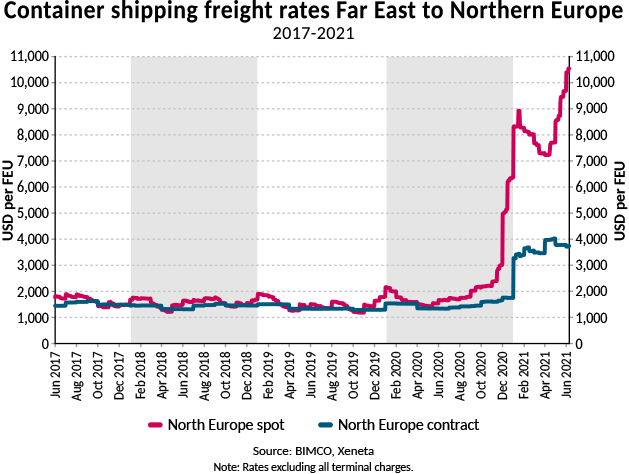
This is despite volumes on this trade being up by only 1.0% in the first four months of 2021 compared to pre-pandemic 2019, an increase of just under 60,000 TEU. The wider supply chain crunch as well as the global pressure on container shipping, equipment shortages and disruptions such as the blockage of the Suez Canal and COVID-19 disruption at major Chinese ports are behind the moderate increase.

Long term contract rates have also risen to record high levels, with carriers locking in long term contracts at USD 3,836 per FEU.

Despite having to pay record high freight rates for some shippers, the bigger worry is reliability. The high demand for container shipping this year has meant more cargoes being rolled over and shippers finding it harder than ever to secure a spot for their box(es) on the desired sailing. While the shippers that are most valuable to carriers are escaping from these record high freight rates, others are paying thousands of dollars in surcharges, and even this is often not enough to secure space on already fully booked ships.

Growth slowing, but bauxite exports still record high in Africa

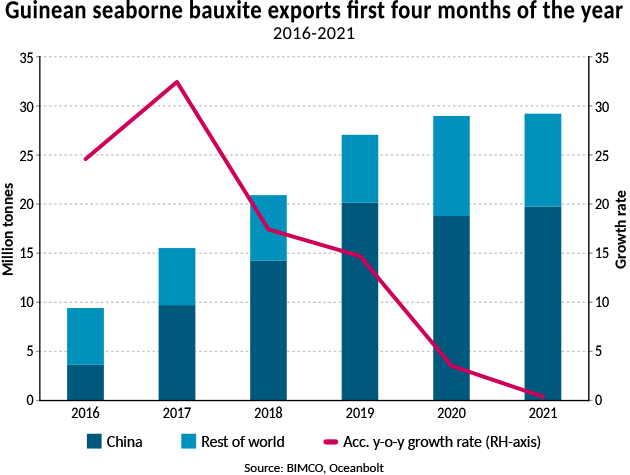
Moving south and back into dry bulk, one of Africa’s largest exports is bauxite, with Guinea alone accounting for more than half of global seaborne bauxite exports in 2020. These too have been record-high since the start of the year, reaching 29.2m tonnes in the first four months of the year, slightly up from the previous record set in the first four months of 2020 of 29.0m tonnes. So far this year, 258 journeys have been started in Guinea carrying bauxite, 141 of which are Capesize ships.

The largest buyer of Guinean bauxite is China, which has taken 19.7m tonnes, and although this is an increase from 2020, it is not record high as Guinean bauxite exports to China in the first four months of 2019 reached 20.2m tonnes.

Despite the record high volume, the growth rate so far this year is in fact the lowest it has been since this trade was established, coming in at just 0.8%. The growth rate has tapered off markedly since it peaked in 2017 when it grew by 64.8% in the first four months of that year compared with the same period in 2016.
However, the wider dry bulk industry is relatively isolated from both positive and negative developments on the dominant Guinea to China trade as the majority of the volumes are carried on purposed-built and long-term leased ships.

After a slow start; South America is exporting soya beans like never before

Across the South Atlantic, after a slow start to the year, Brazilian soya bean exports during April and May were the two strongest months on record. In both months, seaborne exports came in above 16.3m tonnes, compared to the previous record of 14.8m tonnes set in April 2020.
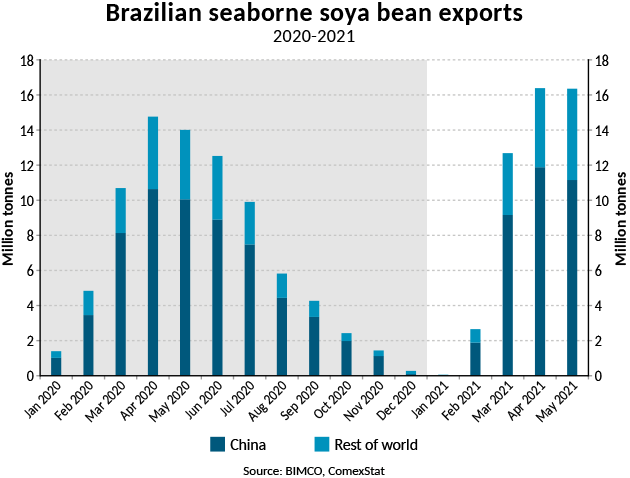
The slow start to the year means that the two months of record high imports has brought accumulated year-on-year growth in the first five months of the year up to “only” 5.3%, although at 48.1m tonnes, this is still the highest start to the year on record. Of these total exports, around 70% are sent to China, equivalent to 455 Panamax loads of 75,000 tonnes.

Many records to be found in North America, but one stands out

A record high soya bean export season can also be found in the US. When looking at this continent, one record cannot be ignored, as it is the primary driver behind the current highs of the container market.

North American container imports are up by 33.6% in the first four months of the year, reaching 10.9m TEU. This is the first time they have exceeded 10m TEU in the first third of the year. Accounting for almost 70% of total North American imports, imports from the Far East have grown by 45.0% from last year as consumer demand for goods made in the Far East has reached record highs, thanks to stay-at-home orders and government stimulus checks burning holes in consumers’ pockets.

Even adjusting for the pandemic, volumes on the Far East to North America trade are up by an impressive 31.4% from the first four months of 2019, an increase of 1.8m TEU. This means an extra 120 fully loaded 15,000 TEU ships were needed during the first four months of this year compared to demand in 2019 on this trade alone, a task not only for carriers to meet, but also for ports and hinterland connections. The latter two have proved particularly problematic in the US.

Almost 60% of the extra TEUs transported globally in the first four months of 2021 compared to the same period in 2019 have been imported by the US. The latter has seen total imports rise by 2.1m TEU, compared to the 3.6m TEU that global volumes have increased by. If you remove US imports from the picture, global growth in container volumes from 2019 falls from 6.7% to 3.3% in the first four months of the year.

Completing the round trip, record amounts of air

The combination of record high container imports and US exports still struggling to reach pre-pandemic levels, the number of empty containers being sent on the backhaul transpacific trade is growing even faster than the already impressive growth in loaded imports.

Compared to the first four months of 2019, the US West Coast has exported 62.5% more empty containers than it did last year, with 2.9m boxes being loaded onto ships, the highest ever four-month period. This is 1.8 times more than the number of loaded containers being exported. These empty boxes are being returned to Asia as fast as they can, as Asian exporters wait for them to return so that the cycle can start again.

Back to Asia to find one of the few tanker shipping records around

Unlike dry bulk and container shipping, tanker shipping made its money last year, and is still suffering the consequences of lower global oil demand. However, no trip around the shipping world is complete without tankers, and few and far between, some records can be found. In fact, back in China (the world’s largest crude oil importer) 2021 has been the strongest year for crude oil imports ever. In the first five months of this year, China imported 220.5m tonnes of crude oil (source: GACC), compared to 215.6m tonnes imported in 2020.

Although a record, the growth rate has slowed markedly from previous years when it was close to 10%. Instead, compared to the first five months of 2020, Chinese crude oil imports are up 2.3%, and as the year progresses, it is unlikely volumes will keep posting growth compared to 2020, due to the oil price war. Chinese imports of crude oil peaked in June and July 2020 above 50m tonnes per month, but volumes this year are unlikely to reach those levels.
Source: BIMCO, By Peter Sand, Chief Shipping Analyst


SOURCE READ THE FULL ARTICLE

https://www.hellenicshippingnews.com/around-the-world-in-seven-shipping-records/


The shipping industry needs to look past zero carbon fuels to decarbonise the sector. ‘Circularity’ and ‘servitisation’ could be the new buzzwords to watch for, according to Danish Ship Finance (DSF).


In its latest Shipping Market Review, DSF offers up the idea of consolidated fleets of super standardised vessels as an attractive business case for circular maintenance where spare parts can be remanufactured, reused and recycled multiple times to save costs and reduce the environmental footprint.

The servitisation model – which DSF defines as where equipment manufacturers extend their business to include the use of their equipment instead of selling it – allows for optimal data extraction from the standardised fleet of vessels, which in turn allows the equipment manufacturer to improve performance and optimise the vessel.

DSF acknowledges that circular maintenance is not a new notion with some vehicle and industrial plant manufacturers employing the same to refurbish, reuse and recycle their used products and parts. But combine this circularity with the standardised fleet concept and vessels can be provided as a service at a fixed, all-inclusive price per minute with circular maintenance lowering costs. With an eye on the far horizon, DSF notes that all elements of a vessel, its maintenance and its demolition could be designed for circularity, with all materials and components designed to be recycled, remanufactured and reused.

The vessel-as-a-service concept opens up new value drivers for operators

Market models

But this level of change will not happen overnight. “This kind of change will require not only shipowners but also equipment manufacturers to change their go-to market model to one that sells ‘time in traffic’ rather than a product,” DSF said. Currently, most vessels are operated under a business model where “the asset play guides decision making”, it added. Therefore, retrofits and operational upgrades are only done if they deliver immediate cost savings without the need for long payback investments. An asset play model seeks to take advantage of short-term market imbalances, whereas DSF’s proposed servitisation model aims to improve the long term efficiency of the assets. “The servitisation model allows investments with long repayment periods to be made maybe even stretching to the next lifetime,” said DSF.

Another benefit of the servitisation model is that the risk of stranded assets is reduced because equipment manufacturers can upgrade the performance of a vessel when needed – as long as those upgrades do not increase the cost of its use.

DSF spins out this model even further, suggesting that vessel ownership could be aggregated across fewer entities, even across ship segments. “Vessel operation could remain fragmented but may over time consolidate in line with the application of new technologies that are likely to reduce margins and increase competition,” it said.

The vessel-as-a-service concept opens up new value drivers for operators. Whereas traditional players generate income through freight rates alone, those utilising this new business model can also generate revenue from trading zero carbon fuels and data from vessel operation. “Traditional players may struggle to compete on costs, since the new players can reduce costs via circular maintenance and economies of scale while offering additional services through the advanced vessel connectivity system that has been scaled across the centralised ownership base,” said DSF.

Shared ownership

Building on the centralised ownership model proposal, DSF asks whether there is potential in a scenario where individual operators book cargo transportation on vessels shared between many to optimise capacity utilisation and reduce their environmental footprint. “Experience from other industries (the telecommunications industry, for example) suggests that structural separation can allow more value to be created if infrastructure sharing allows massive scaling on a larger customer base,” it says.

The success of alliances and pools already alludes to the potential here. This next step will support an asset owners’ ability to scale and harvest economies of scale through standardisation, allowing them to establish a critical asset base that allows major investments in new digital technologies.

“Initial investments will be aimed at increasing operational efficiency and routing (in order to lower fuel consumption), but the focus will soon shift to moving into adjacent domains to establish a platform-based ecosystem play that orchestrates data driven insights across supply chains to optimise value creation and develop new revenue streams,” said DSF.

The overarching aim here is to create a “fully integrated transport as a service transit system that includes a digital platform, access to the latest cargo mobility offerings, incentives (eg lower costs, zero carbon mobility, transparency), and measurement tools (including CO2 to ensure that all transport services are running at full efficiency”.

DSF points to experience from other industries to support its theory that a service model that is fuelled by the data from operating the standardised asset base could become at least as valuable as asset operation itself. “The vessel as a service model will allow players to focus on data monetisation throughout the lifecycle of vessels through recurring revenues and paid over the air upgrades, which may eventually include those related to autonomous vessel capabilities,” DSF said. “In today’s market, the absence of an established ecosystem often results in hard to scale island solutions between few players, which end up generating significantly less value than they would have done with a scaled solution.”
Source: The Baltic Briefing


SOURCE READ THE FULL ARTICLE

https://www.hellenicshippingnews.com/green-shipping-calls-for-a-holistic-approach/


Company DETAILS

SHIP IP LTD
VAT:BG 202572176
Rakovski STR.145
Sofia,
Bulgaria
Phone ( +359) 24929284
E-mail: sales(at)shipip.com

ISO 9001:2015 CERTIFIED