On Monday, Eastern Shipbuilding Group (ESG) held the keel authentication ceremony for the next U.S. Coast Guard Offshore Patrol Cutter (OPC), USCGC Chase. Admiral Karl Schultz, commandant of the U.S. Coast Guard, and Rep. Lucille Roybal-Allard (CA-40), House Homeland Security Appropriations Subcommittee Chair and ship sponsor, delivered remarks to mark the occasion.

“Here at Eastern we start each day with the recognition that we are building a new era of cutters for the young women and men of the United States Coast Guard who will sail in them on critical National Security missions for decades to come. From our thirteen hundred family members to your nearly 60,000 active duty, reserve, and civilian workforce . . . our pledge remains the same – these cutters will always get you home,” said ESG President Joey D’Isernia.

The cutter honors previous namesake vessels including those named after Salmon Portland Chase, former chief justice of the U.S. Supreme Court, governor, and antislavery leader.

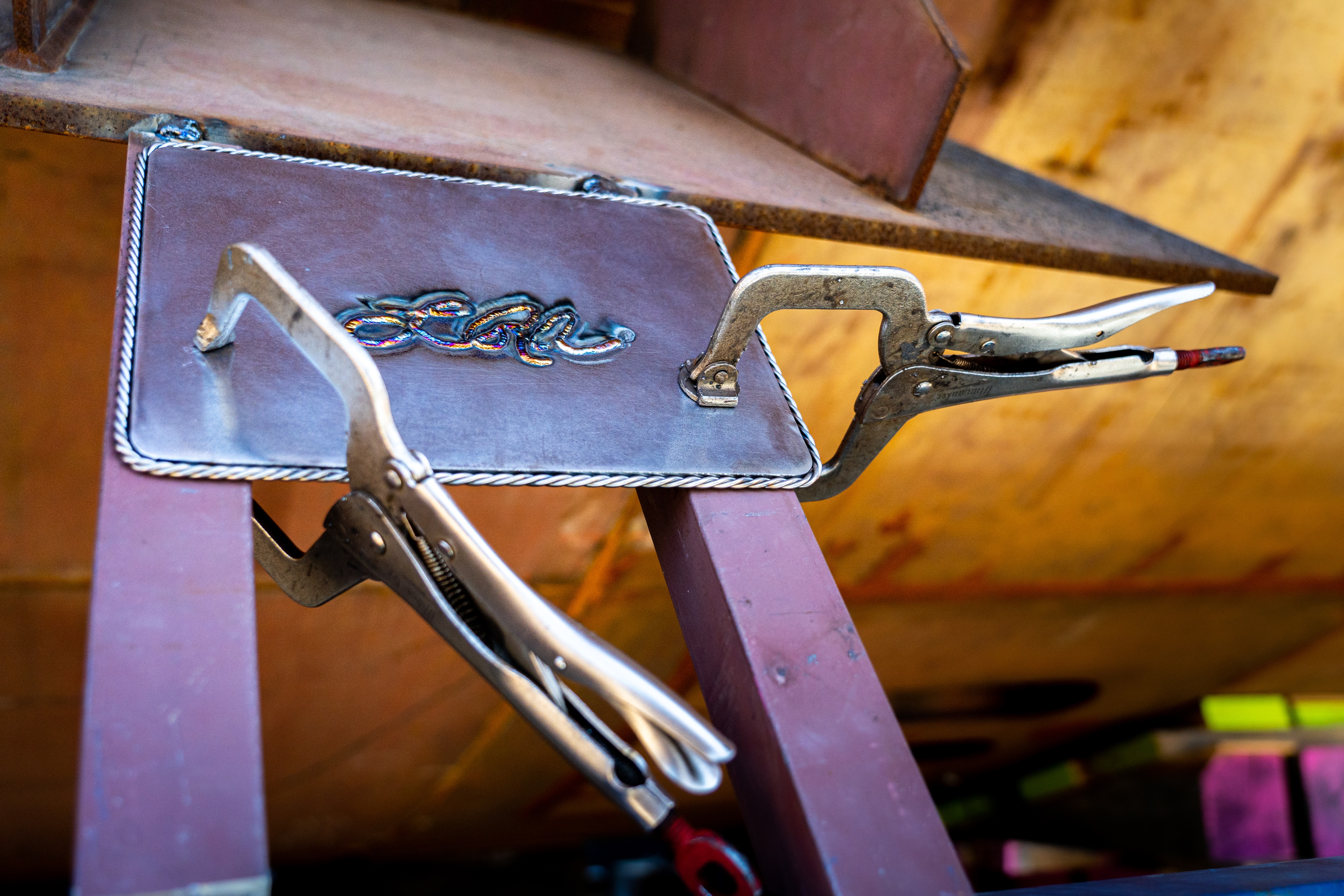
Image courtesy Adm. Karl Schultz / USCG

The keel-laying ceremony represents the start of a ship’s life by commemorating the assembly of the first modular construction units. Historically, to attest that the keel was properly laid, the shipbuilder would carve their initials into the keel. This practice is commemorated today by welding the ship’s sponsor’s initials into the keel authentication plate.

Last month, ESG was awarded a contract to begin construction of the third hull in the OPC series, the future USCGC Ingham, and to purchase long-lead-time materials for the fourth hull. The OPC – the Coast Guard’s largest single procurement program in history – fills a niche between the national security cutter, which is designed for long range open ocean missions, and the fast response cutter, which serves a patrol and SAR function closer to shore.


SOURCE READ THE FULL ARTICLE https://www.maritime-executive.com/article/esg-holds-keel-laying-for-second-offshore-patrol-cutter


In an effort to enhance the efficiency of its shipbuilding operations, and possibly develop new business opportunities, Italy’s Fincantieri signed a letter of intent with Italian robotics company Comau to develop robotic and other solutions for shipbuilding and other heavy construction applications.  The companies will work together to develop and test the new applications at Fincantieri’s shipyards.

The focus of the effort will be on the development of prototypes and the manufacturing of advanced robotics capable of handling steel welding projects first at the shipyard. Common in other industries, robotics has become a widely used tool in assembly line manufacturing handling tasks such as welding for the automotive industry. The partnership will draw on Comau’s experience with these applications. Comau, an industrial automatic and robotics company, is currently a part of automaker Stellantis and traces its origins to the 1970s developing robotics for the automotive industry.

According to the companies that have already begun work on developing a welding robot vehicle consisting of an anthropomorphic welding robot and a remote control tracked vehicle. Tests are scheduled to begin at the Fincantieri shipyards by the first half of 2022.

“This partnership is an important innovation for the shipbuilding industry,” said Fincantieri General Manager, Fabio Gallia. “Apart from improving the safety of workers and their ergonomic working conditions, these solutions will enable great progress in pursuing the competitiveness of our production system. Moreover, looking to the future, the possibility of developing projects together with Comau is a great opportunity to further broaden the Group’s range of competencies.”

Under the agreement between the companies, Fincantieri and Comau will be co-owners of the know-how and intellectual property generated while developing the new concepts. At a later stage, they will explore the possibility of marketing welding products both to the shipbuilding industry and other related industries based on the designs developed. For example, they said they believed the technologies could be applied in the production of large-size steel products for infrastructure and special works (e.g. continuous structures for suspension bridges, structures for large-size hoisting systems, products for special constructions).

The companies have also agreed to consider and examine new opportunities to create innovative solutions within the broader scope of a digital factory.

Comau became part of Stellantis as part of the merger of Fiat Chrysler and PSA, the owner of Peugeot. The company has been working to expand its applications into other industries while Stellantis announced that it expects to spinoff Comau in the future


SOURCE READ THE FULL ARTICLE https://www.maritime-executive.com/article/fincantieri-and-comau-develop-steel-welding-robotics-for-shipbuilding


German shipbuilding association VSM is warning of the risk of an “irreversible loss” of skill in the country’s powerhouse marine equipment and shipyard sectors due to distortions in international competition. Without government intervention at the national and EU level, warned VSM, Germany’s yards run the risk of significant decline over the next decade.

Like others, German shipbuilders have been losing ground to Asian competitors for general-purpose merchant vessels for many years, and the sector has been sustained by specialization in cruise, yacht and defense contracts – so-called “complex shipbuilding” for highly-engineered vessels and high-end systems.

In recent years, Asian yards have begun to peel off European ro/ro and ferry orders as well, leaning on subsidies and “massive distortions of competition” to secure business. The same “protectionist tendencies” are also being seen in the equipment supply sector, VSM warned. This has significant implications for the German maritime economy as a whole, which accounts for about 200,000 direct jobs.

“As a German medium-sized company, you cannot counter strategic action by the Chinese state. That is why we need an active policy. With the previous [German government] framework conditions, there is a risk of irreversible loss of essential shipbuilding skills,” said Harald Fassmer, president of VSM and managing director of shipbuilder and supplier Fassmer.

The COVID-19 pandemic and the cruise industry shutdown have brought these vulnerabilities into focus, VSM said, because the disappearance of cruise ordering activity has made the absence of orders in other segments more evident.

“European shipbuilding has been losing market share for decades, because predatory competition is practiced with massive subsidies, especially in Asia, and Europe is not doing anything about it,” said Bernard Meyer, managing director of Meyer Werft. “That is why the question is now whether the civil shipbuilding industry in Germany and Europe will be able to survive to a significant extent in ten years’ time.”

To address the threat, VSM called for “a consistent response at the national and European level” and a fundamental rethink of the framework conditions for European shipbuilding, with the objective of restoring a level playing field.

“The European Union has the largest single maritime market in the world. The geography of our continent provides for an abundance of economic activities on and under the water. That is why we in Europe have the power to optimally use our entire range of maritime capabilities for growth and sustainability,” said VSM managing director Reinhard Lüken.

The warning comes several days in advance of a parliamentary hearing on the maritime economy, accompanied by the release of a German government report on the status of the sector. The report echoes VSM’s concerns, warning of a growing risk of Chinese state-backed competition. “Aggressive competitors from Asia threaten not only Germany as a maritime location, but Europe as a whole. In particular, the Chinese strategy of top subsidies threatens the cruise ship building market segment – as in the past with freight, container or tankers,” notes the report. “With the ‘Made-In-China 2025’ strategy, China is also aiming for the top position in global competition in high-tech shipbuilding.”


SOURCE READ THE FULL ARTICLE https://www.maritime-executive.com/article/vms-asian-shipbuilding-subsidies-put-german-shipyards-at-risk


Shipowners and shipbuilders are working on new ways to leverage emerging technologies to enhance operations in the shipping industry. In the latest development, South Korean shipbuilder Hyundai Heavy Industries Group announced that it has succeeded in developing an artificial intelligence-based fire monitoring system. The system, which is another step toward unmanned ships, also earned classification and flag state approvals.

During the ceremony marking the approvals from the Korean Registry and Liberia, an official of Hyundai Heavy Industries Group commented, “It is meaningful in that it is the first system in the shipbuilding industry to incorporate artificial intelligence into the ship safety management field.”

This system known as HiCams is a video analysis-based safety solution in which artificial intelligence monitors for fires aboard a ship. Artificial intelligence analyzes 20 CCTV images and using big data from the system installed in the machine areas of the ship, such as the engine room, and it can detect the initial stage of a fire from embers or smoke.

According to Hyundai, the improved precision of the system also reduces the possibility of frequent false alarms versus the existing fire detection sensors. Also, unlike conventional sensors that take about two minutes to detect fire, it can detect fire signs immediately. Combining image recognition and processing technology, ship interior and fire big data, and using advanced AI algorithms, the HiCams system accumulates information and learns from itself.

The technology has been approved by the Korean Register of Shipping and the Liberian Registry and was awarded and Approval-in-Principal (AIP) as the first AI-based system in the shipbuilding industry.

HHI also said that it plans to build on the technology to develop a broader range of ship safety applications. Starting with this fire monitoring system, HHI plans to build an AI-based integrated ship safety solution by developing a safety management system that monitors for other emergencies and conditions aboard the ship, including oil leaks, dampness, shifting cargo, and personal injuries.

Also using AI technologies, HHI last year developed the world’s first navigation assistance system HiNAS, a core technology for autonomous ships. They report that they are accelerating the efforts for next-generation smart ship technology by developing a digital twin-based virtual test drive solution.


SOURCE READ THE FULL ARTICLE https://www.maritime-executive.com/article/hhi-uses-ai-for-fire-monitoring-as-first-ai-safety-management-system


Turbine manufacturer MingYang Smart Energy has launched the first floating offshore wind tower ever built in China. The unit has been fully assembled at the company’s factory in Yangjiang, Guangzhou, a small port city about 130 miles southwest of Hong Kong.

Movement control technology has a significant role in the development of viable offshore floating wind systems, MingYang said – particularly in environments subjected to typhoons and extreme weather, like the South China Sea. Like all of the company’s designs, the new floating turbine is built to be highly typhoon-resistant.

“The MySE5.5MW floating turbine is a great example of what we can achieve by combining our existing offshore expertise to shape the integrated fully coupled time-domain simulation and modelling of [the] turbine-floater-mooring system,” the company said in a statement.

The first prototype will be towed out and installed at the China Three Gorges Yangxi Shapa III offshore wind farm as a technology demonstrator for testing. It will operate alongside 31 of Yangjiang’s 6.5 megawatt bottom-fixed offshore wind turbines.

As of the end of 2020, Chinese utilities have built out about six gigawatts of offshore wind capacity – about 95 percent of the total in all of Asia, according to Rystad Energy. Local manufacturers like MingYang control the majority of the supply chain for Chinese offshore wind developments, the consultancy said.


SOURCE READ THE FULL ARTICLE https://www.maritime-executive.com/article/mingyang-completes-china-s-first-floating-offshore-wind-platform


Pacific salmon are foundation species to British Columbia’s coastal ecosystem, and have been a key source of nutrients and energy to some of Canada’s most iconic species, including bears and killer whales, for thousands of years. More recently, they have shared their waters with net pens filled with non-native Atlantic salmon that are being farmed for food.

Some wild Pacific salmon populations have been in sharp decline since the early 1990s. For example, more than half of all Chinook salmon populations in southern B.C. are endangered or threatened. For decades, scientists have been trying to pinpoint the exact causes of these declines.

Southern resident killer whales also live in the area, and have been listed as endangered since 2005. These killer whales feed primarily on Chinook salmon, whose shrinking populations are contributing to the decline of these endangered killer whales.

In an effort to try and understand what might be driving these declines, scientists like myself are investigating if the growing number of salmon farms off the B.C. coast may play a role. We’re concerned that pathogens may be spilling over from farmed salmon to wild salmon and contributing to these widespread declines.

In a new study published in Science Advances, we found that a salmon virus that is common on fish farms was introduced to southern B.C. roughly 30 years ago and is continually transmitted between farmed and wild salmon.

Fish farms and the risk of virus spillover

The large number and density of Atlantic salmon within fish farming operations means they have a high risk of developing disease. Since viruses and other infectious agents are commonly found on salmon farms, some scientists have gone as far as to refer to them as “pathogen culture facilities.” Environmental groups and industry regularly debate whether these pathogens spillover and cause disease in wild fish populations.

One of the most discussed viruses is Piscine orthoreovirus (PRV). PRV is common in salmon farming operations and causes heart disease in Atlantic salmon. Yet government and industry groups maintain that PRV is “endemic to B.C.” and poses “no more than a minimal risk” to Fraser River sockeye salmon. The report’s conclusions are often erroneously extrapolated to all species.

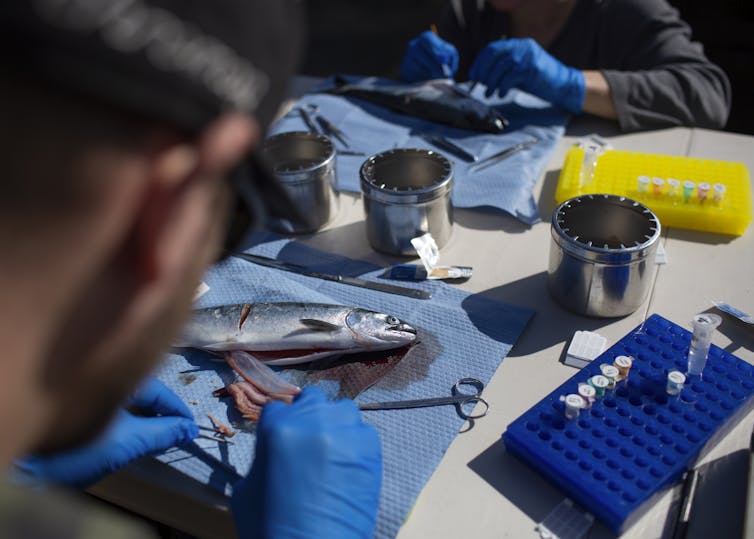
Scientists dissect wild Pacific salmon tissues for molecular analysis and to sequence viral genomes. (Amy Romer), Author provided

The word “endemic” has two meanings. Ecologists use it to describe plants and animals native to a region. But epidemiologists use it to refer to a continual and stable presence of an infectious agent in a defined area. Regardless of the intended meaning, our analysis found that neither is true.

Viruses leave a genetic fingerprint

Genome sequencing can be used to monitor the evolution of a virus — as we’ve seen during the SARS-CoV-2 pandemic. We applied the same techniques to track the paths of different lineages of PRV at different scales, between oceans, but also locally, between different populations of salmon off the coast of B.C.

Mutation rates of viruses are high, and over time, their genomes accumulate genetic differences. These changes to the genome make it possible to understand the origin and dispersal of viruses sampled from different locations.

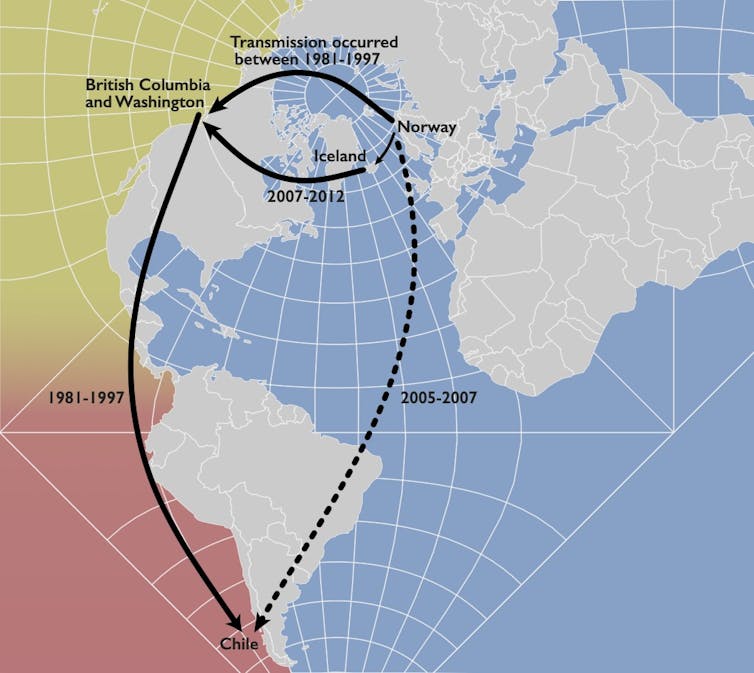
A PRV lineage found commonly in the North East Pacific came from the North Atlantic. We estimate that it was first introduced to coastal B.C. waters relatively recently, approximately 30 years ago. This matches the timing of Atlantic salmon egg imports from Europe to B.C., which helped kick off salmon farming in the province.

Global transmission of Piscine orthoreovirus. (Gideon Mordecai), Author provided

Two lines of evidence point strongly to the transmission of the virus between farmed and wild salmon. Wild Chinook salmon were more likely to be infected with PRV when they were closer to salmon farms. And a genomic analysis found that farmed and wild salmon share the same viral variants, suggesting continual transmission.

Further analysis of the PRV genomes in B.C. waters indicate that the number of PRV infections in the region has increased by two orders of magnitude over the last two decades, a pattern that aligns with the regional growth in farms, where nearly all of the fish become infected.

All variants of the virus, including the type of PRV found in B.C., cause heart lesions in Atlantic salmon. Research in B.C. has found the same disease associated with PRV on Atlantic salmon farms.

Same virus, different disease

More importantly to the ecology of B.C., PRV has been linked to a different disease in Pacific salmon. In Chinook salmon, PRV is associated with “jaundice/anemia,” a disease that is the result of red blood cells bursting, leading to liver and kidney damage.

Despite the evidence linking PRV to disease in both Atlantic and Chinook salmon, the Department of Fisheries and Oceans (DFO) does not classify PRV as a disease agent. This enables the ocean-based fish farms to be stocked with fish infected with the virus.

Our findings show that salmon farms are a source of infection for wild fish. The research provides evidence that supports growing calls to minimize the interactions between salmon farming and wild fish. Given that DFO’s science and decision-making are not independent, I believe that the regulation of the aquaculture industry should be separated from DFO’s responsibility to protect wild salmon.

Disease interactions with farmed fish impact not only the health of wild salmon, but all that rely on them — including the endangered southern resident killer whale. With so many factors at play, conserving salmon is a daunting process. But a small increase in the survival of juvenile salmon that migrate from rivers out to the open ocean can result in millions more adult salmon returning to their natal spawning grounds, a vital resource to both the ecology and people within coastal British Columbia.

Gideon Mordecai is a postdoctoral fellow at the Department of Medicine at University of British Columbia. 

This article appears courtesy of The Conversation and may be found in its original form here


SOURCE READ THE FULL ARTICLE https://www.maritime-executive.com/editorials/study-virus-from-fish-farms-affects-b-c-s-wild-chinook-salmon


Almost inadvertently, US energy security has been threatened by a ransomware attack which demonstrated dramatically how the consequences of such hacks are escalating.

This one probably won’t be the worst, but it will change the way governments respond to ransomware.

Colonial Pipeline carries gasoline, diesel and jet fuel from Houston to New York, with an array of branch lines servicing states across the eastern seaboard of the US. On Saturday May 8, Colonial announced that it had been the victim of a ransomware attack and that to contain the threat it “proactively took certain systems offline,” which “temporarily halted all pipeline operations.”

In a sense that highlights critical infrastructure’s vulnerability. The halt to pipeline operations was entirely unintended by those who carried out the ransomware attack and the operational disruption was “collateral damage.”

The hackers did not target the pipeline’s industrial control systems to deliberately stop the flow of oil. Colonial itself shut down systems to prevent further spread of malware. This disruption would likely have been far worse had the group intended to disrupt the pipeline.

As the shutdown continued over several days, petrol prices surged, service station queues lengthened, customers hoarded fuel as pumps ran dry and the US Consumer Product Safety Commission warned people to “not fill plastic bags with gasoline.” The US Department of Transportation temporarily loosened road transport rules to allow more road-based shipment of fuel as concern over shortages escalated within government.

By Monday May 10, the FBI announced that DarkSide ransomware was responsible for the Colonial hack.

DarkSide operates on a “ransomware as a service” business model, providing centralized services that their “affiliates” can use to extort money from victim organizations. The affiliates conduct the operations, but DarkSide receives a 10–25 percent cut of the ransom. Services fundamental to running ransomware operations include payment servers, encryption and decryption tools to lock and unlock victim data, and a blog to claim responsibility, advertise hacks and pressure companies.

But beyond ransomware, DarkSide affiliates also steal data and threaten to leak it. As victims with good backups may still be motivated by the threat of sensitive data being leaked, this second method of extortion is increasingly common among ransomware gangs. In these instances, DarkSide would collect and store victim data on staging servers.

Other services were even more innovative. It appears that DarkSide was also willing to let paying customers know when they’d hacked publicly listed companies ahead of their blog announcements, presumably so they could short sell stocks ahead of the news of a ransomware attack.

While they were developing a portfolio of extortion tools and tactics, DarkSide was also attempting to manage its reputation to avoid attracting law enforcement attention. It stated that it would not attack medical facilities, schools and universities, non-profits, governments and the funeral sector.

There’s good evidence that the criminals are Russian. They recruit Russian-speaking affiliates and advertise on Russian language forums, they don’t attack the former Soviet republics of the Commonwealth of Independent States and their malware won’t attack devices with Russian language settings.

In the aftermath of the Colonial Pipeline hack, DarkSide issued a statement saying:

We are apolitical, we do not participate in geopolitics, do not need to tie us with a defined government and look for other our motives. Our goal is to make money, and not creating problems for society. From today we introduce moderation and check each company that our partners want to encrypt to avoid social consequences in the future.

In part this seems to be an attempt to distance DarkSide from the Russian government; parts of Eastern Europe and Russia are a permissive environment where cyber criminals are tolerated, but if gangs start to cause geopolitical problems local law enforcement could suddenly become motivated to act.

And diplomatic pressure is being applied. US President Joe Biden said that although he didn’t believe the Russian government was involved, the criminals were Russian. “We have been in direct communication with Moscow about the imperative for responsible countries to take decisive action against these ransomware networks,” Biden said.

Within a day of discovering the attack the CEO of Colonial Pipeline had decided to pay the ransom, saying later that “it was the right thing to do for the country.” The pipeline returned to full operation within the week, although the decryption tool was reportedly so slow that Colonial continued to restore from backups.

Paying ransoms is clearly undesirable from a public policy point of view—it encourages further ransomware attacks and funds the evolution of the ransomware ecosystem. Yet at the same time ransom negotiations will settle on a price where the cost–benefit of paying can be justified and there are many situations where payment is clearly in the best interests of stakeholders.

But cyber insurance should not be used to pay ransoms. Unlike many other types of insurance, cyber insurance deals with a human adversary and the threat is rapidly evolving. Current practice is a vicious circle where insurance payouts encourage and fund improved ransomware which extracts more insurance payouts. Perversely, ransomware hackers will search for their victims’ insurance policies and then use the insured amount to set ransom demands.

In total, DarkSide appears to have extracted at least $90 million in ransoms since August, and more than $9 million in the month of May alone. That was made up of $4.4 million from a chemical distribution company and $5 million from Colonial Pipeline. With increasing attention—Biden said the US would “pursue a measure to disrupt their ability to operate” – the sum seems to have been enough for the hackers.

The day after Biden’s statement the DarkSide hackers said they’d lost access to their infrastructure including their blog and payment servers and would be shutting their service. Lightning-fast US retaliatory action seems unlikely given the time required to prepare for a cyber operation, and the DarkSide crew may simply have taken the money instead of paying their affiliates.

In the short term, DarkSide may have disappeared but, given the sheer volume of money available, other criminals will fill the void. Beyond improving defences, this story also shows that a promising approach is to focus on the ransomware ecosystem and its incentives.

DarkSide and similar groups actively try to avoid law enforcement attention and minimize associations with the state in which they operate. Western nations need to align diplomatic, intelligence and law enforcement efforts to make it much harder for ransomware crews to operate with impunity.

Tom Uren is a senior analyst in ASPI’s International Cyber Policy Centre. This article appears courtesy of The Strategist and may be found in its original form


SOURCE READ THE FULL ARTICLE https://www.maritime-executive.com/editorials/colonial-pipeline-cyberattack-exposes-serious-vulnerabilities
Cdre Jude Terry Makes History as Royal Navy’s First Female Admiral

For the first time in the centuries-long history of the Royal Navy, a female officer will be appointed to the rank of admiral. Commodore Jude Terry, who has served for nearly a quarter of a century, has been selected for promotion to rear admiral – making her the most senior woman in the Royal Navy, past or present.

She will be responsible for sailors and Royal Marines from the moment they are recruited to their final day in Service – spanning their entire careers by overseeing training, welfare and career management.

The 47-year-old will be promoted to rear admiral next year and take over as the Royal Navy’s Director of People and Training and Naval Secretary. Of making history she says simply, “someone has to be first.”

“I have always thought of myself as a naval officer first, then a logistics officer, then Jude and finally as a female. The Navy genuinely doesn’t look at your gender and is an equal opportunities employer – it wants you to be part of a team and deliver outputs to support operations,” she says.

“I have been really lucky throughout my career. I’ve enjoyed great jobs, wonderful support from my family, worked with great people, seized the opportunity to see the world and contribute to a number of operations which have made a difference to people’s lives including Afghanistan, Somalia and Sierra Leone to name a few.”

She currently serves as deputy director of the department she is earmarked to take over, with the goal of helping to shape the Royal Navy and its people up to 2040.

“I am delighted with Commodore Jude Terry’s selection for promotion to Rear Admiral,” said First Sea Lord Admiral Tony Radakin. “Jude is part of a cohort of trailblazers in the Royal Navy who have seized the opportunities on offer and risen to the top. This builds on a rich career of naval and broader Defence appointments, all of which she has excelled at.”

Terry has spent the bulk of her seagoing career in Plymouth-based warships, including survey vessel HMS Scott and two spells with helicopter carrier HMS Ocean.

Of her 12-month second draft to HMS Ocean she spent ten away from the UK in the Baltic and Gulf, and she was responsible for working with a documentary team producing the series Warship for BBC Channel 4.

Her career has taken her to the Gulf and Middle East, Indian Ocean, Far East and the Caribbean. Commodore Terry was awarded the Order of the British Empire (OBE) in the New Year’s Honours List in 2017 for her efforts during three years at the UK military’s operational hub, Permanent Joint Headquarters, during which she was involved in the end of Britain’s front-line operations in Afghanistan, overseeing the closure of bases at Lashkar Gar, Bastion and Kandahar, and the successful efforts to curb the spread of the Ebola virus in west Africa in 2014 – 2015.


SOURCE READ THE FULL ARTICLE https://www.maritime-executive.com/editorials/royal-navy-appoints-its-first-female-admiral


A court in Singapore has approved a prosecutor’s request to freeze the assets of Lim Oon Kuin (also known as O.K. Lim) and his family as litigation continues over the alleged financial fraud at Lim’s businesses. The freeze covers an astonishing $3.5 billion in holdings, and it opens a path to further loss recovery for the creditors of oil trading house Hin Leong Trading, the linchpin in Lim’s former empire.

Lim’s business empire collapsed last year amidst allegations of fraud, and he has been charged with abetment of forgery. Singaporean prosecutors contend that he directed an executive at Hin Leong to falsify documents in order to obtain tens of millions of dollars in trade financing, then failed to repay the money. In May, prosecutors added 23 more charges against OK Lim in connection with allegedly fraudulent transactions with China Aviation Oil (Singapore), bringing the total to 25 counts.

According to PricewaterhouseCoopers, the court-appointed manager for Hin Leong Trading, the Lim family manipulated the firm’s books through irregular accounting entries in order to hide trading losses. The methods allegedly included overstating inventory and accumulating more debt by deceiving lenders, the same acts alleged in Singaporean prosecutors’ criminal suit. The misstatements made Hin Leong look profitable, and the company racked up about $3.5 billion in debt that it ultimately could not repay.

With creditors in control of Hin Leong and two related firms, Ocean Tankers and Xihe Capital, liquidation of Lim’s businesses is proceeding quickly. Despite the rapid-pace sales, however, creditors of Hin Leong have been able to recover less than a tenth of the total $3.5 million owed.

The new freeze seeks to preserve the Lim family’s personal assets for possible recovery, including the holdings of Lim’s son Lim Chee Meng and daughter Lim Huey Ching. The order requires the family to maintain holdings valued at $3.5 billion or more in Singapore. They may still trade or sell their assets – and even remove them from the country – so long as the total does not fall below that threshold, according to the court.


SOURCE READ THE FULL ARTICLE https://www.maritime-executive.com/article/court-freezes-3-5b-of-shipping-magnate-o-k-lim-s-personal-assets


A new study commissioned by Seas At Risk, an association of environmental organizations from across Europe, shows that microplastics in the marine environment come from numerous sources and economic sectors, and have widespread environmental impacts, including climate implications. Released in advance of the upcoming European Commission’s EU Green Week 2021. The study carried out by the Galway-Mayo Institute of Technology explores the sources and solutions for microplastics.

“Given the expected exponential increase of global plastic production, and the subsequent release of microplastics into the environment, it is vital to urgently prevent this pollution from escalating, and to avoid dramatic consequences on marine biodiversity, global ecosystems, and the climate,” says Frédérique Mongodin, Senior Marine Litter policy officer with Seas At Risk. “As certain types of plastics release more microplastics, toxic chemicals, and GHGs than others, choosing the right type of plastic and additives in the design phase can drastically reduce microplastic pollution. However, only the adoption of mandatory and targeted upstream measures at EU level will enable the necessary adjustments across sectors.”

Seas At Risk cites data that shows global plastic production has been increasing exponentially since the 1950s. It stood at over 200 million tons produced in 2000 increasing to 368 million tons in 2019. They cite a forecast that production will exceed 500 million tons by 2025 and 650 million by 2030.

The research looks at the sources of microplastics in the marine environment finding that personal care products that contain added microplastics, such as glitter, or microbeads found in scrubs, only constitute two percent of the total microplastics released into the marine environment. They contend that the majority of microplastics in the ocean are unintentionally added microplastics, and come from sources such as tire dust, synthetic textile fibers, city dust, and marine paints. Additional microplastics resulting from the degradation of larger plastic items at sea come from most economic sectors they report, including agriculture, construction, tourism, aquaculture, fisheries, and shipping.

Of all plastic entering the ocean, the report says that 94 percent ends up on the seabed, where it will take centuries to degrade, releasing chemicals, microplastics, and nanoplastics in the process, which are all harmful to both marine life and the ecosystem balance. The GMIT study says that microplastics also have implications for the climate, both by contributing to the emission of GHGs and by reducing the mitigation effects of the ocean against climate change.

Once exposed to solar radiation, certain types of plastics (mainly single-use plastics and packaging) undergo a gradual degradation and fragmentation process. This releases GHGs, such as methane and ethylene. Methane contributes to greenhouse gas effects 34 times more than carbon dioxide. With an expected increase of 33-36 percent in plastic production by 2025, emissions of methane are predicted to rise to exceed 100 million tons if no mitigation efforts are implemented.

The report says that the most concerning environmental impacts of microplastics contribute to the loss of biodiversity, with implications on the marine food webs, and threaten ecosystem balance. In the study, GMIT researchers identified concerns over the ingestion of microplastics by marine organisms and the bio-accumulation of hazardous substances by marine fauna and flora.

Depending on their characteristics, certain types of plastics release a much higher quantity of microplastics, toxic chemicals, or GHG emissions compared to others. Therefore, the solutions proposed in the study aim to prevent microplastic release at the source.

They are calling for banning specific types of plastics that are proven to release a high number of microplastics, such as synthetic foam polymers used in packaging and boxes as well as plastic mulch in agriculture and horticulture. They also say that mandatory eco-design requirements should be set for textiles at the design stage to gradually eliminate the most problematic fabrics and additives. They also propose the establishment of a maximum threshold for microplastic release by tires into the environment.

The study says that a ban on all non-essential single-use plastic products should be implemented to reduce microplastic pollution in the long term. Others steps should include phasing out potentially toxic additives and create an open-access database of plastic additives to provide information on the presence of chemicals in products.

Among the mandates that they propose governments enact are for the containment of plastic production and recycling facilities to prevent the release of pellets as well as best practice for the handling rules and regular staff training to prevent the loss of maritime containers and fishing gear at sea as this generates large quantities of secondary microplastics.

The complete report and recommendations is available on the Seas At Risk website.


SOURCE READ THE FULL ARTICLE https://www.maritime-executive.com/article/research-into-microplastics-in-the-maritime-environment


Company DETAILS

SHIP IP LTD
VAT:BG 202572176
Rakovski STR.145
Sofia,
Bulgaria
Phone ( +359) 24929284
E-mail: sales(at)shipip.com

ISO 9001:2015 CERTIFIED