America’s ports move approximately $5.4 trillion in goods annually, making them a unique target for cybercriminals. Protecting these transportation hubs is essential to preserving the supply chain and keeping the U.S. economy running.

More than 500 cyberattacks occurred in the marine industry in 2020, according to the U.S. Coast Guard. These exploits are aimed at both traditional port information technology systems and operational technology (OT) systems, which include the cranes, gantries, lifts and conveyance systems that move freight on and off ships.

The Coast Guard is the lead federal agency directly responsible for protecting America’s maritime transportation system. Its 2021 Cyber Strategic Outlook lays out specific responsibilities: “The U.S. Coast Guard will employ frameworks, standards and best practices in prevention and response activities to identify and manage cyber risks to the MTS. Within ports, the U.S. Coast Guard’s Captains of the Port will lead governance by promoting cyber risk management, accountability, and the development and implementation of unified response plans.”

The Coast Guard works directly with state and local governments in support of these duties, and more specifically with port authorities, which ultimately hold responsibility for the cybersecurity defenses of their regional seaports.

What Cybersecurity Vulnerabilities Do Maritime Facilities Face?

Seaports face familiar types of electronic assault: scanning, ransomware, malware, spear phishing and credential harvesting. In 2017, the shipping giant Maersk was laid low by the NotPetya worm, which scrambled the company’s IT and communications systems for two weeks, marking the largest maritime cybersecurity incident in recent years. That affected 76 ports across the globe, including the Port of Los Angeles, and 800 ships. In the end, the hack cost the company $300 million.

However, the Maersk attack was hardly the first. In 2011, the Belgian Port of Antwerp Bruges got hit by drug cartel hackers who surreptitiously took over the tracking of containers carrying hidden cocaine and heroin. The intruders accessed secure data giving them the location and security details of the steel boxes. That allowed the cartel to direct truck drivers to snatch them up before the legitimate owners of the cargo arrived. Port operators only got wise to the situation when they noticed containers inexplicably disappearing.

Seaports are complex facilities. While there is ample awareness of traditional IT vulnerabilities to networks, data and proprietary information, protection on the operational side is far behind, say experts. That includes cranes and container management systems, fuel terminals, shipboard controls, navigation systems, buoys, HVAC controls and more. Many are often creaky machines that have ancient, rudimentary electronic control systems.

“Operational technology is the most valuable thing in the network, and lives can be lost” without good oversight, says Rick Tiene, vice president with Mission Secure, Inc. The challenge is that the programmable logic control (PLC) boxes on maritime machinery are like 20-year-old computers, he says. “It’s a device that has an IP in/out and amps in/out.”

It’s so basic that cybersecurity technology can’t be added to it. Instead, Tiene’s company puts a protection envelope around PLCs.

“We put protection above it and below it,” he says. Practically speaking, that means monitoring the boxes for unusual power spikes that could indicate a cyber intruder has gained control.

A key strategy for security is to try and make it as transparent to the user as possible.”

Billy Marsh CISO, Port of San Diego

How Do Ports Establish Maritime Cybersecurity Initiatives?

“OT is where you have higher risk exposure,” says Ian Bramson, global head of industrial cybersecurity for ABS Group. He adds that OT networks tend to be rickety and layered for years, and they require careful monitoring.

Ransomware may cost money, but monkeying with the valves of a fuel depot or the controls of a crane could be catastrophic. Ships are no less vulnerable. The scariest scenario is the cyber takeover of the ballast control system in a large ship, causing it to capsize and sink. While that hasn’t happened yet, Coast Guard and academic hackers have proven it’s possible, and Iran reportedly included the exploit in plans to disrupt fuel shipments.

The first thing a port needs to do to secure its OT system is to do an asset inventory, Bramson says. Then, a vulnerability assessment is needed to find holes. Next comes monitoring to see whether anyone else is already in the network. Is there any visibility in this area? “You have to get a vendor that knows OT,” he says.

ABS Group is technology-agnostic, but Bramson recommends such companies as Tenable and Claroty Cyber Assurance. There’s also the National Institute of Standards and Technology’s Cybersecurity Framework which is used by many companies to assess risk. It focuses on five areas: protect, detect, identify, respond and recover.

Tiene warns that paper assessments are not enough. Checking boxes to satisfy the top brass or standards organizations doesn’t equate to tangible cybersecurity.

“If that will get you a pass, they do the least they have to do,” he says. The margins in the maritime industry are thin. “Companies are reluctant to spend money on cybersecurity if the competition doesn’t have to.”

What Are Elements of a Strong Maritime Cybersecurity Initiative?

The Port of San Diego has dedicated cybersecurity staff to monitor, track and respond to threats, says Billy Marsh, the port’s CISO. “We treat our OT systems with the same rigor as our IT systems, and then focus on the individual risk assessment of each system to provide additional layers of security.”

Marsh says it’s best to audit thoroughly and frequently. The port uses next-generation firewalls, advanced endpoint protection and ingress filtering, among other technologies.

“A key strategy for security is to try and make it as transparent to the user as possible. If it’s a pain point in the workflow, people will sometimes try to find ways around it,” Marsh says.

He also recommends a patching schedule that covers operating system updates as well as software updates, multifactor authentication, and an incident response and disaster recovery plan for when something inevitably occurs.

In January, the Port of Los Angeles opened the Cyber Resilience Center, created to improve readiness and enhance its threat-sharing and recovery capabilities among supply chain stakeholders. The group currently includes 20 unnamed partners, including cargo handlers, terminal operators, shipping lines, and trucking and rail companies.

The central challenge was making sure the partners can communicate from different platforms, says Kevin Albano, associate partner at IBM Security X-Force, which built the system. “They needed a central place where information could be understood, and it was a priority to focus in on shipping containers.”

In 2020, stakeholders at the Port of New York and New Jersey formed a similar maritime cybersecurity coalition to improve information sharing among port users. The group includes the Coast Guard and the Area Maritime Security Committee, vessel operators, marine terminal operators, and representatives of the energy and financial sectors.

Soure:https://statetechmagazine.com/article/2022/07/how-americas-ports-defend-against-cyberthreats

Congressman Alan Lowenthal and Congresswoman Nanette Barragán have co-sponsored and proposed the bill on 12 July.

The Clean Shipping Act of 2022 is modelled off of the European Union’s Fit for 55 regulatory framework for shipping.

The bill aims to clean up the shipping industry, protect the health of port communities, address environmental injustice, and provide solutions to the climate crisis – including eliminating carbon by 2040, and introduce mandatory requirements to eliminate in-port ship emissions by 2030.

READ: Port of Long Beach joins Green Shipping Corridor

“We no longer have the luxury of waiting to act,” said Congressman Lowenthal.

“We must face the fact that we are at a tipping point in the climate crisis; we must move beyond fossil fuels, and that includes air, land and sea transportation sources. No emissions sources can go overlooked.

“This legislation will set clear standards, and drive the investment and innovation we need to transition to a zero carbon future. It will clean up our ports once and for all, with a straightforward nationwide policy.

“This bill is the right policy for the future of our planet, for the health of our communities, and ultimately for the resiliency of goods movement.”

Upon approval, the bill would give the Environmental Protection Agency (EPA) powers to set carbon intensity standards for fuels used by ships.

“The Clean Shipping Act of 2022 is bold legislation that will make the United States a global climate leader in addressing pollution from the shipping industry and protect the health of port communities in Los Angeles and around the country,” added Congresswoman Barragán.

The Port of Long Beach recently extended its Green Ship Incentive Program for another two years as it builds on sustainable initiatives to reduce vessel pollution.

The port’s green programme was launched in 2012 and rewards vessel operators who deploy the cleanest available ships to Long Beach. The incentive available offers rewards based on engine type, fuel type and other efficiency improvements that reduce emissions above and beyond international standards.

Source: https://www.porttechnology.org/news/us-congress-advances-clean-shipping-bill/


Coral Princess cruise ship carrying over 100 Covid positive individuals onboard has reportedly docked in Sydney.

After departing from Eden on the south coast of New South Wales with over 2,300 individuals onboard, the Coral Princess on Wednesday reportedly berthed at Circular Quay before dawn. It will stay there for a day before returning to its home port in Brisbane.

Passengers are required to record a negative COVID-19 result on a rapid antigen test before they disembark. However, the crew members will need to stay back.

The outbreak involves infected crew members, with 114 individuals in isolation, as reported on Tuesday. Four passengers were isolated after they tested positive, and 24 disembarked earlier in Brisbane, per John Gerrard, Queensland’s chief health officer.

NSW Health has mentioned that passengers who tested Covid positive carried the virus with them rather than getting infected at sea.

On Tuesday, the ship docked in Eden, and 800 passengers disembarked after testing negative.

Kristy McBain, the regional development minister of Eden-Monaro MP and NSW, said locals were happy to see the cruise ship dock after bushfires. The ongoing Covid-19 pandemic heavily impacted the region.

A spokesperson associated with Princess Cruises said the crew who tested Covid positive had mild or asymptomatic symptoms.

At the onset of the pandemic in 2020, around March, another cruise liner of Princess – the Ruby Princess – was linked to one of the eight NSW coronavirus cases.

The latest outbreak on the cruise ship comes as concern rises regarding the increasing spread of the B.5 and B.4 subvariants of Omicron, which may even reinfect those who’ve had the infection earlier.

Source: https://www.marineinsight.com/shipping-news/covid-19-hit-coral-princess-cruise-ship-docked-in-sydney/


New technology and increasing automation and digitalization are combining to streamline the efficiency of the maritime industry. But along with the increasing number of integrated vessels featuring multiple interconnected systems comes the threat of remote attacks that can potentially gain access to or impact critical on-board control systems. Optimal cyber security needs to be in place to ensure vessels remain in operation and to safeguard the safety of crew, passengers, assets and the environment. 

It is critical to implement optimal preventative measures against cyber attacks
“Shipping is the backbone of global trade and the potential disruption that attacks could cause, not to mention the danger to life and property, is a clear temptation for cyber criminals and state-sponsored hackers. It is imperative to protect both corporate infrastructure and individual ships amid increasingly high vessel connectivity. Most people are aware of the risks, the focus is now on implementing optimal preventative measures,” says Jarle Coll Blomhoff, Group Leader Cyber Safety & Security, Control & Bridge Systems – Ship Classification Maritime at DNV.

While corporate IT systems are considered “mature” with a lot of attack surfaces, attacks are still most likely to have a financial impact on a company rather than directly on vessel operations (low consequence). However, operational technology (OT) on board a ship or offshore mobile asset is increasingly connected to shore-based IT systems, providing a potential “back door” for attackers. “Cyber security must protect this low-maturity, high-consequence digital infrastructure so that a ship can stay safe and moving despite being attacked. You can’t risk losing the main engines or any other system considered essential and important under SOLAS rules,” says Blomhoff.

New IACS unified requirements focus on cyber risks of on-board systems
While regulations like the IMO cyber resolution from 2021 require owners, operators and managers to consider overall cyber risks, at the systems level there are no concrete requirements. However, this is now changing, as the International Association of Classification Societies (IACS) just published new unified requirements (URs) that will oblige both yards as system integrators and system vendors to build cyber security barriers into their systems and vessels.

“The URs will apply to everything computer-based on board such as main-engine control systems, steering, cooling systems, fire detection, communications systems including public address systems, and navigation systems – basically anything that is integral to making the ship move, navigate and operate safely,” says Blomhoff.

His team is also working on autonomous shipping, where class qualification of autonomous pilot tools such as object detection will also be very important. “Any kind of decision-support system that provides critical navigation advice to the captain and contributes directly to steering the vessel will also be subject to the URs in future,” he said.

The URs will apply to all newbuilds contracted after 1 January 2024 and will also serve as non-mandatory guidance for existing ships as well as new vessels contracted before that date.

DNV is ready to apply IACS-compliant Cyber secure rules to newbuilds
The URs are minimum prescriptive requirements agreed by all IACS members. Any class society appointed to oversee a newbuild naturally deals with the shipowner and the yard, but from that date they will also need to check that all vendor systems meet the requirements. How individual class societies implement the URs can vary, but for DNV-classed vessels DNV is ready now to apply its existing IACS-compliant Cyber secure rules to existing vessels and current newbuilds, as well as work closely with system suppliers to support a smooth transition in 2024.

“With more than 100 vessels contracted so far for voluntary approval, as well as a larger range of automation and navigation system suppliers type-approving their systems with DNV, we believe DNV and the industry is on a good path,” says Blomhoff. DNV class rules and the IACS URs use the IEC 62443 standards that address OT cyber security in a holistic way, including both technical and process-related aspects.

Ind_404_UR_overview.jpg

New URs ensure holistic cyber security of on-board equipment
Firstly, UR E26 aims to ensure the secure integration of both Operational Technology (OT) and Information Technology (IT) equipment into the vessel’s network during the design, construction, commissioning and operational life of the ship. This UR targets the ship as a collective entity for cyber resilience and covers five key aspects: equipment identification, protection, attack detection, response and recovery.

Secondly, UR E27 aims to ensure system integrity is secured and hardened by third-party equipment suppliers. This UR provides requirements for cyber resilience of onboard systems and equipment plus additional requirements relating to the interface between users and computer-based systems onboard, as well as product design and development of new devices before their implementation onboard.

System delivery across different industries
DNV believes that one strength of the new URs is that they are built on concrete requirements and based on internationally recognised IEC62443 standards for control-system cyber security. This will greatly support suppliers that deliver their control systems across different industries. It is also positive that the two URs are complementary. UR E27 lets suppliers focus on developing cyber-security barriers through, for example, a type approval of their system, so that yards and owners will have a range of pre-approved systems to choose from when implementing the requirements of UR E26 into their vessel designs and operation.

Ind_404_loose_network_cable.jpg

To ensure compliance with the coming IACS unified requirements (URs) E26 and E27 and protect critical control systems, yards and system vendors should take action now.

Steps vendors should take in view of the time pressure
The fact that yards and vendors will have to verify critical systems to meet the requirements represents a big change for the industry given that control systems have a long lifespan and development processes are time consuming. Especially smaller vendors are likely to face resource challenges meeting the requirements within the tight timeframe.

“There are less than two years left and vendors and yards will need this period to assess and verify that their control systems are compliant. We encourage all vendors to, firstly, go through their portfolios and systematically assess which products/systems can they make cyber secure enough to still be in use after 1st January 2024. This pertains especially to vendors offering digital services in the cloud to prevent leakage of, for example, key environmental data,” says Blomhoff.

Vendors should then make a detailed analysis what needs to be done, execute those actions followed by testing and getting type approval. To keep systems safe, they will need to look at attack surfaces, log-in security barriers and configuration protection. They will also need to protect USB removeable device interfaces and network interfaces, especially links to shore, as well as implement consistent patching so software is continually up to date. “They should also ensure that back-up and recovery procedures are in place to return the system to a safe state. If a system goes down you should be able to recover it sufficiently to continue critical operation and ensure key technical functionality,” says Blomhoff.

How can DNV help?
DNV can help in two main ways, by type approval for equipment and systems, either separately or as part of its Cyber secure notation for a new ship, as well as providing advisory services from its independent DNV Accelerator unit. DNV’s Accelerator can help vendors examine all the above challenges on their journey towards type approval. Our experts support customers with support system risk assessment/improvements, penetration testing and training in a third-party witnessing role, as well as system documentation if desired.

Even before the new IACS URs come into force, DNV is already conducting type approval of various automation and control systems with major suppliers on a voluntary basis. For example, DNV has already type-approved key systems from ABB, Kongsberg and Wärtsilä, and is working on the same for several other control and navigation systems.

Type-approved systems reduce risks and documentation work of newbuild projects
“We are fortunate to be the preferred class partner major suppliers choose to work with on type approvals. They value us as a discussion partner based on our experience and expertise. We take the process very seriously as it reflects our brand value. In addition, when vendors choose to get a system type-approved by us it will reduce risks and uncertainties of newbuild projects, as well as reduce the documentation that each vendor needs to provide for each vessel. Detailed cyber security documentation is something that a supplier would like to limit distribution of, hence a type-approval certificate plays more than one role,” says Blomhoff.

He concludes by encouraging all yards and vendors who are in doubt over what the upcoming IACS URs will mean for them, and what do to, to reach out. “Whatever challenges you are facing, I am 100% certain we will be able to support you,” he said.
Source: DNV, https://www.dnv.com/expert-story/maritime-impact/Yards-and-vendors-must-act-promptly-to-comply-with-upcoming-IACS-cyber-security-requirements.html?utm_campaign=Ind_404_Cyber%20sec%20IACS%20reqs&utm_medium=email&utm_source=Eloqua

The global pool of shipping containers increased by 13% to almost 50 mteu in 2021, which was three times prior trend growth. This reflected lessors and ocean carriers ordering a record number of containers, while retiring fewer ageing units, as congestion across global supply chains meant containers were an estimated 15% to 20% less productive than in pre-Covid-19 times, according to Drewry’s recently published Container Census & Leasing Annual Review & Forecast 2022/23 report.


Drewry estimates that each container averaged 18.1 lifts in 2021 compared with 19.2 in 2020 and between 19.5 and 20.6 in the 2010s. Moreover, the number of containers per slot of vessel capacity increased by 8% in 2020 when the pandemic started and remained at this level throughout 2021.

Drewry estimates that as many as 6 mteu of surplus containers now exist in the global equipment pool. While large by historic standards, Drewry considers this surplus to be manageable for the industry.

“The delivery schedule of new ships is very strong with slot capacity expected to increase by 3.6 mteu in 2023 and by over 3.9 mteu in 2024,” said Drewry’s head of container equipment research John Fossey. “With new IMO emissions regulations coming into force in January 2023 forcing some ships to sail slower, much of the surplus equipment currently in service is expected to be absorbed. In addition, there is evidence to suggest that some carriers are planning to have more buffer stock in their equipment pools, while fewer new containers will be built in the next two years.”

Drewry forecasts that output in 2022 and 2023 will be much lower than last year, at 3.9 mteu and 2.4 mteu respectively, with replacement accounting for most of the orders. While newbuild and second-hand prices will fall, a return to the very low prices of 2019 is not anticipated as manufacturers are expected to manage their capacity and pricing strategies very carefully. Meanwhile, the secondary market remains robust and the uses to which ex-trading containers can be put to use continues to expand.

“Looking ahead, ocean carriers will be the main buyers of equipment over the next two years with lessors then taking control again, raising their share of the pool to 54% by 2026,” added Fossey. “Moreover, per diem rates and investment cash returns will general be higher over the forecast period than in the past five years.”
Source: Drewry


The ship recycling market has had to endure some pretty turbulent weeks, but things are starting to pick up once more. In its latest weekly report, shipbroker Clarkson Platou Hellas said that “in what has been a gloomy couple of weeks for the market, coupled with a lack of tonnage and price levels alarmingly coming off, there is now a more positive outlook in the past few days with steel prices rallying by nearly 15% locally. This has prompted end recyclers to put forward more prominent enquiries and cash buyers quoting back closer to the USD 600 $/per ldt number once again for market tonnage. It is worth noting that we are still in a precarious position due to the local currencies against the US dollar across all the Indian sub-continent areas and this could affect the market at any time, with VLCC’s being quoted 30/40 dollars below other smaller units due to the large outlay and lack of financing available to fund such large LDT units”. 

Source: Clarkson Platou (Hellas) ltd

The shipbroker added that “Bangladesh once again feels the firmest market with mixed signals coming from Pakistan as to how aggressive they are for tonnage, especially as cash buyers still feel wounded from the recent round of re-negotiations, they encountered from the waterfront in Gadani and may feel hesitant to engage with the local end buyers. Pricing is very difficult to assess however as the market needs a definitive sale so that we can start to accurately guide where pricing truly lies, but with the firming freight markets in the Tanker sector over the past few weeks, it will be some time before we start to see a glut of tonnage for recyclers to feast upon”.

In a separate note, Allied Shipbroking said this week that “with a fair number of transactions taking place under the current unfavourable conditions in the ship recycling market, the markets performance recorded an improvement driven by the slight rises and stabilization that took place in steel prices in the Indian SubContinent. Nevertheless, market sentiment and forward outlooks remain discouraging as the effects of difficult weather conditions being in the midst of the Monsoon Season, combined with weakening local currencies, continue to have a negative overall impact to the already sluggish Bangladeshi and Indian markets. Pakistan has made a very small improvement in terms of offered scrap price levels but has not been enough to secure any significant volume of tonnage. However, with regards to Bangladesh, we will probably have a clearer overview of the market’s true potential once the Eid Celebrations are over. In Turkey, in addition to the continued rising inflation rate being noted, the government imposed taxes on steel imports from companies in Europe and South Korea wanting to boost domestic production which in turn could help boost confidence amongst ship recyclers to bolster their offered prices”.

Source: Allied Shipbroking

Similarly, GMS , the world’s leading cash buyer of ships said that “as we enter the traditionally quieter monsoon season, it is of little surprise to see recycling markets remaining inert and quiet, with rains / flooding hampering production at yards in Chattogram and Alang labourers returning to their hometowns as recycling activities come to a seasonal crawl. This may have inadvertently triggered the recent leveling of sub-continent steel plate prices as steel output diminishes and plate prices stabilize / firm in reaction. Although vessel prices have cooled off by USD 100/LDT in the sub-continent markets and about USD 250/MT in Turkey, global recycling sentiments remain in the doldrums given the rate of the recent declines. As such, there is no surprise to see minimal activity emanating from all markets at present, including the respective waterfronts that are displaying the shoddy state of current affairs.

Source: GMS,Inc.

Notwithstanding, global currency depreciations remain the primary source of heartburn for the ship-recycling communities, as the worrying declines on steel prices seem to have comparatively stabilized and we hope it should start to show some signs of positivity in the coming week(s). Whilst there still remains a degree of caution and a prevailing nervousness to buy in local markets, there are unlikely to be firm / serious offers for Owners and Cash Buyers alike, and this is part of the reason why even the marginal few candidates have started to dry up of late. Of course, all freight sectors continue to be positively poised as most Owners are now passing drydock on their aging beauties, rather than scrapping their older tonnage even when recycling rates are at historically firm numbers”, GMS concluded.
Nikos Roussanoglou, Hellenic Shipping News Worldwide


Last month, in the race to tackle climate change, DNV held its Singapore Energy Transition Conference with presentations and panel discussions for industry stakeholders and clean energy experts. Focusing on maritime decarbonization, the conference discussed what role Singapore can play in the green energy transition in Southeast Asia. As this thriving maritime hub intensifies its efforts to reduce and eventually eliminate greenhouse gas emissions, the conference was a place to explore what the energy transition journey looks like in 2022.

Remi Eriksen, Group President and CEO of DNV, believes that achieving net zero is politically and economically achievable – but it will take effort, he told the conference in a keynote address.

“Hydrogen, which is the lightest of elements, needs a heavy lift in order to reach the Paris Agreement. Much stronger policies are needed from governments. In this region, particularly with Singapore as a major bunkering hub today, there are huge opportunities for new fuels like ammonia, synthetic methanol, and hydrogen in its purest form,” Eriksen said. “As a high-income country, Singapore must be a catalyst for change in this region. We admire [Deputy Prime Minister and Minister of Finance] Lawrence Wong’s commitment to achieving net-zero by 2050.”

Drawing on DNV’s Energy Transition Outlook, Eriksen predicted that the world’s energy consumption is headed for a rapid transition from an 80/20 split (80 percent fossil / 20 percent non-fossil) to a 50/50 split by 2050. However, achieving net-zero by midcentury may be out of reach without further action.

“It will not be fast enough to meet the Paris Agreement, [and] the earth is heading towards 2.3° C of warming above pre-industrial levels,” Eriksen cautioned.

He suggested that to get the world’s climate ambitions on track, Europe and the United States need to achieve net-zero by 2040, then become net-negative by finding ways to absorb carbon from the atmosphere.

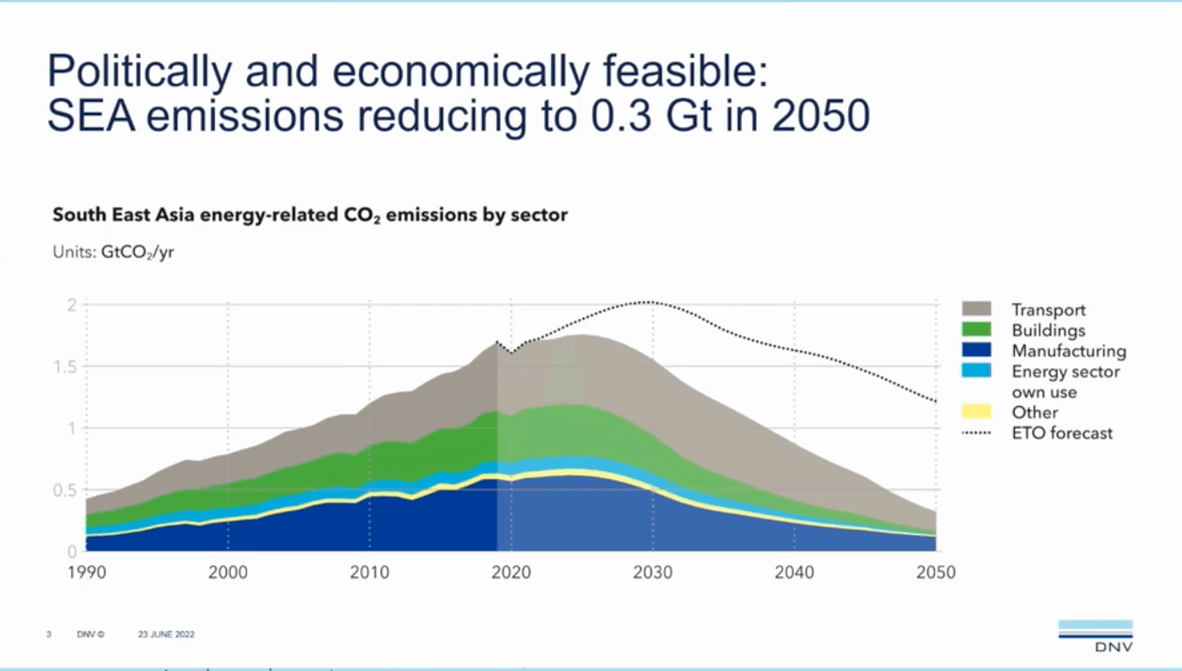
For Southeast Asia’s pathway to net-zero, Eriksen suggests that bringing the region down from its 2019 emissions rate of 1.7 gigatons of CO2 per year will require rapid penetration of renewables and reduction of fossil fuel use. He believes this will need to be driven by much higher carbon pricing and a ban on internal combustion engine cars by 2040.

DNV predicts that Southeast Asia can reduce its greenhouse emissions down to 1990s levels by midcentury (DNV)


Eriksen admits that it will be hard to chase fossil fuels entirely out of the global energy mix in less than thirty years, given the demand for oil in industry and transportation. To address this, DNV is making efforts in carbon capture and storage (CCS), direct air capture, and nature-based solutions. Beyond 2050, once fossil fuels are fully eliminated, DNV sees the ideal energy mix as 70 percent direct electrification via renewables; 20 percent indirect electrification from green hydrogen and hydrogen-derived products; and 10 percent biofuels. Hydrogen will be critical for decarbonizing hard-to-abate sectors like high-heat industrial processes, shipping, trucking, and aviation.

To make enough hydrogen to supply just five percent of the global energy mix, an estimated $7 trillion of investment would be needed by 2050. However, three times more hydrogen – enough for 15 percent of world energy demand – is required to reach net-zero by 2050. That’s an additional 90 million tonnes, equal to the total amount of “grey” hydrogen produced today for industrial and agricultural uses. The challenge is to clean up the world’s hydrogen supply chain and simultaneously double its size to support new uses.

Hydrogen will be critical for shipping. In the 2030s and beyond, Eriksen predicts that ammonia made from green hydrogen will become the industry’s low-carbon fuel of choice. Therefore, ammonia production, storage, and bunkering will hold strategic importance for Singapore, the world’s leading bunkering hub.

“Hydrogen, the lightest substance, needs a heavy lift. Dramatic and urgent changes in all energy value chains are necessary through much smarter end-use enabled through digitalization. For this to happen, we require stronger policies for carbon pricing, subsidies, tough mandates, and bans. There is much work to be done and much to be discussed,” he concluded.

Though the net-zero goals are two to three decades away, and there will be unpredictable changes in technology, finance, politics, and public will over the intervening years, it is nonetheless inspiring to see that a common goal and effort of a cleaner planet is uniting the industry. Singapore has chosen to become a first mover in the race to decarbonize and digitalize the maritime and energy sectors. The “Little Red Dot” city-state is taking drastic efforts to show leadership in the rapidly shifting global landscape, and the industry and the region will closely examine Singapore’s moves.

Source: https://maritime-executive.com/editorials/dnv-predicts-a-key-role-for-singapore-in-shipping-s-hydrogen-future


Recorded numbers are “likely to be inaccurate and too low,” Ipsos study finds

wellbeing at sea
File image

PUBLISHED JUL 14, 2022 1:42 AM BY THE MARITIME EXECUTIVE


The UK Department for Transport and the UK Maritime and Coastguard Agency (MCA) have released a new research study on seafarer wellbeing, and it suggests new avenues for improvement in providing care and understanding the scope of the challenges facing mariners today.

Mental health issues are still taboo and are poorly understood in many parts of the industry, “not just by employers but among seafarers themselves,” the study found. The solution could be to integrate mental-health support for seafarers more deeply into onboard life, and new a MCA app for assistance could help in breaking down barriers to access.

“There is – sadly – still a stigma around mental health. The fact seafarers still don’t feel able to talk about it or access services says a lot about how far we still have to go in terms of reducing that taboo,” said Katy Ware, the Director of UK Maritime Services. “This is exactly why we have launched our Wellbeing at Sea Tool. By identifying stressors and issues at an early stage, we hope that the tool will help to reduce stress among seafarers which is a contributory factor to mental health problems.”

In parallel with the tool’s development, MCA hired research firm Ipsos to conduct an interview-based study of seafarer wellbeing, and specifically about suicide. Ipsos’ team drew on the input of chaplains, seafarers’ charities, unions and other stakeholders over a series of 20 interviews in March and April.

The interviewees identified non-reporting as an obstacle to care. Many seafarers are reluctant to discuss mental health due to perceived taboos, especially in certain cultures. This reluctance has a financial aspect as well: The disclosure of mental health issues could affect employment, depending upon the policies of the specific employer.

“If someone wants to admit they have a mental health problem the [captain] would probably not allow that person to go to sea with them. So, again, they would then not be earning a living,” a chaplain explained to the researchers.

The resources available to seafarers include chaplains, union representatives, charities and (for some) employer-provided support benefits. However, access is uneven across the industry.

“I would say all of the majors, the big companies have some fantastic support in place. Conversely, you’ve got other companies where there’s nothing. They don’t talk about it,” one shipowner told the research team.

Reporting challenges

The participants agreed that seafarer suicide is a serious issue and that the industry can do more to address it. They described it as a damaging event for all, including the victim’s crewmates – who are often traumatized by the experience – and for the vessel operator (in terms of disruption and reputational harm).

A thorough understanding of the problem could benefit from better data. Suicide reporting is uneven, and the stakeholders agreed that any published numbers are “likely to be inaccurate and too low.”

They identified multiple barriers to accurate reporting. First, there are significant challenges for determining whether any given incident is a suicide – particularly if the seafarer is lost over the side. With little to no evidence, a definitive classification is often impossible.

Even if there are clear indications that the death is a suicide, the crew may not wish to accurately report it. Interviewees told the researchers that there is a widespread belief that a report of a “suicide” would prevent relatives from collecting life insurance, which would be a large financial loss. Whether or not this belief is accurate, “seafarers circle the wagons to make sure that the family’s looked after,” one manager explained. “Allow for suicide to be an insured risk and the data would clarify itself very quickly.”

Lastly, each company and flag state has its own approach to recording reports, and the interviewees agreed that some flags are more rigorous than others. “There are a lot of cowboy flag states out there that I’m concerned about . . . that don’t have robust reporting in place,” one shipowner said.

Source: https://maritime-executive.com/article/study-suicide-at-sea-is-likely-underreported


Singapore-based dry bulk owner Berge Bulk is accelerating its use of wind-assisted propulsion technology by contracting with Anemoi Marine Technologies to supply rotor sails for two vessels in its fleet.

Just days after Berge Bulk agreed to equip its Newcastlemax bulker Berge Olympus with BAR Tech WindWings, supplied by Yara Marine Technologies, the company announced that Anemoi Marine will supply wind-assisted propulsion technology for two of its bulkers.

UK-based Anemoi Marine builds rotor sail propulsion systems for commercial vessels, a technology that is fast gaining traction as the global maritime industry pursues a lower-carbon future. Anemoi and competitor Norsepower have a growing number of vessel references as shipowners look for new ways to save on fuel and reduce emissions.

According to Berge Bulk, Berge Neblina – a 388,000 dwt Valemax ore carrier built in 2012 – was made ‘wind-ready’ earlier this year with the structural integration required prior to installing the rotors. The work was carried out during a scheduled drydocking.

Four of Anemoi’s large folding deployment rotor sails will be installed to improve vessel performance. Folding rotor sails can be lowered from the vertical to mitigate the impact on air draught and cargo handling operations.

The flexible ‘wind-ready’ approach has been taken to align with vessel availability and Anemoi’s production slots. The same approach has been taken with the second vessel, Berge Mulhacen, a 2017-built 210,000 dwt Newcastlemax bulker which will also receive four folding rotor sails. Plan approval has been obtained for both ships from DNV.

Anemoi predicts that the four-rotor system will save Berge Bulk 1,200-1,500 tonnes of fuel per vessel annually.

“Wind propulsion is an option we have explored previously in other formats, and we firmly believe it can help achieve our decarbonization commitments,” said Paolo Tonon, Berge Bulk Technical Director.

He added that the partnership with Anemoi commenced with in-depth engineering simulations to find the best possible technical and commercial solution culminating in the rolling out of the rotor sail technology for the two vessels.

Berge Bulk, which owns and manages a fleet of over 80 vessels equating to more than 14 million dwt, believes that investing in wind-assisted propulsion technology will cement its position in the dry bulk industry in terms of efficient ship design and operations and forms part of its committed to developing and deploying commercially viable deep-sea zero-emission vessels by 2030. The company has committed to be carbon neutral by 2025 at the latest.

“Forward-thinking shipowners are turning to wind-assisted propulsion to help them achieve their environmental objectives – and it proves, once again, that rotor sails are a realistic and workable solution that results in significant carbon savings,” said Kim Diederichsen, Anemoi Marine CEO.

Wind-assisted propulsion has emerged as a strong contender as the maritime industry explores decarbonization options to achieve the International Maritime Organization’s greenhouse gases reduction targets for 2030 and 2050.

To date, most of the shipping industry’s installations of wind-assisted propulsion have focused on Flettner rotor technology with several companies attaining meaningful fuel savings and reductions in emissions.

Source: https://maritime-executive.com/article/berge-bulk-adds-rotor-sails-to-two-giant-bulkers


Vessel monitoring data can be augmented with weather forecasts and operational information

Insights into shipping markets, cargo trading and navigation can be derived from the latest vessel tracking information from the automatic identification system (AIS).  

Charterers, traders, ship and port operators, vessel owners and bridge crews gain information and analysis from processing AIS data.  

Getting this information from ships to customers involves several steps and interfaces from a global constellation of satellites and network of coastal receptors, while captains can view AIS signals from surrounding vessels on bridge equipment.  

The next phase of utilising AIS for safe and efficient navigation would be to incorporate it into a global system for just-in-time (JIT) port arrival. 

Spire Maritime director of maritime data operations Mark Deverill says AIS data for vessel tracking will help shipowners and operators to avoid idling at anchorage prior to entering ports, lowering fuel consumption, reducing emissions and improving fleet utilisation. 

Spire is one of the main suppliers of AIS data from a constellation of 120 satellites, with the latest satellite launched June 2022. 

Mr Deverill says satellite AIS helps users to “increase data-driven decisions and gain competitive advantage”. AIS can be used to track vessels, predict their arrival at ports and provide forecasting services. 

“Spire Maritime provides data and tools to predict arrivals and metrics around port operations,” says Mr Deverill. It can monitor vessel traffic on a global basis and track individual ships, monitor vessels’ arrival and departure from anchorages and map next-destination ports. 

This is achieved with dynamic AIS, combining three types of AIS collection including a terrestrial network and satellite AIS. Data is delivered through application programming interfaces (APIs) and messages to graphical displays. 

“We enhance our data with vessel characteristics data, AIS deduplication and cleaning, by matching destinations with predicted routes and estimated time of arrival (ETA),” Mr Deverill says. 

Spire’s satellite constellation sees 250,000 unique vessels each day, including 67,000 IMO-registered vessels and 350M messages per day. It has held a comprehensive database of AIS information since 2019. 

It provides data and tools to predict arrivals and metrics around port operations, to monitor vessel traffic and remove errors from AIS messages. 

Under dynamic AIS, data is processed to improve vessel tracking in the world’s busiest shipping areas by combining three types of AIS into one service.  

Spire can add 35 parameters, providing further vessel information within the Vessels API such as capacity, design, dimensions, history, propulsion, registration, vessel and trading type. 

It aims to provide a complete representation of each ship based on AIS messages, external data sources and analysing ship behaviour. AIS data can also be linked to maritime weather forecasts and ports data. 

“We can create data on port congestion and turnaround times and forecast weather-related risks along a route,” says Mr Deverill. “We can predict ETAs, matching them with the destination port information. We can then verify or correct the reported ETA from AIS.” 

Spire data allows users to monitor movements outside ports to verify congestion reports and recognise which ports have the longest waiting times, by monitoring ships at anchorage points outside ports and their movement into harbours. 

Analysts can then monitor congestion around ports and provide ships with information on the expected waiting times at anchorages before their arrival. Spire has developed a port congestion tool and a global index, using AIS data to identify the worst vessel waiting times. 

Its weather data enables long-period forecasts along routes and ports, which can be fed into voyage plans. 

“After the tracking, port activity monitoring, route and ETA prediction, the final parts of the equation are weather services and adding the arrival predictions without direct operational involvement,” says Mr Deverill. 

Spire provides weather forecasts and historic data for maritime and ports and weather risk analysis along proposed ports. 

Source: https://www.rivieramm.com/news-content-hub/turning-ais-data-into-ship-port-insight-71984


Company DETAILS

SHIP IP LTD
VAT:BG 202572176
Rakovski STR.145
Sofia,
Bulgaria
Phone ( +359) 24929284
E-mail: sales(at)shipip.com

ISO 9001:2015 CERTIFIED