From Shekou to Seattle, Amsterdam to Auckland, containerships are backing up like never before in the 65-year history of the industry as the liner industry grapples with the enormous strain brought by Covid-19 and exceptional consumer behaviour.

Data provided to Splash today from Seaexplorer, a container shipping platform created by logistics giant Kuehne+Nagel, shows the global carrier snarl-up with supply chains under enormous stress.

While much has been written about the ongoing port congestion issues in the US and the fallout from a recent outbreak of Covid-19 at ports in South China, the map (see below) supplied by Seaexplorer clearly shows the global phenomenon of liner congestion in 2021. Red dots represent clusters of ships while orange ones mark out ports that are congested or suffering from disrupting operations.

As it stands today, there are more than 300 containerships waiting for berth spaces to open up around the world.

Global deepsea liner networks are stretched thinner than any time in the past

Commenting via LinkedIn, Otto Schacht, executive vice president for sea logistics at Kuehne + Nagel, noted: “Shippers better increase inventories, supply chains are too tight, just in time does not work in these times, consumer demand will remain strong.”

“In terms of capacity this is highly likely to be severely skewed towards larger vessels waiting in line and therefore even more in capacity terms,” commented Lars Jensen, CEO of Danish liner consultancy, Vespucci Maritime.

“The global deepsea liner networks are stretched thinner than any time in the past, with port congestion and network disruptions tying up vessels and boxes all over the world,” Alan Murphy, CEO of Sea-Intelligence, told Splash today.

In the past, there would be plenty of buffer in the system, otherwise known as overcapacity, to handle most of these disruptions, but with the networks stretched thin, every additional disruption is adding to the backlog.

“As we’re now heading into the peak season with no buffers, we should expect this to last at least through the year,” Murphy warned today.

Looking at the map today, Simon Heaney, senior manager, container research at UK consultants Drewry, said that bottlenecks and delays at ports around the world are the symptom of the wider breakdown in the supply chain infrastructure, all related to the pandemic that spurred changes in consumption habits and reduced inland productivity.

“It is very clearly a global problem as the map shows, and as such is going to take time to be resolved,” Heaney said, suggesting that there are “big philosophical questions” the industry and its customers need to address about how to best avoid a repeat of this calamitous scenario.

With dwell times increasing dramatically off South China this week, the Shanghai Containerized Freight Index (SCFI), a global reference point for spot box rates, leapt again to new highs today, climbing another 91 points to 3,704 points, 247% up year-on-year.

SOURCE READ THE FULL ARTICLE

More than 300 liners waiting for berth space, container congestion mapped globally


The chief mate, Bosko Markovic, on the MSC Gayane when it was arrested in Philadelphia in 2019 with a record haul of cocaine worth $1.3bn has been sentenced to seven years in US prison. Markovic was promised $1m to lead the smuggling effort onboard. He was responsible for recruiting some of the seven crew members who have also been found guilty of taking part in the operation.

Markovic was recruited in the Balkans to oversee the smuggling operation, like some of the other crewmembers involved in the job. None of the convicted men have named the suppliers of the cocaine.

The crew used burner phones to communicate with the drug suppliers in South America and coordinated the loading of the drugs from speedboats that approached the container vessel several times under cover of night. The drugs were hidden in shipping containers.

“His role was necessary,” said assistant US attorney Jerome Maiatico. “A smuggling scheme of this magnitude would likely not have been possible without the chief officer in on the scheme.”

Splash reported in April on sentences announced for co-conspirators.

SOURCE READ THE FULL ARTICLE

Chief mate gets seven years in jail for smuggling $1.3bn worth of cocaine on MSC ship


The principle goods highway to the world’s consumers is jammed. In the wake of a Covid-19 outbreak at Yantian Port in eastern Shenzhen on May 25, vessels have backed up in the South China Sea, while others have sought alternatives in western Shenzhen, Hong Kong and Nansha to the south of Guangzhou. However, the Pearl River is now packed with anchored giant boxships waiting for berths to open up as the below enlargeable image taken by MarineTraffic at 4pm local time today clearly shows (green dots represent ships at anchor).

Liners are also increasingly taking the decision to avoid the area as a whole as Covid outbreaks spread to Nansha and Shekou in western Shenzhen. Newly enforced lockdown measures in the area are also limiting the availability of truck drivers.

By way of an example Maersk, the world’s largest liner, now advises that 64 vessels have omitted Yantian and Shekou, up from 40 vessels listed just two days ago.

The situation has now surpassed March’s Suez Canal blockage in terms of container disruption with median dwell times for containers at Yantian now pushing 18 days according to data from project44.

“From port handling in Yantian alone, the sheer number of containers (not vessels) impacted now exceed the number of containers impacted in Suez,” Lars Jensen, CEO of advisory Vespucci Maritime, wrote in an update on LinkedIn today.

Jensen warned: “Add to this ripples such as problems in recent weeks getting new empty containers into South China. Then you will have a pile of cargo in backlog coming out of Yantian once everything re-opens given rise to a surge on the destination side with some timelag. You will have a pile of reefer cargo already on vessels inbound for Yantian but which is now being discharged in other ports increasing the risk that other ports will run out of reefer plugs (as we also saw in early 2020).”

Like the Suez blockage, shippers have been warned to brace for extended ripple effects from the Yantian closure over the summer months.

Yantian handled 13.3m teu in 2020. It is responsible for more than one-third of Guangdong’s foreign trade and a quarter of China’s trade with the US.

SOURCE READ THE FULL ARTICLE

Pearl River Delta jammed


The International Maritime Organization (IMO) has called on all stakeholders including shipowners, and recognized organizations to provide input to the Experience Building Phase (EBP) designed to see just how the International Convention for the Control and Management of Ships’ Ballast Water and Sediments, 2004 (BWM Convention) is working.

The BWM Convention is a treaty adopted by the IMO to help prevent the spread of potentially harmful aquatic organisms and pathogens through ships’ ballast water. Principally, since 8 September 2017, all ships have had to manage their ballast water so that aquatic organisms and pathogens are removed or rendered harmless before the ballast water is released into a new location. This will help prevent the spread of invasive species as well as potentially harmful pathogens.

Following entry in to force of the BWM Convention, the IMO’s Marine Environment Protection Committee (MEPC) immediately launched an Experience-Building-Phase (EBP) to monitor the implementation. This data-gathering and analysis process is designed to identify aspects of the Convention’s implementation that are working as required, and to further enhance the aspects that are not working. To build a complete and realistic picture, the process requires the input of all stakeholders to identify where challenges may have occurred that were not initially envisaged. The analysis covers a wide range of issues from operation of systems and the role of the crew through to testing and sampling.

The IMO has commissioned the World Maritime University (WMU) to supervise the data gathering and analysis as required by the exercise, and they are inviting BIMCO members to submit data and information that will be treated in the strictest confidence. This provides BIMCO members a unique opportunity to express any concerns with the way the Convention is being implemented.

At present, shipowners are invited to submit their reports to the flag State who duly submit the report. However, this new initiative will see the WMU, on behalf of the IMO Secretariat, collecting complementary data for the EBP. As such, BIMCO members are now able to submit more detailed “complementary data” directly to WMU if preferred, rather than using the stakeholder interface via the flag State.

BIMCO members willing to share information with the WMU rather than via the flag State as part are invited to firstly contact the WMU for further details by emailing EBP21@wmu.se. The deadline for all input is 22 October 2021.


SOURCE READ THE FULL ARTICLE

White House readies supply chain disruptions task force


Maritime software and communications start-up SnakeWays has signed East African based Coastal International Shipping Line (CISL) to its ship-to-shore communications service, SnakeBox.

CISL will deploy the SnakeBox on board the company vessels to manage communication services over satellite and cellular networks. The SnakeBox will also host the advanced SnakeMail application as an upgrade to the vessels’ current email service.

The vessels will have the SnakeSwitch function enabled on the SnakeBox to intelligently manage routing between cellular and satellite networks based on availability, price and quota. SnakeMail will be available to officers and crew via the ship’s business network and the inbuilt Wi-Fi of the SnakeBox.  The SnakeBox manages different access rules depending on the ship-to-shore network connection and the different user on board.

“We needed to upgrade our vessel connectivity and from the outset we were impressed with the capabilities of the SnakeWays team and the way they have adapted state-of the-art technology to meet the specific requirements of the modern ship manager,” said Spyridon Tzamtzis, technical director of CISL. “Particularly important to us was the ease of deployment on board with minimal disruption to the existing IT network of the vessels. “

Peter Schulze, CEO of SnakeWays commented: “The extension of our customer base to four continents within a year of SnakeWays commercial launch is a very significant milestone for the company. It validates our concept of an independent, free-standing communication platform that hosts critical communications applications such as SnakeMail and SnakeSwitch. Based on smartphone technology the SnakeBox is a light, cool-running, alternative to the traditional shipboard setup of a “Smart Box” twinned with a PC based email application. ”

SOURCE READ THE FULL ARTICLE

https://thedigitalship.com/news/maritime-satellite-communications/item/7343-east-african-shipping-company-signs-up-to-snakeways-communications-service


The International Maritime Organization (IMO) has called on all stakeholders including shipowners, and recognized organizations to provide input to the Experience Building Phase (EBP) designed to see just how the International Convention for the Control and Management of Ships’ Ballast Water and Sediments, 2004 (BWM Convention) is working.

The BWM Convention is a treaty adopted by the IMO to help prevent the spread of potentially harmful aquatic organisms and pathogens through ships’ ballast water. Principally, since 8 September 2017, all ships have had to manage their ballast water so that aquatic organisms and pathogens are removed or rendered harmless before the ballast water is released into a new location. This will help prevent the spread of invasive species as well as potentially harmful pathogens.

Following entry in to force of the BWM Convention, the IMO’s Marine Environment Protection Committee (MEPC) immediately launched an Experience-Building-Phase (EBP) to monitor the implementation. This data-gathering and analysis process is designed to identify aspects of the Convention’s implementation that are working as required, and to further enhance the aspects that are not working. To build a complete and realistic picture, the process requires the input of all stakeholders to identify where challenges may have occurred that were not initially envisaged. The analysis covers a wide range of issues from operation of systems and the role of the crew through to testing and sampling.

The IMO has commissioned the World Maritime University (WMU) to supervise the data gathering and analysis as required by the exercise, and they are inviting BIMCO members to submit data and information that will be treated in the strictest confidence. This provides BIMCO members a unique opportunity to express any concerns with the way the Convention is being implemented.

At present, shipowners are invited to submit their reports to the flag State who duly submit the report. However, this new initiative will see the WMU, on behalf of the IMO Secretariat, collecting complementary data for the EBP. As such, BIMCO members are now able to submit more detailed “complementary data” directly to WMU if preferred, rather than using the stakeholder interface via the flag State.

BIMCO members willing to share information with the WMU rather than via the flag State as part are invited to firstly contact the WMU for further details by emailing EBP21@wmu.se. The deadline for all input is 22 October 2021.


SOURCE READ THE FULL ARTICLE

https://www.bimco.org/news/environment-protection/20210608-bwm


Shipping and maritime companies hoping to attract Generation Z (Gen Z) talent should develop personalised and interactive eLearning programmes featuring video content and bold colours, according to education industry research and experts.

In an FE News blog on Gen Z (those born after 1996), Sam Blyth from learning management systems (LMS) developer Instructure wrote that new technology was making it easier to create engaging, interactive experiences for learners. She added that students can control their learning journey by “deciding how, where and when to engage with course material, and to learn in a way that suits them best”.

OneLearn Global, a digital eLearning provider to the maritime sector, has applied this and other findings – such as more than half (59 per cent) of Gen Z preferring to learn by watching videos, according to a Pearson study – to its personalised next-gen LMS, which features interactive and video content.

The company also uses green throughout its LMS to appeal to the eco-friendly sensibilities of Gen Z. A blog by marketing and PR agency Zen Media talks about how green “means nature and all things organic and natural”. It also describes green as one of the easiest colours on the eye, communicating safety, harmony, growth, luck, wealth, optimism and stress relief.

These findings are in line with a Barnes & Noble College report about Gen Z using on-demand interactive learning tools and videos alongside traditional approaches to education, such as reading a textbook or listening to a teacher in class. Moreover, they benefit from watching recorded lectures and other online content, going through digital study guides or carrying out web-based research.

According to the Barnes & Noble report, Gen Z wants engaging, interactive learning experiences, to be challenged and to be empowered to make their own decisions. As digital natives, they also “expect technology to play an instrumental role in their educational experience”.

The upshot is that maritime and shipping companies should invest in digital technology and online learning tools to attract Gen Z students to the industry, according to Nigel Cleave, senior advisor at OneLearn Global.

“Younger generations brought up in a digital world are used to consuming content – be it educational or recreational – online and through mobile phones or tablets. Using technology to study a particular subject or watch a lecture is second nature to them, which is why it’s so important for the shipping industry to provide training or learning and development through digital and web-based channels.”

Mr Cleave added that educational tools for Gen Z learners in the maritime sector should be engaging, interactive, mentally and visually stimulating, intuitive and available 24/7.

“Anyone with Wi-Fi or broadband has instant access to masses of data and content, so people’s attention spans are naturally shorter than they once were,” he said.

“Younger generations want quick, bitesize training programmes, lasting no more than 20 minutes, that entertain and engage them. And they expect to take those courses whenever they choose on multiple devices, meaning eLearning has to be available to those maritime learners or industry employees looking to upskill, whether they are ashore or at sea.”

SOURCE READ THE FULL ARTICLE

https://thedigitalship.com/news/maritime-software/item/7346-tech-driven-maritime-training-key-to-attracting-gen-z


Norwegian family-owned shipping and offshore enterprise Ugland Marine Services has confirmed a fleetwide order of Navarino’s Spectrum, following a successful 3-month trial.

Spectrum offers a centralised platform for remote monitoring, maintenance and management of the entire IT and connectivity infrastructure onboard a vessel, and provides various options to comply with cyber-risk management regulations.

Mr. Marius Kjølleberg, senior ICT security consultant at Ugland, spoke with the Navarino team about the service potential and the functionalities that Spectrum offers. He explained, “Our primary reasons for choosing Spectrum were the Windows Update functionalities and the asset management tools. When we have, let’s say, 10 client computer systems onboard, it is a much faster process to download Windows Updates through Spectrum than to individually download them on each piece of IT infrastructure, which will ultimately make our lives quite a bit easier. Not only this, but this minimises data consumption, supporting the financial goals of the company.”

For Ugland it was also important to choose a service with solid asset management capabilities to ensure compliance with the new IMO regulations. The Asset Management component supports any asset category with an emphasis on those categories that are specific to the maritime sector.

Ugland will benefit from a range of functionalities, such as defining custom asset categories, providing a flexible and complete solution. The asset categories include both equipment that is connected to the vessel’s IT network as well as to OT assets. With Spectrum, network-enabled equipment is populated automatically, providing a complete picture of equipment, software catalog and network topology. This information is available in printable reports from both the vessel’s dashboard and the centralised fleet-wide dashboard.

“We have a good open relationship with Navarino. If I need something tweaked, I can speak with the team and get the service adapted. Navarino also provides a very dynamic range of services which we definitely benefit from. For example, all of our vessels use Navarino’s most advanced Infinity solution, Infinity Cube. This also makes Spectrum so easy to install as the service can be easily deployed using Infinity, whereby no extra hardware is required,” Mr Kjølleberg explained.

“Overall, we look forward to seeing what opportunities Spectrum holds. The service has many functionalities that we haven’t yet discovered. Although Ugland already have an extensive IT department, we feel that Spectrum would be particularly beneficial for companies looking for extra support with their IT infrastructure”.

SOURCE READ THE FULL ARTICLE

https://thedigitalship.com/news/maritime-software/item/7345-ugland-rolls-out-spectrum-by-navarino


has technical causes.

This was closely followed by

I have sometimes heard: “80% Human Error, what are we going to do about it”. Well, I have good news: if you would want to reduce it, that is very easy. Just build bad ships and put even worse equipment on board and you will see the percentage of Human Error in accidents reduce dramatically. The only downturn is that you will have to accept an increase in the number of accidents.

I have discovered that such a BOOM can be an overkill. I noticed that some people needed so much time to recover, that they missed part of the rest of the presentation. Some were taken aback, thinking that I was looking for a confrontation…

So I have developed a better sized BOOM, and hope that this is sufficient to raise your interest, without triggering negative feelings. My new start:

Just suppose you want to buy a car, and the seller notices that safety is an important issue for you. Just suppose that he will say: this is not such a good car: almost 100 % of the accidents with this car are because of “Human Error”. That other car is much safer: only 60 % of the accidents are because of “Human Error”, the other accidents are because of brakes failing, steering break-downs, etc etc. Would you agree with this seller?

In fact, what happens as soon as there is any systemic technical problem with a car? There will be a recall! In 2018, Toyota recalled more than 2,4 million Prius cars because of possible power stall in rare circumstances. Toyota declined to say if an actual accident did happen…. In road traffic we’re talking in excess of 99% “Human Error”…..and no one would want it differently. Actually we don’t even discuss it. I am quite sure that in road traffic 20% accidents due to technical failures would be absolutely unacceptable. It would be nice if we could reduce this irritating figure of 20% “Technical Failures” in shipping too! (realising that – while reducing the number of accidents – this would automatically increase the percentage “Human Error”)

My hypothesis is that any mature, well developed system is bound to have a high percentage “Human Error”. As the system develops, and the reasons for technical failures are analysed, these are remedied. The number of technical failures will then reduce. On the human side, as the system develops, risks are better known, and procedures will be developed, bringing down the number of accidents due to “Human Error”. However, humans will continue to have to make decisions based on incomplete information, while having to serve multiple, partly conflicting goals, in an imperfect designed and regulated environment. So it is much harder to bring down this number. The sum total is much less accidents, and as accidents attributes to technical failures reduce even more than accidents attributed to “Human Error” , the percentage “Human Error” will increase. A high percentage “Human Error” is an indication that the people at the sharp end are given tools that are ‘fit for purpose’.

I like to just play with numbers to gain a better understanding of what the ramifications of statements are. Let’s just do that with this statement: suppose that in a developing system there are 1000 incidents, 500 due to technical failures and 500 due to “Human Error”. As the system matures, and the technical requirements are better known, adding a bit of steel here, fixing that connection, making that part a bit more resilient, brings down the number due to technical failure to 50. Better selection, training and procedures brings down “Human Error” to 150. So over the years safety increased dramatically. Accidents due to technical failures reduced from 500 to 50. Accidents due to “Human Error” reduced from 500 to 150. The total number of accidents reduced from 1000 to 200. In percentages the total number of incidents reduced by 80%, but “Human Error” has gone up from 50% to 75%(!) while technical failure reduced from 50% to 25%. Although I don’t know of any research on the subject, I’m convinced that in the 17th century the percentage “Human Error” was much lower than presently, as many accidents happened because of technical failures, or uncontrollable circumstances.

By the way, although it can be assumed that mature, well developed systems have a high percentage of “Human Error”, this can not be turned around: a system with a high percentage “Human Error” does not necessarily have to be a mature, well developed system. There is always the possibility that a high percentage “Human Error” is due to insufficient selection, training, experience etc. However for a mature, regulated system it is unlikely that this would play a large part.

The message I want to bring across with this article is quite simple: Mature, well developed systems are bound to have a low percentage of technical failures. Consequently these systems will have a high percentage if Human Error. There is no need for a knee-jerk reaction to try to reduce this. Most likely it is a good sign and there is no need to reduce this percentage! We need other indicators to know what needs improvement and how that could be achieved.


SOURCE READ THE FULL ARTICLE

https://safety4sea.com/those-irritating-20/


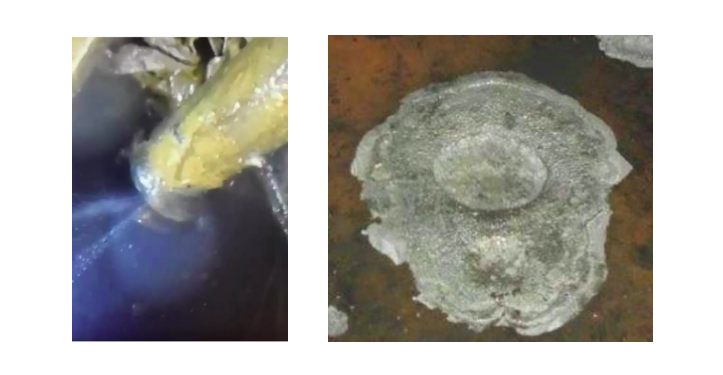
The Marine Safety Forum has published a Safety Alert relating to the discovery of a leak in a tank caused by corrosion. The incident highlights issues associated with the disposal of caustic chemicals.

The incident

The Chief Engineer was carrying out daily tank-sounding routines in the engine room when he observed an unexpected rise in liquid level. The frequency of soundings was increased and monitored closely for 24hrs.

The next day, the Chief Engineer informed the Master that the tank volume had increased by approximately 200 litres and requested permission to open the tank for investigation. A risk assessment and permit to work for dangerous space entry was actioned and the tank opened for inspection later that day.

GET THE SAFETY4SEA IN YOUR INBOX!

Upon investigation, the Chief Engineer discovered a pinhole leak in the structure beneath the sounding pipe, allowing salt water to enter the space from outside the tank. The Master informed the Duty Technical Manager, and the vessel was sent to a layby berth for repairs.


Probable causes

Initial investigation by the ship’s engineers concluded that the striking plate at the bottom of the sounding pipe was missing. This allowed the brass weight to repeatedly strike the steelwork, damaging the paint coating and exposing the steelwork to corrosion.

Further investigation concluded the following:

  • The tank had been inspected and maintained in accordance with company procedure;
  • The brass weight of the sounding tape had damaged the paint coating on the striking plate and steelwork below;
  • A  corrosive  chemical  had  been  incorrectly  disposed  of  and introduced  to  the  tank,  accelerating  the  corrosion process;
  • The  acid  may  have  become  trapped  under  bubbles  of  damaged  paint,  allowing  concentrated  corrosion  over  the short time;
  • The combination of exposed steelwork and caustic solution destroyed the striking plate and steelwork below.


Actions taken

  • Effective repairs were carried out onboard in collaboration with third-party welders and divers;
  • All crew was reminded of the importance of correct chemical handling – including safe disposal. Onboard a vessel, there are many different chemicals used; some of these chemicals pose a serious health risk with some being extremely caustic. These chemicals should be used in the appropriate and prescribed way and not misused;
  • MSDS  (Material  Safety  Data  Sheet)  sheets  are  provided  for safety and information  and contain all relevant information about the chemical, such as the physical and chemical properties, hazard identification, handling and storage and disposal considerations;
  • Caustic or otherwise dangerous chemicals, and their containers, should be disposed of at an authorized hazardous or special waste collection point in accordance with any local regulation.

Vessels must ensure that after using caustic chemicals, the contents/container are disposed of to an authorized hazardous or special waste collection point in accordance with any local regulation. Should you be unsure where or how to dispose of any chemical, please contact the office, or waste disposal provider on the approved supplier list,

…the MSF advised.

SOURCE READ THE FULL ARTICLE

https://safety4sea.com/lessons-learned-tank-corrosion-causes-leak/


Company DETAILS

SHIP IP LTD
VAT:BG 202572176
Rakovski STR.145
Sofia,
Bulgaria
Phone ( +359) 24929284
E-mail: sales(at)shipip.com

ISO 9001:2015 CERTIFIED