
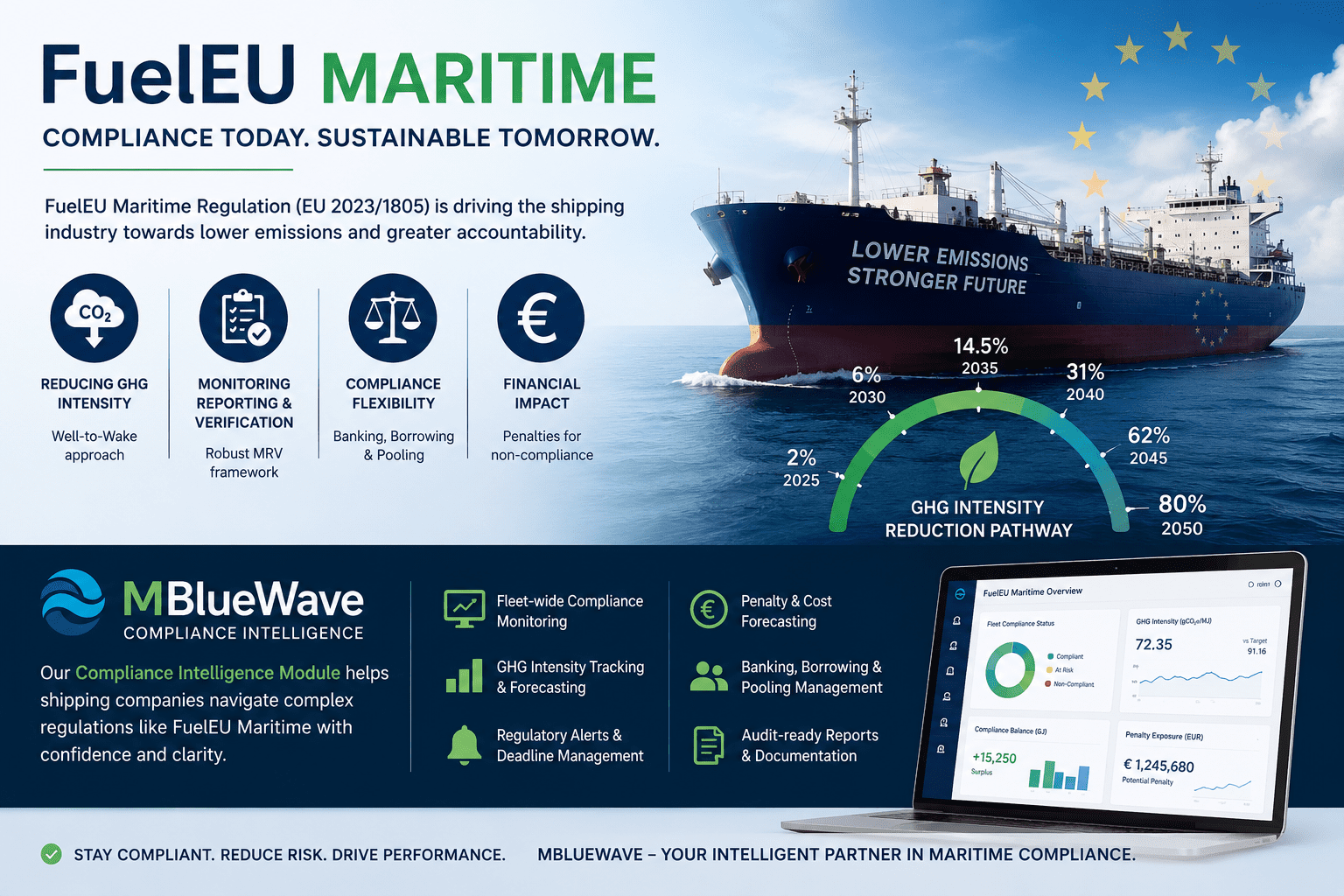

The maritime industry has entered a new era of environmental regulation with the implementation of the FuelEU Maritime Regulation (EU 2023/1805), which became effective on 1 January 2025. The first reporting and verification cycle commenced during the first half of 2026, introducing new operational, financial, and compliance obligations for shipowners, managers, and operators.
While FuelEU Maritime is primarily designed to reduce greenhouse gas (GHG) emissions from shipping, its implications extend far beyond environmental performance. The regulation introduces new compliance costs, reporting requirements, penalties, and strategic decisions that directly affect vessel profitability and financial planning.
For shipping companies, FuelEU Maritime is no longer simply an environmental regulation—it has become a critical business and financial management challenge.
Understanding FuelEU Maritime
FuelEU Maritime aims to reduce the greenhouse gas intensity of energy used onboard ships operating within European waters. The regulation adopts a Well-to-Wake (WtW) methodology, meaning emissions are assessed across the entire fuel lifecycle, including:
- Fuel extraction or cultivation
- Production and processing
- Transportation and distribution
- Final combustion onboard
This approach significantly expands the emissions profile compared to traditional Tank-to-Wake measurements and places increased pressure on operators to evaluate their fuel strategies and vessel efficiency.
Scope of Application
The regulation applies according to a vessel’s exposure to EU and EEA voyages:
- 100% of energy used on voyages between EU/EEA ports.
- 100% of energy consumed while at berth in EU/EEA ports.
- 50% of energy used on voyages entering or departing the EU/EEA.
As a result, many internationally trading vessels that only occasionally call at European ports will still fall within the scope of FuelEU Maritime.
Progressive Reduction Targets
The baseline GHG intensity has been set at:
91.16 gCO₂e/MJ (based on 2020 levels)
From this baseline, the regulation introduces progressively stricter reduction targets:
| Year | Required Reduction |
|---|---|
| 2025 | 2% |
| 2030 | 6% |
| 2035 | 14.5% |
| 2040 | 31% |
| 2045 | 62% |
| 2050 | 80% |
These targets create an increasing compliance gap for ships relying solely on conventional fossil fuels and are expected to accelerate investment in alternative fuels and operational efficiency measures.
FuelEU Maritime Compliance Responsibility
The responsibility for compliance rests with:
- Shipowners;
- ISM Managers;
- Bareboat Charterers; or
- Any organization that has assumed operational responsibility under the International Safety Management (ISM) Code.
This means that technical, operational, environmental, and finance departments must work together to manage FuelEU obligations effectively.
Understanding Compliance Balances
A central concept introduced by FuelEU Maritime is the Compliance Balance.
Positive Compliance Balance
A vessel operating below the required GHG intensity target generates a compliance surplus.
Negative Compliance Balance
A vessel exceeding the permitted GHG intensity generates a compliance deficit.
The annual compliance balance determines whether a vessel may face penalties or can utilize one of the flexibility mechanisms provided by the regulation.
FuelEU Maritime Flexibility Mechanisms
Banking
Ships with a positive compliance balance may bank their surplus indefinitely for future use.
However:
- Banked surplus cannot expire.
- Banked surplus cannot be transferred to another ship, even within the same fleet.
Borrowing
Ships with a negative compliance balance may borrow compliance from the following reporting period.
Conditions include:
- Additional 10% penalty on the borrowed amount.
- Borrowing cannot occur in two consecutive reporting periods.
Pooling
FuelEU Maritime allows compliance balances to be pooled between vessels, including ships belonging to different owners or operators.
Pooling is permitted only when:
- The total pool balance remains positive.
- Deficit vessels do not increase their compliance deficit.
- Surplus vessels do not become deficit vessels.
Each ship may participate in only one compliance pool during each reporting year.
Financial Penalties for Non-Compliance
Ships that retain a negative compliance balance after all flexibility mechanisms have been applied are subject to financial penalties.
The current penalty is approximately:
€58.54 per GJ of non-compliant energy balance
For many operators, these penalties can become significant operating costs, directly affecting voyage profitability and budgeting decisions.
Monitoring, Reporting and Verification (MRV)
The first FuelEU Maritime reporting period covers:
1 January 2025 – 31 December 2025
Verification activities commenced during January 2026.
The Monitoring, Reporting and Verification (MRV) process requires shipping companies to:
✔ Monitor fuel consumption and energy use.
✔ Calculate Well-to-Wake GHG intensity.
✔ Determine annual compliance balances.
✔ Manage banking, borrowing, or pooling decisions.
✔ Submit verified reports within the prescribed deadlines.
✔ Prepare for audits and regulatory inspections.
The Growing Challenge for Shipping Companies
FuelEU Maritime has effectively linked environmental performance with financial performance.
The regulation requires companies to answer difficult questions:
- How should penalties be accounted for?
- How should banked surpluses be measured?
- How should compliance costs be forecasted?
- What are the financial implications of pooling agreements?
- How should future compliance deficits be managed?
Without proper monitoring and forecasting tools, organizations risk non-compliance, unexpected costs, and operational inefficiencies.
How MBlueWave Compliance Intelligence Supports FuelEU Maritime Compliance
At SHIP IP LTD, we have developed the MBlueWave Compliance Intelligence Module to help shipping companies manage the increasing complexity of maritime regulations, including FuelEU Maritime requirements.
The module enables organizations to:
✔ Monitor FuelEU compliance obligations across the fleet.
✔ Track GHG intensity performance and regulatory exposure.
✔ Identify potential compliance deficits before reporting deadlines.
✔ Forecast penalties and compliance costs.
✔ Generate management dashboards and KPI reports.
✔ Maintain audit-ready documentation and evidence.
✔ Receive intelligent alerts on regulatory deadlines and reporting requirements.
✔ Support strategic decision-making regarding banking, borrowing, and pooling opportunities.
The Compliance Intelligence Module acts as a centralized regulatory monitoring platform, helping technical, environmental, operational, and finance departments work from a single source of truth.
Preparing for the Future
FuelEU Maritime represents one of the most significant regulatory changes affecting shipping since the introduction of the EU ETS.
As greenhouse gas reduction targets become progressively stricter toward 2050, shipping companies that invest early in compliance intelligence, monitoring systems, and digital reporting tools will be better positioned to control costs, improve operational efficiency, and remain competitive in an increasingly regulated industry.