
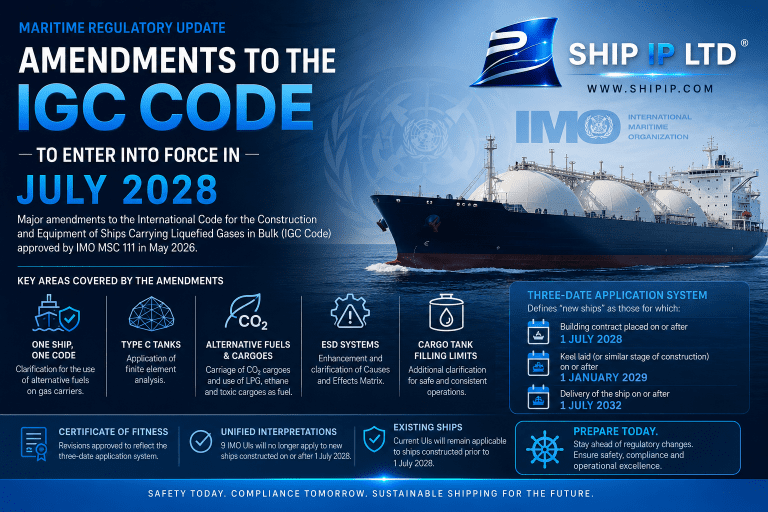

The International Maritime Organization (IMO) has approved significant amendments to the International Code for the Construction and Equipment of Ships Carrying Liquefied Gases in Bulk (IGC Code), with the revised requirements expected to enter into force on 1 July 2028. These amendments were approved during the 111th session of the IMO Marine Safety Committee (MSC 111) in May 2026 following an extensive review process initiated in 2022.
Why Are the Amendments Important?
The revision of the IGC Code reflects the maritime industry’s rapid transition towards alternative fuels, decarbonization initiatives, and the growing use of environmentally friendly technologies onboard gas carriers. The amendments aim to improve safety, remove ambiguities in existing requirements, and provide clearer guidance for ship designers, builders, owners, operators, and classification societies.
Key Changes Introduced by the New IGC Code
The amendments cover several important areas, including:
1. “One Ship, One Code” Principle
The amendments clarify the application of the “One Ship, One Code” philosophy, ensuring that gas carriers operating with alternative fuels are subject to one consistent safety framework and avoiding conflicting requirements between the IGC and IGF Codes.
2. Finite Element Analysis (FEA) for Type C Tanks
Updated requirements introduce the application of finite element analysis methodologies for Type C cargo tanks, enhancing structural assessment and safety evaluations.
3. Carriage of CO₂ and Alternative Fuel Applications
The revised Code addresses:
- Carriage of carbon dioxide (CO₂) cargoes
- Use of LPG as fuel
- Use of ethane as fuel
- Use of certain toxic cargoes as fuel
These provisions support the industry’s transition toward lower-emission fuel solutions.
4. Emergency Shut Down (ESD) Systems
The amendments enhance and clarify the Causes and Effects Matrix associated with Emergency Shut Down (ESD) systems, improving operational safety and emergency response procedures.
5. Cargo Tank Filling Limits
New provisions introduce additional clarification regarding cargo tank filling limitations, aiming to improve cargo handling safety and operational consistency.
Applicability of the Amendments
The new requirements will apply to both existing and new ships where appropriate. However, amendments requiring modifications to a vessel’s design or construction will only apply to ships considered “new ships” under the agreed three-date application system.
A ship will be considered a new ship if:
- The building contract is placed on or after 1 July 2028; or
- In the absence of a building contract, the keel is laid or the vessel reaches a similar stage of construction on or after 1 January 2029; or
- The vessel is delivered on or after 1 July 2032.
Changes to the Certificate of Fitness
To align with the new three-date application system, the IMO has approved revisions to the International Certificate of Fitness for the Carriage of Liquefied Gases in Bulk.
Only products listed in Chapter 19 of the IGC Code will be permitted to appear on the Certificate of Fitness and will be identified as cargo and/or fuel, as applicable.
Unified Interpretations to be Withdrawn
Upon entry into force of the amendments on 1 July 2028, several IMO Unified Interpretations (UIs) will cease to apply to new ships, including:
- MSC.1/Circ.1543
- MSC.1/Circ.1559
- MSC.1/Circ.1590
- MSC.1/Circ.1606
- MSC.1/Circ.1617
- MSC.1/Circ.1625
- MSC.1/Circ.1651
- MSC.1/Circ.1669
- MSC.1/Circ.1679
These circulars will, however, continue to apply to existing ships constructed before 1 July 2028.
What Shipowners and Managers Should Do Now
Although the amendments will enter into force in July 2028, shipowners, ship managers, technical departments, and shipyards should begin preparations early by:
✔ Reviewing newbuilding specifications for future gas carrier projects.
✔ Assessing the impact of alternative fuel provisions and CO₂ cargo carriage requirements.
✔ Evaluating Emergency Shut Down (ESD) arrangements and cargo tank design requirements.
✔ Updating compliance procedures, training programs, and documentation processes.
✔ Engaging with classification societies and flag administrations regarding future implementation requirements.
Conclusion
The 2028 IGC Code amendments represent one of the most comprehensive updates to the Code in recent years and will significantly influence the future design, construction, and operation of gas carriers. As the industry moves toward decarbonization and alternative fuels, early preparation and proactive compliance planning will be essential for maintaining safety, operational efficiency, and regulatory readiness.