Crystal Cruises and two of its ships have been bought by private equity operation Heritage Group, led by Manfredi Lefebvre d’Ovidio, and will operate through travel company A&K Travel Group.

The P&I insurer is now UK Club (effective June 15th).

Crystal Cruises had to be sold after the collapse of its parent Genting Hong Kong early this year, when it ran out of cash and could not raise any more.

Crystal was forced to suspend operations at the end of January 2022 and earlier this month the Bahamas auctioned off the line’s two large cruise ships to settle debts.

Lefebvre d’Ovidio acquired 80% of A&K in May 2019, while 20% was owned by Geoffrey Kent, son of the founders of the company.

The two ships, Crystal Symphony (IMO 9066667) and Crystal Serenity (IMO 9243667) will resume service in 2023 after undergoing extensive refurbishment and will operate under the revived Crystal Cruises brand.

The cruise ships were reported sold the week before last by the Supreme Court in the Bahamas, with the Crystal Symphony going for $25m and the newer Crystal Serenity fetching $103m. The brand name and other assets of the cruise line were acquired separately from the US-based liquidators of the company.

Crystal Cruises, launched by Japan’s NYK in 1991, was sold to Genting Hong Kong in 2015.

Geoffrey Kent, who becomes Co-Chairman of Crystal Cruises along with Lefebvre d’Ovidio , said that “the idea of combining the unparalleled onboard service that Crystal Cruises is known for, with the extraordinary tailor-made experiences Abercrombie & Kent has been successfully providing for our guests for the past 60 years, fills me with excitement, enthusiasm, and pride”.

A&K will also be partnering with V.Ships Leisure for the operation of the cruise ships.

1995-built, Bahamas-flagged, 51,044 gt Crystal Symphony was owned by Crystal Symphony care of Crystal Cruises LLC of Los Angeles, California. ISM manager was V Ships Leisure SAM of Monaco-Ville, Monaco. Equasis has it as entered with American Club, but that coverage has now ceased. Its new insurer is UK Club on behalf of Symphony Holdings Ltd (effective since June 15th 2022). As of June 28th the vessel remained at anchor off Freeport, Bahamas.

2003-built, Bahamas-flagged, 68,870 gt Crystal Serenity was owned by Crystal Serentu Ltd care of Crystal Cruises of Los Angeles, California, USA, with V Ships Leisure SAM of Monaco Ville, Monaco, and had been listed as entered with American Club. It too is now entered with UK Club, effective June 15th, on behalf of Crystal Serenity Ltd. As of June 25th the vessel was at anchor off Freeport, Bahamas.


Shipowners, operators and managers need greater cyber resilience as they introduce higher levels of digitalisation across their fleets

Ships and ports are increasingly becoming victims of cyber attacks as networks and vessel IT is further linked to online and cloud-based services.

Delegates at Riviera Maritime Media’s Maritime Cyber Risk Management Forum, held 28 June in association with Norton Rose Fulbright, heard they need to integrate cyber security into their digitalisation programmes.

International Seaways vice president and chief information and security officer Amit Basu said cyber resilience should be embedded in newbuild projects and retrofitted into existing ship systems. “Digitalisation is growing at an extremely swift rate, which is causing a significant increase of the cyber-attack surface on the ships,” he said.

On the other side, cyber criminals are innovating and are more sophisticated in their approach to the maritime industry with targeted attacks more common.

“Cyber security alone is not enough anymore, it is time to aim for cyber resilience,” said Mr Basu. “Cyber resilience is an organisation’s ability to withstand and quickly recover from cyber events disrupting usual business.”

He recommends owners manage cyber security with a multi-layered approach encompassing people, processes and technology.

“Align IT and business for a united front against the cyber threats,” said Mr Basu.

Cyber resiliency objectives need to be aligned with digital transformation business goals and these initiatives must embed cyber-security measures in the project specifications from the initiation stage.

“Integrate cyber security into digital transformation programmes,” said Mr Basu. “Our entire industry must build together a cyber resilient ecosystem.”

Wärtsilä Voyage head of cyber security technology Paivi Brunou said evolving technologies driving shipping forward increase the risk of cyber attacks.

“With the advent of highly digitalised shipping, remote operations andautonomous navigation, cyber security is becoming critical to the emerging technological improvements in maritime environments,” she said.

Shipowners should therefore implement context-relevant and effective cyber controls and capabilities to reduce attack surfaces in their systems. Vessel operators need to identify the residual risks and “work together to implement best way to minimise those through layered security activities,” said Ms Brunou.

She suggested working with third parties on security, collaborating with partners and sharing information on cyber security related near-misses and incidents via a trusted channel.

“The industry needs to take action to increase cyber security and resiliency by leveraging public and private partnerships and collaboration,” she said.

“Maritime cyber security needs to be ready not only for what is happening today, but what will be a reality during the next decade.”

Inmarsat director Laurie Eve said achieving cyber resilience requires many elements of security and threat intelligence as well as training, secure network connections and incident response plans.

“Training needs to refreshed, updated and continuous, with a no-blame culture to encourage issue reporting,” said Mr Eve.

He said shipowners should consider employing a security operations centre to provide intelligence and monitor onboard networks to maintain a situational awareness of threats.

An incident response plan can be used when security is overcome by a cyber threat.

“Assume there will be a breach at some point and be ready to limit the damage,” Mr Eve said. “Invest in an incident management policy, provide training and do rehearsals and use existing guidance.”

Inmarsat has a Fleet Secure portfolio of products and services for securing end points, communications and email, and increasing crew awareness and unified threat management.


“We are ensuring that different parts of our digital system will talk to each other in one smart network”


How do you visualise the UAE maritime sector growing in the post-pandemic world? What role will RAK Ports play here?


Despite the many challenges the maritime sector faced during the global Covid-19 pandemic, RAK Ports saw its volumes reach record highs. Although current market volatilities and commodity price swings are challenging, our growth trajectory continues and 2022 is set to be another outstanding year. This consistent uptick in volumes is great news for RAK Ports, but it means our business must adapt quickly.


The UAE will continue to be a critical hub for global shipping in the years ahead, and RAK Ports is ideally poised to play a leading role. Sustainability will be a key theme, and the UAE will again be at the forefront. We are already assessing how stricter emissions regulations may affect vessels operating in our waters and how we can best integrate alternative energy strategies at RAK Ports. The UAE recently showcased its Hydrogen Leadership Roadmap to promote the country’s maritime energy transition, as we work towards net-zero carbon emissions by 2050. That plan includes our industry producing green hydrogen and processing it as the basis for bunker fuel for ships and for export.


RAK Ports has made significant investments in expansion in the past few years. What are the key areas of investments?


We are not only investing into physical infrastructure with a massive land reclamation project already well underway at Saqr Port/Freezone, which will provide much needed space for new industrial investment to support the diversification of the local economy and more opportunities for skilled employment; we are also working on a full digitisation strategy to increase efficiencies. While many ports are implementing standalone digital systems, we are taking a more connected approach at RAK Ports. This will ensure that different parts of our system will talk to each other in one smart network. For example, our German-engineered dry-bulk cranes already use IoT technologies to submit automated reports that allow our customers to see the status of their cargo loading in real-time.


Ramesh S. Ramakrishnan
Image Credit:


“Future challenges for companies would include strengthening digital capabilities and protecting against cyberattacks”


Ramesh S. Ramakrishnan | Chairman, Transworld


Congratulations on the MoU signed between Transworld and eShipper! What does this deal signify for Transworld and the UAE shipping and logistics sector in general?


With this Joint-Venture with eShipper, Transworld Group further augments its services to its customers by providing end-to-end services using a combination of advanced infrastructure, multimodal fulfilment and last mile delivery. The strong legacy, brand and service synergies of both the organisations coming together will offer a unique service offering to our esteemed customers and Transworld Group becomes one of the few companies in the UAE to provide services ranging from shipping to last mile operations. eShipper has a very specific expertise and have been building it up in Canada and North America over the last 15 years.


We have entered JV with them to enhance our e-commerce delivery, in the Middle East to start with, which will eventually come to India. Online buying is here to stay. It is a good space for somebody like us, having the right technology, people, and skill sets. This also compliments a lot of what we do as a logistics company.


As a sector pioneer, what is the toughest challenge you foresee for shipping and logistics in a post-pandemic scenario and how do you see Transworld surmounting, it?


One of the biggest challenges during the pandemic for companies was to abruptly take their operations digital. Thankfully for Transworld Group, we started the process of digitalisation few years ago and we were successfully able to adapt during the pandemic. Going forward, one of the biggest challenges for the companies would be to quickly adapt and strengthen their digital capabilities to be able to align with the industry and also protect themselves from cyberattacks.


What are Transworld’s expansion plans over the next five years?


The essence of Transworld growth trajectory has been innovation and getting into new frontiers. There are lots of different areas within the logistics and supply chain space offering us score to evolve and build new business ideas. Our supply chain business, for example, the sea freight, air freight, warehousing, 3PL, 4PL, business, has been growing. The plan now is to refocus our energies on increasing the pace of growth.


We are also looking at enhancing our global footprint in the Americas, Europe, Africa and Far East. So, be it through our asset-owning or asset-light businesses, we are focused on serving our customers better. Our focus is on becoming a complete solutions provider for our customers. Today if a customer asks for any service from Transworld, we can provide first mile to last mile solutions.


As a philosophy TW group is driven by the higher purpose of delivering prosperity to humanity.


While we are in the business to make profits for our shareholders, employees and associated partners, the sublime goal is to use this wealth as a medium to share and create prosperity for the entire ecosystem and be a catalyst for positive change. Our corporate responsibility activities are spread across all sections of the society and environment. The employees and their respective families are all involved in our social activities, thereby spreading the culture of compassion and giving.


We are also setting ourselves a goal at the Transworld Group where by taking a pledge to work towards being a carbon-neutral organisation by 2043. To reach that aim, over the next few years, we will start with focusing on reducing our greenhouse gas emissions to meet these goals in a more measurable manner.


UAE-Maritime-Captains-of-Industry-Laurance-MFC-for-web
Laurance Langdon
Image Credit:


“The wider challenge is that the global shipping industry needs to catch up and embrace change”


Laurance Langdon | General Manager, Modern Freight Company (MFC)


How much in your view as an industry pioneer has the industry changed since the early years and what is its scope for expansion going forward?


With the vision of the UAE leaders, the move to digital and paperless and the implementation of blockchain, change is happening fast in the logistics sector. It’s clear that JAFZA wants to be the region’s central point for business and their openness to listen to their customers enables this change, and MFC has for decades always been a go-to partner for JAFZA to discuss and test these new ideas. There is a wider challenge, and perhaps the bottleneck is that the industry needs to catch up and embrace many of these changes so globally everyone is connected, but for now the UAE is definitely well positioned for the future.


Enhancing business procedures is an obstacle for shipping firms, how is MFC evolving to counter this?


Covid sent out a message to businesses — evolve or die, demanding a different work ethic. So, MFC overhauled its processes, investing in a new ERP, a system built in-house for our customers. Visibility and customer connectivity is in demand, and now we are more efficient, which improves our customer experience.


UAE-Maritime-Captains-of-Industry-Waleed-Tasneef-for-web
Waleed Abdulla Mohamed al-Tamimi
Image Credit:


“We are considered to be the largest maritime classification office in the UAE”


Waleed Abdulla Mohamed al-Tamimi | General Manager, Tasneef Maritime


As the first UAE maritime body to apply the GCC Code, how is Tasneef Maritime guaranteeing the safety of the UAE maritime environment?


The GCC Code is a set of guidelines developed by the GCC nations for Non-Convention Vessels that are smaller than 500 tons, and are not obliged to follow International Maritime Organisation (IMO) Conventions. The code focuses on the safety of the small vessels and ensures that they don’t cause marine pollution, using this code as a reference. Tasneef inspects these vessels for their compliance and issues certifications to enable them to obtain navigation licenses from the UAE Flag Administration.


Without Tasneef Certification, these vessels cannot operate in UAE waters. With over 70 professional staff, we are considered the largest maritime classification office in the UAE.


What classification and advisory services do Tasneef offer?


Tasneef can provide Classification and Statutory Services for all types of commercial vessels that require certification by law., such as tankers, bulk ships, container ships, etc. We also provide certification services for naval vessels and private yachts that include the UAE Yacht Code. The advisory services are numerous. One of the services we introduced uses Artificial Intelligence in the inspection of assets to ensure their integrity. Assets can be large civil structures like ports or complicated offshore structures such as production rigs for oil and gas.


“The industry saw a steep learning curve through 2020-21, with massive increase in freight costs”


UAE-Maritime-Captains-of-Industry-Rosh-Manoli-CSS-for-web
Rosh Manoli
Image Credit:


Rosh Manoli | Vice President – Freight Forwarding, Consolidated Shipping Services Group


As an industry head, in your view how has ocean freight management changed post-pandemic?


The industry had a steep learning curve through 2020-21, while witnessing a massive increase in freight costs, with container and shipping prices reaching up to ten times higher than before the pandemic. Congestions in major ports have also played a huge role and we still cannot ascertain if this will reduce, seeing that the pandemic is not over yet. The successive waves of Covid have impacted a drop in personnel as well – right from a shortage of professional truck drivers to logistic operators in key markets causing difficulties in optimised operation of ports, terminals, and warehouses. As an organisation, CSS has been resilient to withstand these changes.


What are CSS’ expansion plans?


CSS is expanding its operations into Saudi Arabia, in line with the KSA vision of 2030 that also focuses on logistics as a key economy driver. We are also expanding into East Africa this year. CSS also invested in tech, ramping up our IT capabilities to maintain a 360-degree control for operational cohesiveness.


Original Source link


ShipXplorer has announced the official launch of its new web tracking portal and ship tracker, powered by its parent company AirNav Systems, with the stated aim of creating the world’s largest AIS-based ship tracking network.

ShipXplorer says it aims to leverage growing demand in the market to build out a terrestrial tracking network along the coastline of over 80 countries, supplementing this coastal network of ground stations with strategic partnerships with satellite data providers to achieve 100% AIS coverage.

“This is a significant and exciting step in the growth of our company,” said Andre Brandao, CEO of ShipXplorer.

“The ship tracking industry has always been a goal for us. We are very proud to enter this new market to offer new solutions to the industry that is constantly looking for tools to meet the new challenges faced by the maritime and ship industry.”

Alongside its tracking service the company has also developed a range of AIS tracking hardware products, its ShipXplorer AIS Dongle, which acts as a USB signal receiver, as well as an omnidirectional ShipXplorer AIS Antenna and its SeaRange AIS Receiver for decoding and displaying AIS transmissions.

Source: https://smartmaritimenetwork.com/2022/06/28/shipxplorer-launches-online-ais-based-vessel-tracking-service/


China’s crude oil imports have doubled from 2011 to 2021 and now account for 20% of global seaborne crude oil volumes. While China’s January to May 2022 seaborne crude oil imports are down 2.2% y/y, a 51.4% m/m boost in imports from Russia has helped lift China’s seaborne crude imports to 42.6 million tonnes in May, up 8.7% m/m and 13.0% y/y.


“Russian crude oil accounted for 13% of China’s seaborne crude import in May, up from 9% earlier in the year,” says Niels Rasmussen, Chief Shipping Analyst at BIMCO and adds “Meanwhile, imports from Brazil, Saudi Arabia, and Kuwait declined compared to April.”

While year-to-date seaborne and total crude imports are down 2.2% y/y and 1.7% respectively, the US Energy Information Administration (EIA) estimates that local Chinese crude production was up 3.4% y/y whereas consumption is estimated to be down 0.9% y/y. Refinery runs have also been low as local demand has faltered and the export quota in 2022 is 37% lower than in 2021. All in all, crude inventories have been on the increase and hit a 10-month high in May.

The EIA still estimates that oil consumption in China will rebound and grow 2.7% y/y from June until the end of December. It also forecasts a 1.2% rise for the full year compared with 2021. This bodes well for crude tanker volume demand, but risks related to global economic growth remain.

Changes in crude oil trade patterns are expected to accelerate during the rest of 2022, particularly towards the end, as the EU’s ban of Russian oil and oil products enters into force.

“Russia will seek to increase volumes to India and China, and they are likely to replace volumes from the Persian Gulf, Brazil, and West Africa. Those volumes will instead move towards Europe,” says Rasmussen and adds “depending on final trading patterns this could increase average sailing distances and demand for Afra- and Suezmax ships in particular. This is because they carry most of Russia’s exports as well as a higher share of volumes from the Persian Gulf, Brazil, and West Africa into Europe than into India and China.”
Source: BIMCO, By Niels Rasmussen, Chief Shipping Analyst


It’s been another bumper month for long-term contracted ocean freight rates, as the cost of securing container shipments climbed by 10.1% in June. Following on the heels of a record 30.1% hike in May, this now means rates stand 169.8% higher than this time last year, with just two months of declines in the last 18 months. Despite a degree of macro-economic uncertainty clouding the horizon, all major trades saw prices moving up, with some corridors showing significant gains.


Oslo-based Xeneta has released the figures, drawn from its Xeneta Shipping Index (XSI®) Public Indices for the contract market, which crowd-sources and aggregates real-time data from the world’s leading shippers to deliver market insights. Those insights, notes Xeneta CEO Patrik Berglund, continue to confound commentators.

A question of sustainability
“Rates developments that would have been front page news a few years ago are in danger of becoming the norm in a market environment that is historically hot,” he states. “After last month’s colossal rise, we see another hike of 10%, pushing cargo owners to the limits, while the carriers fill their pockets. Again, we have to question, is this sustainable? And the signs are gathering that, well, it might not be.”

Berglund points to falling spot rates – that may increasingly tempt shippers away from traditional contracts – in addition to looming industrial action in ports (in Europe and, potentially, the US) that could further damage schedule reliability only just recovering from recent congestion and COVID-induced disruption. In addition, there’s the fact that the US has signed into law the Ocean Shipping Reform Act, designed to stop shipping companies from profiteering, and the looming shadow of widespread inflation that may impact upon consumer demand and slow economic activity.

Frayed relationships
“The carriers have had it all ‘their own way’ for the last 18 months or so,” Berglund comments, “but will they now be studying this wide array of factors with some concern? Not while rates continue to rise, but the relationship between their community, shippers and, to some extent, other key society stakeholders has been damaged by disruption, poor quality services (in terms of reliability) and runaway rates increases.

“We’ve already seen some cargo owners looking to distance themselves from traditional carriers and, for example, charter their own vessels, and you have to ask what will happen next? Will shippers continue to pay sky-high contracted rates in an atmosphere of declining demand, inflation, geopolitical uncertainty, disruption and the ongoing threat of COVID restrictions? Something, one feels, has to give.”

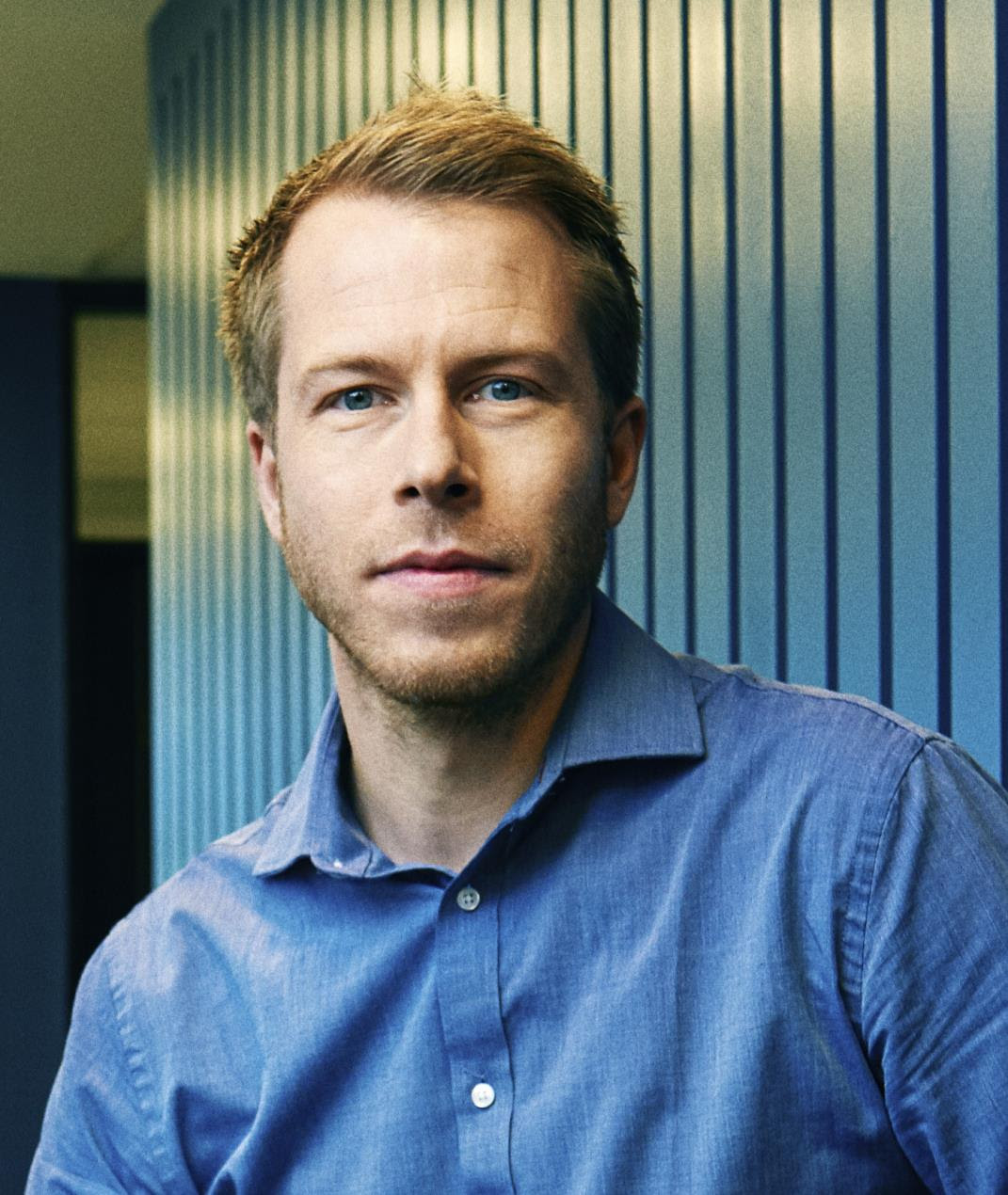
Xeneta CEO Patrik Berglund

Xeneta CEO Patrik Berglund ​

The only way is up
For the time being, however, the rates arrows continue to point skywards across the board. According to June’s XSI®, which maps developments across all significant trade corridors, import and export benchmarks showed universal growth.

European imports index continued their recent climb, rising 13.7% to stand 163.4% higher than the equivalent period last year. The regional export index jumped by 6.2% and is now 148.2% up year-on-year. Similar signs were seen for Far East imports and exports, with the former rising 5% (up 62.5% against June 21) and the latter jumping 11.6%. The export benchmark is now a mighty 200.6% up year-on-year. This performance was mirrored by the US import figure, which climbed 8.6% over the month to stand 203.2% against last June. Growth on exports was more modest, with a 0.3% rise taking the index 41.7% up year-on-year.

“As we enter another period of turmoil, shippers will transform themselves into risk-averse buyers. Top of mind for them will be which trades they will procure on the spot market and which on the contract market, and their duration. They will aim to strike the best possible balance between both markets depending on their own business needs,” surmizes Berglund.

Stay tuned
He concludes: “The carriers are acutely aware of how their strategies have paid dividends, and won’t want to relinquish this position of power in contract negotiations. But at the same time, they, like the shippers, cannot control the macro-factors that dictate the wider economy. The complexity of the situation makes it difficult to forecast how this will develop, but, one thing’s for certain, develop it will. Stay tuned to the latest market intelligence to give you the understanding your business needs.”

Xeneta’s XSI® is compiled from the latest crowd-sourced ocean freight rate data aggregated worldwide. Companies participating in the benchmarking and market analytics platform include names such as ABB, Electrolux, Continental, Unilever, Nestle, L’Oréal, Thyssenkrupp, Volvo Group and John Deere, amongst others.
Source: Xeneta


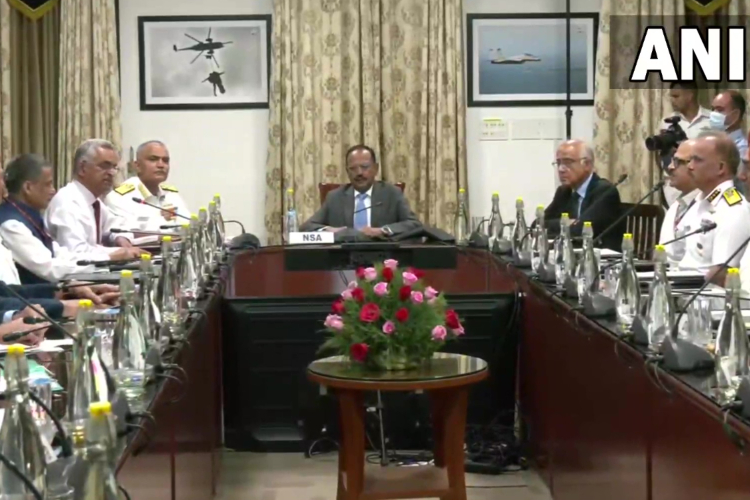
National Security Advisor Ajit Doval has said that in the current complex and challenging geopolitical situation, it’s necessary to focus on maritime security. He said, “he trajectory of this nation is well defined, we know where we’re going. And when our time comes, India will not be able to become the power it deserves to be unless it has a very strong maritime system. This is perfect timing for it.”

He said, “in the national security discourse importance of land and maritime borders are very different. You cannot fence them, put 24×7 vigilance, the concept of sovereignty in land borders is territorial and well-defined.”

Doval said this on Thursday while addressing the first meeting of the Multi-agency Maritime Security Group to discuss important policy matters affecting maritime security. The meeting was presided over by the National Maritime Security Coordinator, Vice Admiral Retd. Ashok Kumar.

He said, “Indian ocean is a great asset to us. With the cardinal principle of security, our vulnerabilities are directly proportional to our assets. More we develop, the more assets we create; the more prosperous we get, the greater would be vulnerability and greater would be the need for security.

Ajit Doval presiding over the meeting of multi-agency Maritime Security Group

During the meeting, Doval said,” In the changing geopolitical scenario, the Indian ocean which has been an ocean of peace is gradually becoming competitive. We see a potential of having a clash of interest, we need to protect it and be vigilant.”

Ajit Doval said, “We have responsibility towards neighbours be it disaster management or security for them, we’ve been doing it. We recently had an example of countries coming together when Colombo Security Conclave was held to tackle maritime threats in Indian ocean.”

We have a responsibility towards our neighbours, whether it is disaster management or safety for them, we have been doing this. We had an example of countries coming together recently when the Colombo Security Conference was held to deal with maritime threats in the Indian Ocean. We know where we are going… If India does not have a very strong maritime security system, it will not be able to become the power it deserves. This is the perfect time for it. Intelligence agencies provided important information about smuggling, gun running, counter-terrorism, and espionage.”

Source: https://www.awazthevoice.in/india-news/nsa-doval-says-maritime-security-a-priority-area-for-india-13106.html/


(www.MaritimeCyprus.com) The shipping industry is currently in an ongoing transition towards decarbonization. Many market actors are accentuating their focus on modern and greener ship designs, operations, alternative fuels, energy efficiency and carbon capture technologies. Green financing, environmental, social and governance (ESG) reporting and European Union (EU) taxonomy are just a few examples of mechanisms that were previously downplayed by the industry and have now become increasingly widespread. Furthermore, there is an increased demand for green or carbon neutral freight, with many companies calling for full neutrality by 2040. As a result, shipowners are engaging more actively with partners in their commercial eco-system (shipyards, designers, original equipment manufacturers, etc.) to ensure that vessels incorporate design elements that facilitate the conversion from fossil-based to zero-carbon marine fuels.

The urgency of finding solutions to the climate change problem is growing as a top priority for both domestic and international policymakers. Around a quarter of the world’s greenhouse gas (GHG) emissions are linked to international trade, according to the most recent estimates. As the lifeblood of global trade, the shipping sector faces significant challenges in decarbonizing due to its diversity, which ranges from ferries to massive tankers, as well as the fact that clean fuels such as green hydrogen, ammonia and methanol are not yet available at scale.

Policymakers are considering ways to encourage the shipping industry to use low-carbon modes of transportation. A specific reference to shipping was not included in the Paris Agreement, and some observers believe this omission can be explained by the fact that countries are cooperating with the International Maritime Organization (IMO), which is a specialized agency of the United Nations (U.N.), to reduce the emissions associated with international shipping.

Individual countries may include targets for shipping in their national mitigation plans, and they may be able to act more promptly than the IMO. For example, in a new climate plan, the European Union (EU) proposes that the scope of its Emissions Trading System (ETS) be expanded to include carbon dioxide (CO2) emissions from ships, which would be the first time this has been done. In a similar vein, Japan has informed the IMO that it would support a carbon tax that would raise more than $50 billion (B) per year, marking a significant step forward by the world’s second-largest shipowner nation in addressing emissions from maritime transport. The inclusion of this provision would impose a price on emissions from shipping.

ABS has launched its industry-shaping Low Carbon Shipping Outlook to help the maritime sector evaluate potential pathways to low-carbon shipping.

The Outlook defines ship technologies, operational efficiencies and alternative fuels and energy sources needed to reach 2030 and 2050 targets.

2030 targets can be met through operational measures and efficiencies driven by connectivity and data analytics and energy efficient designs. Fuels are in focus to get to 2050. The conceptual designs confirm that the fuel technology today does not meet the 2050 demands.

To fully understand what it will take to adopt alternative fuels globally, we can compare to LNG as fuel. It has taken 10 years for LNG bunkering infrastructure to develop and supply less than 1% of the global fleet. Other alternative fuels will face similar infrastructure development, regulatory and supply chain challenges.

Source: ABS


HE JOB of a seafarer is not exactly a walk in the park.”

I usually cite this quote from the Supreme Court case of Oriental Shipmgt. vs Bastol (G.R. No. 186289 June 29, 2010) as opening statement during my paralegal lectures on seafarers’ rights.

The quote emphasizes the Supreme Court’s view on the nature of the seafarer’s work: “What makes the job more difficult, aside from exposure to fluctuating temperatures caused by variant weather changes, the job obviously entails laborious manual tasks conducted in a moving ship, which makes for increased work-related stress. All these factors may have exacerbated a seafarer’s medical condition.”

During my recent virtual lecture with maritime students of John B. Lacson Foundation Maritime University in Molo, Iloilo City, I discussed the reality of their profession that a vessel has always been identified as a high-risk workplace.

The industry remains fraught with health and safety hazards that increase seafarers’ risks of accidents, illnesses and mortality, while others may go missing or die in maritime disasters.

The European Maritime Safety Agency declared in a report  that there were 745 work-related fatalities among maritime workers and nearly 9,000 persons injured between 2011 and 2020.

Some are exploited and subjected to discrimination, abuse, maltreatment, and unfair labor practices.

Pope Francis earlier said in a message that without seafarers, the global economy would come to a standstill; and without fishermen, many parts of the world would starve.

However, Pope Francis said that they face the seafaring dangers of storms and piracy, long periods of time away from their families and working conditions that are often harsh and low-paying.

Despite said risks, the seafarer, like other overseas Filipino workers (OFWs), is often looked up to as one of today’s heroes who, through huge remittances in billions of dollars they earn, have propped up our economy.

The sea-based sector’s remittance comprises at least 22 percent of the total OFW dollar remittances.

Records from the Banko Sentral ng Pilipinas (BSP) showed the sea-based sector’s remittances for the past five years:  $6,870,827,000 in 2017; $6,139,512,000 in 2018; $6,539,246,000 in 2019; $6,353,522,000 in 2020; and $6,545,002,000 in 2021.

The data showed that remittances increased in 2018 by $731,315,000, then increased in 2019 by $399,734,000, then decreased in 2020 by $185,724,000, then increased in 2021 by $191,480,000.

The Scalabrini International Migration Network recently engaged in an online campaign dubbed as “No Shipping, No Shopping” that coincides with the celebration of the International Day of the Seafarer led by International Maritime Organization.

In 2010, the Conference of Parties to the International Convention on Standards of Training, Certification and Watchkeeping for Seafarers (STCW) adopted a resolution establishing the Day of the Seafarer every June 25, which recognizes the valuable contribution of seafarers  to international trade and  world economy.

The international shipping industry is the life blood of the global economy as it is responsible for the carriage of around 90 percent of world trade.

Without shipping, intercontinental trade, the bulk transport of raw materials, and the import/export of affordable food and manufactured goods would simply not be possible.

For most merchant ships trading internationally transporting every kind of cargo, it is estimated that there is one Filipino seafarer for every four to five complements on board a vessel at any time.

The Philippines is still considered as the major supplier of maritime labor globally.

Philippines Overseas Employment Administration (POEA) data indicate that the total number of seafarers deployed overseas from the country reached 376,663 in 2017; 337,502 in 2018; 469,996 in 2019 and 217,223 in 2020.

Aside from the Day of the Seafarer every June 25, the Philippines also celebrate National Seafarers’ Day (NSD) every last Sunday of September.

Then President Fidel V. Ramos issued on July 9, 1996 Proclamation No. 828 declaring Aug. 18 as NSD; the Stella Maris was tasked to coordinate with the public and private sector in activities related to the celebration of said event.

The purpose of the Proclamation is to give due recognition to the vital role of Filipino seafarers towards the development of the Philippines as a maritime country.

Later, Proclamation No.1094 was issued in 1997 by President Ramos which moved NSD to every last Sunday of September every year.

The country will be celebrating the 27th National Seafarers’ Day this year.

Source: https://www.panaynews.net/seafarers-job-not-a-walk-in-the-park/


Stream Marine Training (SMT) is demonstrating its commitment to leading the way in alternative fuels by offering Bahamas Maritime Authority- (BMA) approved Basic (BIGF) and Advanced (AIGF) Training for Service on Ships using Fuels covered within the IGF Code.

The BMA has approved the UK-based global training course provider to deliver the STCW BIGF and AIGF course by webinar.

The courses are designed to give both basic and advanced training to seafarers responsible for designated safety duties associated with the care, use, and emergency response to the fuels on board ships subject to the International Code of Safety for Ships using Gas or other low-flashpoint Fuels (IGF Code).

Seafarers undertaking the basic training course will gain knowledge of the properties of fuels covered within the IGF Code and the hazards associated with their use as a fuel; health, safety and environmental precautions and measures when working on vessels; and the transfer and storage of fuels covered within the IGF Code.

CEO of the Stream Marine Training Group, Martin White said: “We are delighted to have received BMA approval to deliver these courses. We can now offer seafarers vital basic and advanced safety training for working on vessels covered by the IGF Code both online and face-to-face.”

CEO of Stream Marine Training Group, Martin White

“Stream Marine Training is a world class provider of maritime training and has led the way in alternative fuels coaching. We are passionate about making a difference in the maritime industry and offering these courses, and this is another way to demonstrate our commitment to the IMO’s goal of reducing CO2 emissions.”
Capt Jerry Mooney, Technical and Compliance Officer in The BMA’s Seafarers and Manning Department, said: “The BMA is committed to sustainability in shipping and we are pleased to be able to approve these two courses which will train seafarers to work safely with the alternative fuels that are being introduced into the sector.”
Source: Stream Marine Training


Company DETAILS

SHIP IP LTD
VAT:BG 202572176
Rakovski STR.145
Sofia,
Bulgaria
Phone ( +359) 24929284
E-mail: sales(at)shipip.com

ISO 9001:2015 CERTIFIED