Despite support packages lined up by governments and power companies, ‘drastic moves’ may become necessary before the onset of winter, Rystad said, predicting that the power crunch is likely to strike earlier than expected.

Warning that it is increasingly a case of ‘when’, not ‘if’, the crisis arrives, Vladimir Petrov, the firm’s senior power analysts said: “Europe’s options with regard to gas, coal, nuclear and renewables filling the power gap are extremely limited and costly. European governments have announced a raft of policies to secure more supply, support consumers, and potentially curb demand should the crisis continue. The point at which the crisis will bite more deeply is looking closer and closer.”

Germany, Europe’s largest economy, has been hit hardest by the energy crisis because Russian gas accounted for about 55% of its supplies. There are few options for extra gas imports at present, Rystad said, although the Netherlands could ramp up output from the giant Groningen field, once Europe’s largest gas reserve. This is politically sensitive, however, following a succession of earthquakes over the last three decades.

Coal plant life extensions

Now, coal plants earmarked for decommissioning to meet greenhouse gas reduction targets are to undergo life extensions. Altogether, 46.7 GW of installed coal power generation was to be decommissioned between now and 2038 and this number was expected to fall to 36.1 GW this year, with the closure of about 24 units.

About 80% of the plants originally planned for decommissioning between 2020 and 2022 burn imported hard coal. Their life extensions will mean more imports. Prices, already dramatically higher than the beginning of the year, are likely to climb further. Rystad noted that AP12 thermal coal benchmark (6,000 kilocalories per kilogram delivered ARA range) is now trading at about $377 per tonne, up almost $250 since early January.

Suppliers of high-energy, low sulphur coal include South Africa, Colombia, and Australia, potentially good news for operators of panamax and capesize bulkers. Exports from South Africa have increased sharply this year, Rystad said, but lifting volumes further is a challenge. Most of the country’s exports are handled by the Richards Bay Coal Terminal which is currently operating at reduced capacity due to disruption on the railway, run by state operator Transnet. Producers are now even turning to road transport for the 90km journey at a price four times higher.

Nuclear power shutdowns

Meanwhile, in Europe, seven nuclear power stations with just over 7GW of capacity are due to be shut down between now and the end of next winter. None of these is likely to have shutdown reversals, with the phase-out of three German plants signifying an end to the country’s use of nuclear energy. However, of the seven nuclear facilities, the three German ones are the most likely to continue operating for a spell, Rystad said,  although no decision has yet been taken.

Each nuclear plant generates more than 1GW – energy that the analyst says would greatly reduce some of the stress likely to be evident in the power grid this winter.

One positive note: in separate analysis, the firm has predicted that US natural gas production is set to hit an all-time high in the months ahead and will continue to rise next year. The astonishing difference between the US benchmark Henry Hub price ($7 per MMBtu) and the Dutch TTF, the European marker ($47 per MMBtu) makes production, liquefaction and shipping an economically attractive proposition. However, there is now concern in some quarters over the supply of global LNG shipping capacity.

Source: https://www.seatrade-maritime.com/tankers/stark-warning-european-energy-crunch


Claudio Headshot.png
The UK government should embrace the maritime industry as a means to meet targets on ‘levelling-up’, decarbonisation and economic growth, according to Peel Ports.

The logistics group’s CEO Claudio Veritiero said the maritime sector and government should form a partnership to meet national objectives and overcome the remaining challenges from Brexit and the pandemic.

Peel Ports Group published a 40-page report “A level playing field – The role of ports in achieving better outcomes for the UK’s levelling up agenda,” a response to the UK government’s February 2022 levelling up white paper.

“There has never been a better time, nor a more pivotal time, for us to assert our ambitions, considering the current environment…  there is enormous scope for synergy between what is required for levelling-up, achieving Net Zero ambitions and the maritime logistics community,” said Veritiero.

The report said that coastal communities are under particular pressure, and that ports provide well-paying, productive jobs to people from the port hinterland area.

“There can be no levelling-up without giving current and next generations the chance to find their way in rewarding, meaningful work that also affords them and their families a good standard of living and hope for the future,” said the report.

Peel Ports’ own data showed 80% of its workforce of 2000 lives in the port hinterland area, its employees earn 36% above the UK average wage and are 51% more productive than the average UK worker.

The report goes into detail on the effects of its apprenticeship programme in Liverpool, the continued potential of the UK offshore energy sector, and the role of freeports in levelling-up.

Peel Ports said that the imbalance of UK cargo reflects a broader imbalance in the country, with 90% of deep-sea containers coming into the country’s south-east ports despite 60% of that cargo being destined for areas north of Birmingham.

“Levelling-up means looking at the most efficient way to transport goods to and from all parts of the UK, using the full stretch of the country to create quicker, easier and more reliable supply chains. In doing so it will benefit over-heated parts of the country while adding much-needed jobs and business opportunities to regions outside of the South East,” it said.

The group called for a new approach of utilising regional ports to increase capacity and capability, instead of short-term fixes to existing bottlenecks.

“A nationwide approach would result in a more sustainable supply chain, delivering cargo closer to the centres of economic activity, and greener use of the local logistic sector,” said the report.

Source: https://www.seatrade-maritime.com/ports/maritime-sector-best-hope-uk-levelling-net-zero-and-economic-growth


Port OF Sines--2021.jpg
Shell, ENGIE, Vopak and Anthony Veder have agreed a feasibility study into producing green hydrogen in Portugal and distributing it in the Netherlands.

The agreement was signed between Shell New Energy, tank storage company Vopak, gas tanker outfit Anthony Veder and law carbon services company ENGIE. The companies will assess the production and liquifying of Hydrogen in Portugal for transportation to the Netherlands for sale and distribution. Shell and ENGIE will work on the whole value chain, with Vopak and Anthony Veder focused on storage, shipping and distribution.

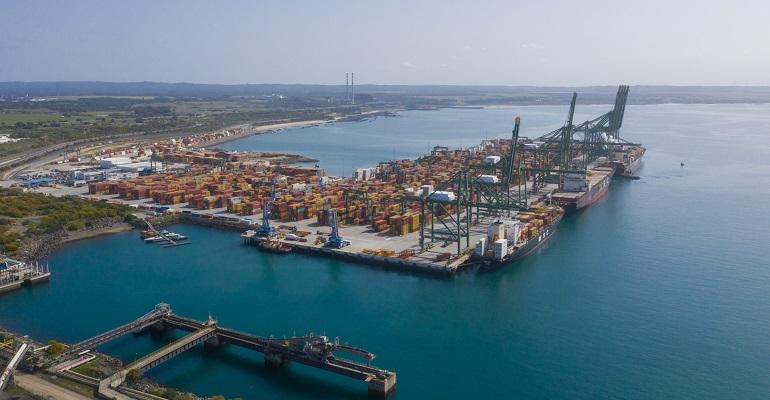
The vision is for hydrogen to be produced in Sines port using renewable power for electrolysis, with the first shipment of liquid hydrogen leaving Sines for Rotterdam by 2027. Volumes are expected to start at 100 tonnes per day with room to scale up over time.

The hydrogen will have applications as a low-carbon fuel or fuel component for use in heavy duty machinery, marine and aviation.

“We consider liquid hydrogen as a key solution to import renewable energy into markets such as the Netherlands or Germany. We are developing the next generation of trucks which can use liquid hydrogen directly” said Dr. Andreas Gorbach, Head of Truck Technology and Member of the Board of Management Daimler Truck AG.

The partners in the venture called for policy instruments to help provide price certainty for hydrogen end users, stimulate adoption and drive infrastructure development.

Portugal and the Netherlands confirmed their joint goals at the Rotterdam World Hydrogen Summit in May 2022.

source: https://www.seatrade-maritime.com/sustainability-green-technology/industry-partnership-considers-portugal-netherlands-green-hydrogen


The Covid-19 pandemic catalysed remote working, and with that, inadvertently spurred companies to adopt additional safety technologies. However, it remains to be seen whether companies will continue to recognise the value of improving workplace safety and embrace new technologies to do so.


During a discussion organised by Safetytech Accelerator, in partnership with The Financial Times, and presented at the Lloyd’s Register Foundation Safer World Conference, Emily Whitcomb, director of the Work to Zero initiative at US non-profit safety advocate National Safety Council (NSC), said that Covid-19 was a major disruptor for safety.

She said: “We were on the cusp of the next safety revolution. With Covid-19, companies had to look for other ways to control risks… how can you automate things so that humans are not having to gather? What we found was that when Covid-19 hit, a lot of companies were looking at the technologies they were using and they were able to pivot a little bit to help.

“We saw a lot of companies were able to quickly pivot technologies like proximity sensors, to be used for social distancing among their workers. With office workers able to use Zoom and the Internet to engage with each other, companies found that they were able to get experts to come onsite; they didn’t have to physically come in.”

Safetytech Accelerator managing director, Dr Maurizio Pilu, noted that while certain industries, such as shipping, are notoriously late in adopting new technologies, the pandemic had speeded up this process.

Dr Pilu said: “Covid-19 seemed to accelerate an existing trend. What we have seen in other sectors is that often there is no turning back, once people get the taste of it [new technologies].”

He believes that technologies, ranging from drones, to AI, computer vision and wearables, have become affordable, flexible and robust enough to be adopted.

Dr Pilu continued: “As we have seen in the past, technology has to be right to go over the adoption tipping point and I think it’s starting to look right in many, many ways.”

James Pomeroy, Global Health and Safety Leader and Director at UK engineering consultancy Arup Group, agreed that while the pandemic has facilitated remote working, current generations of workers are demanding better safety standards.

Pomeroy elaborated: “It’s a generational shift—they [workers] don’t want to sit through PowerPoints, they don’t want to sit through hours and hours of training, they want something that they can play with, something that’s in their pocket that’s easy to use, readily designed and is interesting.

“Safety is plateauing. In some countries, we have actually seen an increase in fatalities, and that includes work-related commuting. So, there is this tipping point that we are seeing, generations coming through, demanding better solutions. We need to look at catastrophic risk and sustainability as part of that. Companies are looking at safety as a reputational, financial, social and equitable issue that they need to think differently about.”

Anglo Eastern Ship Management’s Managing Director, Group QHSE and Training, Pradeep Chawla, said that this company tries to be one of the early adopters of new technologies, adding that his company is one of the few that uses various types of simulators to train seafarers.

Chawla said ,“We’ve adopted gaming as a technology for teaching, moving from single-user to multi-user games. With respect to injuries, as an industry, we have more or less, passed that stage of just riding procedures and checklists and most of the good companies in shipping are at a stage where they are dealing with behaviour-based safety, rather than process-based safety and checklists.
“When it comes to challenges in adopting safety technology, it’s like any other industry. People are people; there’re the early enthusiasts who will line up outside Apple showrooms to get the latest version of iPhone and they’re the granddads who don’t want to go beyond the Nokia interface. I think that what has changed is that the cost of technology is reduced… it’s a known fact that any early adopter of technology pays more than those who come in later.”
Source: Lloyd’s Register


The new service, deploying six 2,500 teu containerships, provides a direct link for customers from north China to Southeast Asia, with improved transit times and more service offerings.

Port calls include Dalian, Tianjin, Qingdao, Busan, Incheon, Vung Tau, Leam Chabang, Singapore, Tanjung Pelepas, Jakarta and Panjang.

This new service is the fourth new shipping routes that Dalian port has opened up for RCEP (Regional Comprehensive Economic Partnership) countries and is the second Southeast Asia service launched in July connecting with Vietnam and Thailand.

In the first half of 2022, Dalian port posted a container volume of 1.88m teu, an increase of 10.8%.

Source: https://www.seatrade-maritime.com/containers/mscs-northeast-china-southeast-asia-service-debuts-dalian


The tanker market is experiencing a structural shift in trading routes, which could have long-standing implications for ship owners. In its latest weekly report, shipbroker Gibson said that “back in March we looked at commercial stock developments for both crude and products in the key trading hubs. Whilst the invasion had just begun and therefore not yet had any impact on inventory levels; stocks were already trending towards historic lows. Now, after 5 months of war and resurgent oil demand, stocks have come under further pressure and conceivably, are expected to face additional tightness as sanctions against Russia ramp up towards the year end and into early 2023”.


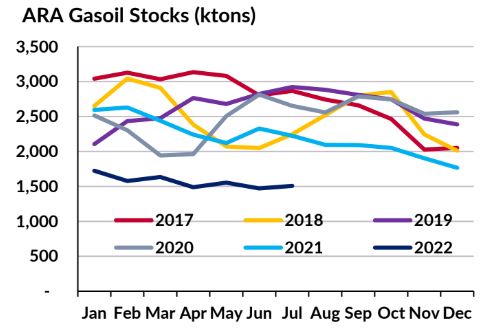
According to Gibson, “in Europe, by far the largest destination for Russian oil and products, gasoil/middle distillate stocks have remained near record lows, failing to register any seasonal increase despite higher local refining activity. Typically, storage volumes would rise during summer ahead of increased winter demand; however, without any meaningful increase in inventories in the coming months, Europe will face a precarious position heading into winter, forcing increased volumes of long-haul imports as the refined products import ban takes effect. In contrast to the middle of the barrel, gasoline stocks sit at healthy levels, with the region ramping up refinery output to maximise distillates, gasoline supply has increased as a result, supporting export flows”, the shipbroker concluded.

Source: GIBSON SHIPBROKERS LTD

It added that “across the pond, the picture looks somewhat different. US gasoline stocks sit at a 7-year seasonal low during peak demand season. Whilst storage levels typically draw down this time of year due to high demand, persistent supply tightness is likely to support transatlantic gasoline flows throughout the year. Total distillate inventories tell a similar story. However, whilst supply has risen in the US Gulf towards ‘usual’ levels, the Eastern seaboard is exceptionally tight, which could cause a supply squeeze come winter when demand peaks, necessitating imports from overseas and potentially creating a ‘reverse arbitrage’”.

“In the East, the picture is somewhat mixed. In Singapore, a barometer for the Southeast Asia market, light distillate stocks (primarily gasoline/naphtha) are near record highs for this time of year, yet middle distillate stocks sit close to record lows – a similar picture to Europe, driven by lower exports from China, resurgent regional demand and competition for Middle East exports. Strong regional refining margins should boost volumes later in the year, although volumes from the Middle East may come under pressure as Europe is forced to source alternatives to Russian supplies. Fujairah, the main products hub for the Middle East and East Africa, shows a contrasting picture yet again. Light distillates are in tight supply and close to record lows, whilst middle distillates have risen to healthy levels for this time of year. The hub is expected to grow as a destination for Russian products, making it difficult to call inventory levels in the months ahead”, Gibson said.

“So, what are the implications of these balances on trade flows? Many of these fundamental imbalances have been in place for decades, such as Europe being short of diesel. The difference now is that the deficit will have to be filled from further afield with traders already making plans for post sanctions supplies. These matters will be complicated by uncertainty over how much Russian product can be redirected. If, as claimed by President Bolsanaro, a contract between Brazil and Russia has been agreed, then more US Gulf product is likely to be redirected to Europe. Likewise, we wait to see how many Russian barrels find their way into Africa and Asia. The reallocation of flows is likely to be accentuated by low inventories, with very little supply cushion to help manage the disruption”, Gibson concluded.
Nikos Roussanoglou, Hellenic Shipping News Worldwide


Congestion at US West Coast ports hit the headlines last year as it reached record levels with vessels waiting more than three weeks to berth at the key ports of Los Angeles and Long Beach (LA/LB) with severe pressure on the supply chain. However, the latest edition The McCown Report by Blue Alpha Capital said that the port congestion situation in the US had morphed from primarily impacting the West Coast to impacting all coastal ranges.

According to the report the total number of containerships waiting to berth at US ports had fallen from a peak of 150 at the start of the year to 125, however, many more vessels waiting at facilities on the East Coast.

“While the West Coast represented over two-thirds of containerships wating for berths in January, it is only one-third now as the ships at anchor and resulting congestion has shifted eastwards,” the report said.

“The last month has seen an increase in this eastward shift and now Houston and New York have as many containerships waiting for berths a LA/LB combined.” The sharpest increase has been seen though at Savannah which now has 42 ships waiting for berths, six times the number the port can accommodate, translating to a typical 14 day wait at anchor.

By contrast LA/LB saw an average of 22 containerships waiting at berth during June, a 33% drop from May, and a 79% reduction from the start of the year.

The growth in congestion at US East Coast ports has been driven in part by deployment changes from US West Coast ports by shipping lines seeking to avoid delays at LA/LB and opting for the all-water route for shipments to the US East Coast. The threat of labour disruption at US West Coast ports with the ILWU contract covering 22,000 dockworkers expired at the beginning of this month has also “contributed marginally” to re-routing to the East Coast according to the report.

“The acceleration in the long-term shift that had already been occurring due to the underlying cost economics was driven by the early and major congestion on the West Coast.” McCown is of the view most of the loads that have shifted will continue to be routed by US Gulf/East Coast ports due to better underlying economics.

Going forward continued delays at US ports are expected, and the top largest US ports saw 5.9% increase in inbound volumes in July. “With containerships now waiting at all coasts and many ports operating near or at capacity, it seems clear that further will more consistently put strain on the US port system,” McCown said.


BIMCO has developed and published an electronic bill of lading (eBL) standard for the bulk shipping sector, with the aim of accelerating digitalisation in the supply chain by establishing a common industry approach.

The eBL Standard is a structured dataset consisting of 20 predefined data fields that are common to bulk shipping bills of lading. These include information like port of loading and discharge, bill of lading number, cargo gross weight, and date and place of issue.

“Issuing bills of lading electronically has been possible for more than 20 years. Despite the availability of safe and well-established platforms that have been approved by the International Group of P&I Clubs, less than 2% of seaborne world trade is carried on electronic bills of lading (eBL),” BIMCO says.

“One of the obstacles to wider acceptance of eBLs that has been identified is that it is currently not possible to transfer an eBL from one approved platform to another, i.e., a lack of interoperability. This is a particular issue for trade finance banks wanting to transition from paper bills to eBLs as it requires training of staff in the use of multiple platforms, despite the very low volume of eBLs.”

“Transferring an eBL between platforms requires that the eBL is in the same digital language by adopting a technical standard. So, the first step is developing and applying such a standard.”

BIMCO’s eBL Standard is aligned with the UN/CEFACT Multimodal Transport Reference Data Model as well as standards produced by DCSA and FIATA. BIMCO is also a founding member of the FIT (Future International Trade) Alliance, a cross-industry coalition of organisations working together to produce open standards for electronic trade documents.

The standard’s design is consistent with bills of lading already used in the bulk sector, for example, CONGENBILL, with the underlying framework applying equally to BIMCO’s various bills of lading and other bulk bills of lading.

Source: https://smartmaritimenetwork.com/2022/07/18/bimco-publishes-data-standards-for-electronic-bill-of-lading-in-bulk-shipping/


With inflationary pressures leading central banks around the world to increase rates, a global recession could very well be in the cards moving forward. In such a likelihood, demand for shipping is bound to take a hit, although, it should be noted that there are a number of factors which could help prevent this, or at least offset its impact. In its latest weekly report, shipbroker Allied said that “recession fears have started to mount once again as many market pundits speculate that the latest slump in commodity prices noted over the past month is a precursor of global markets being set for a major cool down. During the first half of the year, the main worry has been over the rapid rise noted in raw material prices which had been feeding a surge in consumer price inflation.


According to Allied’s Mr. George Lazaridis, Head of Research & Valuations, “the numerous disruptions noted across global logistical supply chains, coupled by a resurgent demand, had already started to feed the inflation beast from 2Q21. Yet the situation in Ukraine sent this inflationary pressure into a massive tailspin, with energy prices leading the way and adding further problems to the macroeconomic mix, as the fast-paced rate by which crude oil, natural gas and coal started to rise, inevitably drained consumer demand levels and diverted cash flows away from economic growth activity and towards higher-priced energy imports.

Source: Allied Shipbroking

“In an effort to contain the inflationary pressures that had started to mount, central bankers started to raise interest rates, in effect putting a gradual squeeze on the money supply so as to keep prices under control. Yet it is this very decision that may well be pushing for a recession. The rise in interest rates is slowly cooling down demand for new homes, cars and other consumer products. The argument goes that this dampening consumer demand follows through to raw resources such as steel, aluminium, wood and other bulk commodities. Prices for most of these commodities have shown a fair drop over the past month, both in the physical and paper markets, possibly indicating that this trend may well be already taking place. In the case of the paper market, the outflow of money from commodity markets could well be also due to their lower appeal amongst speculators as the rise in interest rates help boost yields for other investments”, Allied’s analyst said.

Mr. Lazaridis added that “in the case of the physical market, further hurt has been brought about this weekend by a sharp rise in COVID-19 cases across several major Chinese cities. We already had major disruptions present a month ago due to lockdown measures placed in Shanghai. A new series of lockdowns and halting of business activity across Shanghai, Guangdong, Henan, Zhejiang, Gansu and Macau would surely pack a serious punch on sentiment as well as demand for most commodities. Within shipping markets, we have already seen the dry bulk market struggle to recover much of the lost ground it witnessed during late May and most of June.

Source: Allied Shipbroking

Coal (and to some extent grain) trading activity have helped cover some of the slack left behind while also causing a major shift in terms of what is traditionally perceived as a fronthaul voyage and a backhaul. Yet relying on coal for support in the freight market is risky in its own right. Energy commodities still hold a fair amount of momentum in terms of their prices and given the continued disruptions being felt as part of the situation in Ukraine, the expectation is that there is still a fair amount of support for further prices hikes to be felt. Yet given the current fragility of the global economy, further price hikes in key commodities such as coal, crude oil and natural gas, could very well tip things even sooner into a recession, which would lead to substantially lower demand growth even for these energy commodities. Given the current market sentiment and all these above factors at play, it is no surprise then that reports of a massive stimulus package of around $220 billion (similar in size to the stimulus released after the initial COVID-19 outbreak in 2020) in China which is underway to emerge in the second half of the year barely managed to shift markets at this point”, he concluded.
Nikos Roussanoglou, Hellenic Shipping News Worldwide

Source: https://www.hellenicshippingnews.com/a-world-recession-could-slow-down-demand-for-shipping/


In January 2022, the Cruise Line Industry Association (CLIA) released its State of the Cruise Industry Outlook 2022 report in January, forecasting that 100 per cent of cruise lines will have resumed operations before the year’s end. Despite the expectation of new Covid-19 variants appearing, and the impact of the war in Ukraine, 2022 has been a positive year for the cruise industry. Already by May several major cruise lines had returned their entire fleet to service. In addition, with health authorities further relaxing Covid-19 travel restrictions and consumer confidence on the rise, cruise lines have gradually moved to eliminate occupancy caps onboard.

Focus needs to stay on safety
However, the return to passenger operations does not come without challenges. For operators, one of those challenges is training and building up the competency and knowledge of their crew.

dnv_assisting_in_crew_training.jpg

Thorough training of new and existing crew members is of utmost importance for the cruise industry to maintain a compelling safety track record.

Operational safety has always been a top priority in the cruise industry. Still, Captain Jan Solum, Area Manager for DNV and Director of DNV’s Cruise Ship Center in Miami, notes that it is more of a struggle for the industry to maintain its safety culture in the present climate. While vessels continue to return to service, Solum cautions that significant risks are hiding in plain sight. He believes it is paramount that cruise ship operators direct further attention to their crew to promote the safety culture vital to the industry’s successful return.

Covid shifted to safety focus
On 14 March 2020, the U.S. Centers for Disease Control and Prevention issued a no-sail order for cruise vessels to avoid the risk of introducing, transmitting or spreading Covid-19 on board while travelling. Similar words went out from authorities worldwide, and soon the global cruise industry was screeching to a stop. “This was a completely unprecedented situation,” says Solum. “When passenger operations stopped, revenue stopped coming in, and cruise companies were forced into making difficult decisions.” Those decisions included sending vessels into lay-up, reducing crew and staff, and taking on significant debt to maintain liquidity. No one had a clue how long the no-sail period would last. In the end it was 15 months before the first cruise ship set sail again from Miami.

“I had one executive tell me at that time when operations were restarting that if it had been clear at the beginning of the pandemic how long the industry would be out of commission and just how bad things would get, there wouldn’t be any cruise companies left today,” added Solum.

Much work was needed to bring the industry back online. Given that most vessels were at reduced manning levels, many shipboard and shore-based positions needed to be filled, making hiring one of the top priorities for operators. Solum explains: “Those who lost their jobs during the pandemic found employment opportunities elsewhere. Many of them didn’t return when the industry restarted, at least not to their previous role. So, to fill the personnel gap, operators had to widen their search more broadly and look at candidates with the right credentials, including those without experience in the cruise industry.”

Balancing health and safety measures
As cruise operations began again, changes have been made to the safety culture in the industry, Solum says. He acknowledges that many of these changes are a result of the new Covid protocols and procedures established to reduce health risks. “Naturally, much attention is going to the new protocols because the pandemic gripped our lives for such a long time,” he says. In the early days of the pandemic a public perception developed that cruise vessels were Petri dishes for Covid.

The industry has been working hard to shake this perception. “Cruise lines are actively striving to demonstrate that cruising is safe, but they can only fulfil this promise by strictly enforcing the health procedures and protocols.” Insufficient emphasis on the new protocols increases the risk of a Covid outbreak on board, which would damage the public’s perception of the industry and make it more challenging to sell cruises and secure future revenue.

However, the expert cautions that operators should be mindful to prevent the necessary extra emphasis on passenger health from overshadowing attention to other areas of safety. “An uptick in the number of near misses has been reported, and we’ve seen more unusual mistakes made on board vessels — not the kind of mistakes commonly made by experienced, seasoned crew. The new procedures are not the only contributing factor to the increase, but the trend is unsettling,” Solum states.

Crew training remains essential for safety
As vessels transition from lay-up to operation, the responsibilities of on-board personnel change, which also plays a role in the overall safety scenario. For those who worked throughout the lay-up period, the new manning arrangements require a mental adjustment. “While the individual responsibilities may change instantly, we are human beings, and we can’t just flip a switch. There is an adjustment period during which subconsciously you might find yourself compelled to continue doing what you were doing before. There is also the fact that every vessel has at least some crew members on board who joined recently from outside the cruise segment, and they may not be accustomed to how things are done in the industry.” It is imperative that operators invest in their personnel and provide continuous training, Solum adds. “This is where the value of running exercises and drills comes in. You don’t want to wait for real-life situations to start training. You want to see how the crew reacts in drills so that you can assess mistakes and correct them.”

It is essential to recognize this starting point when seeking to improve. “We have extensive training packages in our Maritime Academy, including marine accident and incident investigation training and tools to find opportunities to improve their management system (M-SCAT). We have also learned valuable lessons from the airline industry,” Jan Solum points out. “For example, our Advisory experts can help drive the right behaviour through the use of checklists and digital tools, or by conducting a review of the bridge resource management (BRM) system with a focus on learning from past near misses.”

Evaluating safety performance helps to improve
By performing DNV’s HOT assessment to evaluate the interdependencies between the human (H), organizational (O) and technological (T) dimensions, it is possible to identify the causes of weaknesses in safety performance and reveal discrepancies between the intended processes of the organization’s safety management system and what happens in reality.

In some respects, the cruise industry has had to reinvent itself in coming back online, says Solum. “It is almost like tearing down your house and rebuilding it from scratch,” he explains. “Before you begin construction, you need to examine the foundation to check what needs reinforcing. Otherwise, you may overlook something critical that could threaten the integrity of the structure you are building.”

With safety culture you can never rest on your laurels, he adds. It takes continuous effort and attention, and a focus on training and increasing the competence and knowledge of your staff and crew. “It is essential to take the time to understand your specific risks and ask yourself how you can address them. Reducing the number of near misses, statistically speaking, will lessen the risk of one of those incidents escalating to something greater,” he says. “In our current reality, we must focus on fighting Covid-19, but we can’t lose sight of the bigger safety picture as we do.”
Source: DNV, https://www.dnv.com/expert-story/maritime-impact/Promoting-safety-culture.html?utm_campaign=Cru_395_Safety%20Aspects&utm_medium=email&utm_source=Eloqua


Company DETAILS

SHIP IP LTD
VAT:BG 202572176
Rakovski STR.145
Sofia,
Bulgaria
Phone ( +359) 24929284
E-mail: sales(at)shipip.com

ISO 9001:2015 CERTIFIED