HMM, Korea’s largest shipping company, plans to expand its capacity from the current 820,000 TEUs to 1.2 million TEUs by 2026 and invest 15 trillion won in strategic shipping assets during the next five years.

HMM announced a mid- to long-term strategy at its main office in Yeouido, Seoul, on July 14. It marked the first time in 10 years that HMM announced such a large-scale investment plan. The company has been under the control of its creditors, including the Korea Development Bank, since 2016.

HMM posted operating profit of 3.1486 trillion won in the first quarter of 2022, setting a record for six consecutive quarters since the fourth quarter of 2020.

The company plans to secure logistics infrastructure such as terminals to expand its profit base and expand its shipping routes.

To promote balanced growth between its container and bulk businesses, HMM will dial up its bulk ship fleet from the current 29 vessels to 55 by 2026.

The expansion will include large ships that are needed to secure shipping alliance routes, medium-sized ships targeting emerging markets and small ships mainly for Asian routes.

HMM will also strengthen environment-friendly logistics services under the goal of reaching carbon neutrality in 2050. The shipping company has replaced ship fuel with low-sulfur oil and installed scrubbers to reduce carbon emissions. In addition, it plans to make efforts to secure eco-friendly fuel-based low-carbon ships, such as LNG-powered vessels.

HMM will invest more than 15 trillion won by 2026 to respond to changes in the shipping market. Ten trillion won will be invested in core assets such as ships, terminals, and logistics facilities, and five trillion won in diversification of its business portfolio. In particular, HMM will invest nearly 4 trillion won in eco-friendly ships such as LNG-powered ships, as eco-friendly ships will be a game changer in the shipping market.

An HMM official said the company has not yet discussed the timing or method for privatization with its major shareholders.

Source: https://www.maritimeeconomy.com/post-details.php?post_id=Z25rZQ==&post_name=HMM%20to%20Expand%20Capacity%20from%20820000%20TEUs%20to%201.2mn%20TEUs%20by%202026&segment_name=6


With more than five months left in the year, 2022 has already set new LNG shipbuilding records. An astounding 216 LNG carriers — equivalent to about a third of active global fleet — were on order at shipyards as of the end of April 2022, according to the recently released IGU World LNG Report 2022. Perhaps even more incredible, 150 LNG newbuilds — almost 70% of these ships — were ordered between 2021 and the end of April 2022.

“High spot charter rates (averaging US$100,000 in 2021), the re-acceleration of liquefaction capacity additions from 2024 and the prospects of new LNG FIDs this year, have prompted fleet operators to maintain a strong order book for LNG vessels, said the International Energy Agency (IEA) in its Gas Market Report Q3-2022.

And this bullish shipbuilding market has yet to show signs of slowing. In his BRL Weekly Newbuilding Contracts for 11 July 2022, Barry Luthwaite said the record number of LNG newbuild orders has reached 94 for the year, surpassing the 84 placed for all of 2021. “It is simply staggering to note that a combined total of 178 LNG vessels have been committed in only slightly over 18 months. This surpasses all previous history,” he said.

For the week, Hyundai Heavy Industries (HHI) landed 10 LNG carriers, including an order from a European shipowner for eight 174,000 m3 LNG carriers, with suspected links to Qatar Energy’s North Field East expansion requirements. “The Qatar link seems to be borne out by the relatively low per unit price of US$214.9M, indicating berth space may have been reserved some time ago,” said BRL.

“Surely the price [per ship] will pass US$250M in the near future”

Two additional 174,000-m3 newbuilds were ordered by Greek shipowner Capital Gas, slated for construction at Hyundai Samho Heavy Industry (HSHI). The ships will be delivered in May and August 2026. “This contract pushed up pricing to a new level, with each vessel costing US$245.4M apiece. Surely, the price [per ship] will pass US$250M in the near future. More orders are known to be in the pipeline,” said BRL.

Despite taking in 70% of the global LNG carrier orders in H1 2022, South Korean shipbuilders are not sipping port and smoking cigars in celebration. That is because defaults on payments for the construction of specialised ARC7-class icebreaking LNG carriers for Russian LNG projects have triggered a spate of contract cancellations.

“The vessels will never be delivered to Russia, but western owners are moving to buy up the cancelled contracts. This gives partial satisfaction to South Korean builders, but the cash flow situation could grow worse for the big three Korean builders of Daewoo, Samsung and Hyundai,” said BRL.

Another issue to be resolved centres around the shipbuilding slots reserved by Qatar for its massive 151-ship newbuild programme, priced at rates well below today’s US$228M per vessel (170,000 m3). “Now, arguments are going on disputing the new prices wanted by the shipyards to cover today’s global economic situation which sees everyone fighting a slump and inflation nearing double figures, pushing up raw material pricing. The US$250M LNG carrier is just around the corner,” said BRL.

Last year, 57 new LNG carriers (all except one with capacities between 170,000 to 180,000 m3) were delivered, increasing the size of the global fleet by 10% to 634 vessels, including 45 floating storage and regasification units (FSRUs) and five floating storage units (FSUs), according to IGU.

Source: https://www.rivieramm.com/news-content-hub/bullish-lng-shipbuilding-reaches-new-heights-72016


French energy major TotalEnergies will supply, install and operate a floating storage and regasification unit (FSRU) for Germany’s Deutsche ReGas to help the country import more liquefied natural gas this year

Deutsche ReGas is developing the Deutsche Ostsee LNG terminal in Lubmin, the exit point of the Nord Stream pipelines which flow from Russia. In recent weeks, flows from the Nord Stream pipelines have decreased as maintenance work on the pipeline begins, but there are fears the shutdown might extend given the war in Ukraine.

Germany has no LNG terminals and in June, the country’s economic ministry warned a prolonged shutdown could be catastrophic for its industries.

The FSRU will help Germany keep the gas flowing and is expected to be operational by December 2022 and capable of feeding 4.5Bn m3 of natural gas annually into the country’s transmission network.

Source: https://www.rivieramm.com/news-content-hub/total-to-supply-and-operate-fsru-in-germany-as-fears-grow-over-a-prolonged-halt-to-nord-stream-supply-72029


INS Sindhudhvaj bid adieu to Indian Navy on Saturday, 16 Jul 2022, serving for a glorious period of 35 years. Vice Adm Biswajit Dasgupta Flag Officer Commanding -in-Chief, Eastern Naval Command was the Chief Guest for the ceremony. The Decommissioning event was attended by 15 of the former Commanding Officers including Cmde SP Singh (Retd), the Commissioning CO and 26 Commissioning crew veterans.

The submarine crest depicts a gray colour nurse shark and the name means flag bearer at sea. Sindhudhvaj, as the name suggests, was the flag bearer of indigenisation and Indian Navy’s efforts towards achieving Atmanirbharta in the Russian built Sindhughosh class submarines throughout her journey in the navy. She had many a firsts to her credit including operationalisation of the indigenised sonar USHUS, Indigenised Satellite Communication systems Rukmani and MSS, Inertial Navigation System and Indigenised Torpedo Fire Control System.

She also successfully undertook mating and personnel transfer with Deep Submergence Rescue Vessel and only submarine to be awarded CNS Rolling trophy for Innovation by the Honourable Prime Minister Mr. Narendra Modi.

The traditional ceremony was conducted at sunset, with an overcast sky adding to the solemnity of the occasion when the Decommissioning Pennant was lowered and the submarine was paid off after a glorious patrol of 35 Years.


Source: https://www.maritimeeconomy.com/post-details.php?post_id=Z25sbg==&post_name=INS%20SINDHUDHVAJ%20Decommissioned%20After%2035%20Years%20of%20Glorious%20Service%20to%20The%20Nation%20India&segment_name=


British shipyard, Harland & Wolff, has been awarded a £55 million contract to regenerate a former Royal Navy mine-hunting vessel, HMS QUORN.

  1. £55 million to regenerate former Royal Navy mine-hunting vessel
  2. Supporting 100 jobs at Harland & Wolff Appledore site in south-west
  3. Enhancing mine-hunting capability for NATO ally

British shipyard, Harland & Wolff, has been awarded a £55 million contract to regenerate a former Royal Navy mine-hunting vessel, HMS QUORN.

On behalf of the Lithuanian Government, the Defence Equipment Sales Authority (DESA) awarded the contract that will see HMS QUORN renovated and restored, bolstering NATO maritime capability in Europe.

Supporting ambitions to bolster British shipbuilding, laid out in the National Shipbuilding Strategy Refresh, the regeneration will support 100 jobs at the south-west shipyard.

The work will see an influx of contractors for the project across the local and national supply chain, with 14 major subcontract packages in engineering, equipment and integration, along with other refurbishment services.

Minister for Defence Procurement, Jeremy Quin, said:

I’m pleased that this multi-million pound contract will see a former Royal Navy mine-hunting vessel restored and regenerated in a British shipyard, supporting UK jobs and strengthening shipbuilding in the south-west.

Lithuania is a key NATO ally and Joint Expeditionary Force partner, and this mine-hunting vessel will bolster NATO maritime capability across Europe, ensuring the Alliance remains ready to respond to evolving global threats.

HMS QUORN completed 27 years of Service with the Royal Navy before being sold to Lithuania in April 2020. The vessel patrolled the seas as part of the Royal Navy fleet of Hunt Class Mine Countermeasures Vessels (MCMVs) until 2017.

The Hunt Class vessels specialise in active mine-hunting. They use high-definition sonar to scour seabeds for mines, which are then destroyed by the ship’s clearance diving teams or mine disposal system.

A key NATO ally and partner in the Joint Expeditionary Force (JEF), Lithuania will add the restored mine-hunting vessel to its existing fleet, with the addition of this capability boosting NATO capability across Europe.

Tailored for the Lithuanian Navy, the work includes upgrades to the ships mission and sonar systems, and an additional search and rescue capability. The contract will also add new main engines, generators and propulsion gear as well as refurbish the accommodation, hull, ancillary systems, electrical systems and painting.

Cdre Richard Whalley, Head of DESA, said:

This contract award reinforces our excellent working relationship that we have with Lithuania as our NATO ally as well as UK owned Harland & Wolff. We’re really pleased to see HMS QUORN refurbished in Appledore Shipyard and look forward to continuing our work with them supporting the British supply chain.

It is planned that the ship will be handed over to the Lithuanian Navy in 2024. HMS QUORN is the third mine-hunting vessel that DESA has sold to Lithuania, following the sale of HMS Dulverton and HMS Cottesmore in 2008.

Source: https://www.maritimeeconomy.com/post-details.php?post_id=Z25qZw==&post_name=GBP%2055%20million%20to%20restore%20minehunter%20for%20NATO%20ally&segment_name=26


When Russia invaded Ukraine in February, Finnish technology company Wärtsilä suspended all deliveries, sales, orders, and bidding for Russian customers. It further downscaled its operations in the Russian Federation in April, taking a $200 million writedown on the value of its business and giving up about five percent of its annual net sales. According to Russian media, the decision may have spurred the creation of a new Russian company to serve Wärtsilä’s Russian customers in the electronic-navigation space.

Wärtsilä acquired the civilian division of electronics and software company Transas in 2018. Though Transas was a global company with a UK headquarters, it had been founded in St. Petersburg in 1990, and it had a substantial Russian workforce. At the time of the purchase, the high-profile acquisition looked very attractive: it handed Wärtsilä a portfolio of simulation, traffic control, fleet operations and ECDIS technology, along with related businesses like training and after-sales service.

But the market withdrawal from Russia has had an impact on the Transas business line (known as Wärtsilä Voyage after the merger). Wärtsilä took a $75 million writedown on goodwill and intangible assets related to its Voyage unit in April, the largest single component of the $200 million impairment.

Now, according to Russian outlet RBC, two ex-Transas, ex-Wärtsilä Voyage vice presidents are starting a new firm which reflects the division’s Russian roots. The newly-formed EMCT (Evolution of Marine Digital Technologies) will provide products for Russian customers left behind by Wärtsilä’s exit, and will also compete in “Russia-friendly” countries in the years ahead.

In an interview with RBC, development director Vladimir Ponomarev (formerly VP Solutions for Wärtsilä Voyage) noted that St. Petersburg had been the birthplace of many Voyage products. He predicted that with the founding of EMCT, there would be a “smooth replacement” with similar products for the sanctioned Russian shipping market.

“The departure of Wärtsilä from Russia in March 2022 effectively deprived [Russian] users of qualified expert support and the opportunity to develop software and hardware solutions to meet changing requirements and standards. In most cases, this situation can be critical, at least on the horizon of 6-12 months,” Ponomarev said. “[EMCT is] ready to take on the tasks of expert and technical support for current users of Wärtsilä, as well as to develop and bring to the market domestic hardware and software solutions that can replace Wartsila products in a short time.”

EMCT’s creation is part of a broad wave of import substitution across the Russian economy. As Western businesses have pulled out or sold off their Russian divisions, others have stepped in to fill the gap – most prominently, the fast-food chain “Vkusno i Tochka,” the inheritor of McDonald’s Russian chains.

Source: https://www.maritime-executive.com/article/ex-waertsilae-execs-plan-to-serve-russian-market-for-e-nav-products


KUALA LUMPUR: Malaysian Maritime Enforcement Agency (MMEA) personnel have gained immensely from a training exercise off the Kuantan coast recently with Japan Coast Guard’s (JCG) training vessel “Kojima”, especially in handling emergencies involving foreign vessels.

The Search and Rescue Communication Exercise (SARCOMEX) on July 6 was crucial in view that Malaysian waters are an important passage for economic transportation to the Southeast Asia region, according to the Japanese Embassy in Malaysia.

SARCOMEX was made possible through JCG joining hands with MMEA’s Maritime Rescue Coordination Centre Putrajaya (MRCC), it said in a statement today.

The exercise was conducted at the MRCC Putrajaya with “KOJIMA” off Kuantan at sea with both parties contacting one another as a communication exercise for the rescue operation.

“This exercise improves MRCC personnel’s confidence level in handling emergency situations involving foreign vessels,” he told Bernama today.

“Coordinated by the Japan International Cooperation Agency (JICA), SARCOMEX improved my communication skills and gathering information techniques when conducting a search and rescue mission,” he added.

The Embassy of Japan said the training vessel “Kojima” departed from Japan at the beginning of May this year and navigated through the Pacific Ocean to San Francisco, Honolulu, and Singapore to provide training for cadets of the Japan Coast Guard Academy.

SARCOMEX was carried out during Kojima’s return journey to Japan from Singapore and the exercise improved the capabilities of Search & Rescue (SAR) activities for maritime safety and deepened the mutual relationship between JCG and MMEA.

All these have been made possible largely due to Japan’s move to expand cooperation with Malaysia beyond bilateral relations and further promote security and maritime safety cooperation as well as capacity building.


Mohd Ridhaudden said: “SARCOMEX prepares MRCC personnel to stay ready and vigilant to any call that requires assistance, locally and abroad.”

“This is because the call can originate from Malaysia or even other countries, which is why it requires MRCC personnel to enhance their communication skills capabilities in handling emergency calls.”

Providing details of the exercise, another participant, Sub Lieutenant Maritime Rezzal Muhammad Hazmi, also from MMEA, said the training simulated MRCC Putrajaya receiving distress alerts from a Japanese vessel My Umimaru, in which one crew member needed immediate medical assistance.

‘Kojima’ coincidently is nearby the location given and hence MRCC Putrajaya requested JCG to join the SAR operation on the scene.

He said the purpose of the exercise was to oversee the coordination between MRCC Putrajaya and the JCG vessel in rescuing the victim. This exercise involved 4 JCG officers and 4 MRCC personnel.


Commander Ryosuke Tateishi, a JICA expert dispatched to MMEA from JCG, said that the exercise would certainly upskill the capabilities in preparation ahead of any calamity at sea, especially in Malaysian waters, which is an important passage for economic transportation to the Southeast Asia region.

“Our cadets together with MRCC Putrajaya had undergone a ‘role play’ for distress at sea exercise, where we had focused on maintaining the communication lines to synchronise with the movement of people involved in the rescue, an integral part of any rescue exercise,” he said.

Japan has supported the capacity building of Malaysian coast guard officers since MMEA was established in 2005, where Japan’s coast guard officers now serve as instructors to provide training.

Former Japanese Prime Minister the late Shinzo Abe, who visited Malaysia in March as a special envoy of Prime Minister Fumio Kishida, had said it would be

meaningful for both countries to further promote security and maritime safety cooperation as well as capacity building.

He had said that this would contribute to the realisation of a ‘Free and Open Indo-Pacific (FOIP)’ and the ‘ASEAN Outlook on the Indo-Pacific (AOIP)’ to secure peace and prosperity in the region and the international community. – Bernama

Source: https://www.nst.com.my/news/nation/2022/07/814114/mmea-personnel-gain-valuable-experience-kojima-training-vessel


Six years ago, BW LPG embarked on a journey that would create the world’s largest fleet of LPG dual-fuel-powered very large gas carriers (VLGCs) when it began planning for compliance with the IMO 2020 0.50% sulphur cap. Like many shipowners, BW LPG had to weigh commercial and technical options regarding fuel choice, engine technology and refuelling availability, crew safety and training and vessel design.

“We quickly settled on LPG as the fuel type, which we strongly believe is the future fuel for the next generation of vessels,” BW LPG executive vice president technical and operations Pontus Berg explained in 2020. “Our initial design was for a newbuild, but we later converted that into a retrofit solution,” he said.

Mr Berg cited several factors in concluding that converting existing vessels to burn LPG was the best choice. “Operationally, LPG is cleaner and easier to manage than fuel oil or LNG. But in terms of bunkering, there are real savings to be made. We can bunker LPG while loading cargo, and this can save between four- and five-days bunkering time per year. Furthermore, bunkering directly at the loading terminal saves time and the additional costs of a bunkering barge.” With existing import and export terminals serving as bunkering hubs, and the possibility of performing ship-to-ship refuelling via small LPG carriers, this eliminates the ‘chicken and egg’ concerns that hamper the uptake of other alternative fuels”, he said.

As for choosing to retrofit rather than build new, Mr Berg pointed out that converting an existing vessel to LPG dual-fuel propulsion would significantly cut CO2 emissions and payback time.

“The construction of a new vessel generates about 70,000 tonnes of CO2, but taking a retrofit approach reduces this massively, down to about 2,000 tonnes. And while operating on LPG as opposed to fuel oil saves close to 5,000 tonnes of CO2 per year, the environmental payback for a newbuild is 15 years; for a retrofit that falls to less than six months,” he said.

“These vessels are not only making tangible reductions in carbon emissions, but also helping our bottom-line”

With its strategy in place, the Oslo-listed shipowner’s first steps on its decarbonisation journey were clear: a commitment to a pioneering retrofit project in partnership with MAN Energy Solutions and other maritime industry stakeholders that would see four of its VLGCs converted to burn LPG as a fuel.

The deal, announced publicly and to the trade press at a ceremony in Copenhagen in September 2018, coincided with the official launch of MAN Energy Solutions’ two-stroke, electronically controlled, Diesel-cycle, LPG dual-fuel ME-LGIP engine at the Danish engine designer’s research centre.

Two of those new LPG-burning engines, MAN B&W 6G60ME-LGIP Mk9.5, were destined for the world’s first two LPG dual-fuel-powered newbuild VLGCs ordered by Belgian shipowner Exmar for long-term charter to Equinor. The first of those, the 88,000-m3 Flanders Innovation, built to Lloyd’s Register class in China, was delivered by Jiangnan to the Nicolas Saverys-led Exmar in 2021. A new era of LPG-propelled gas carriers was born.

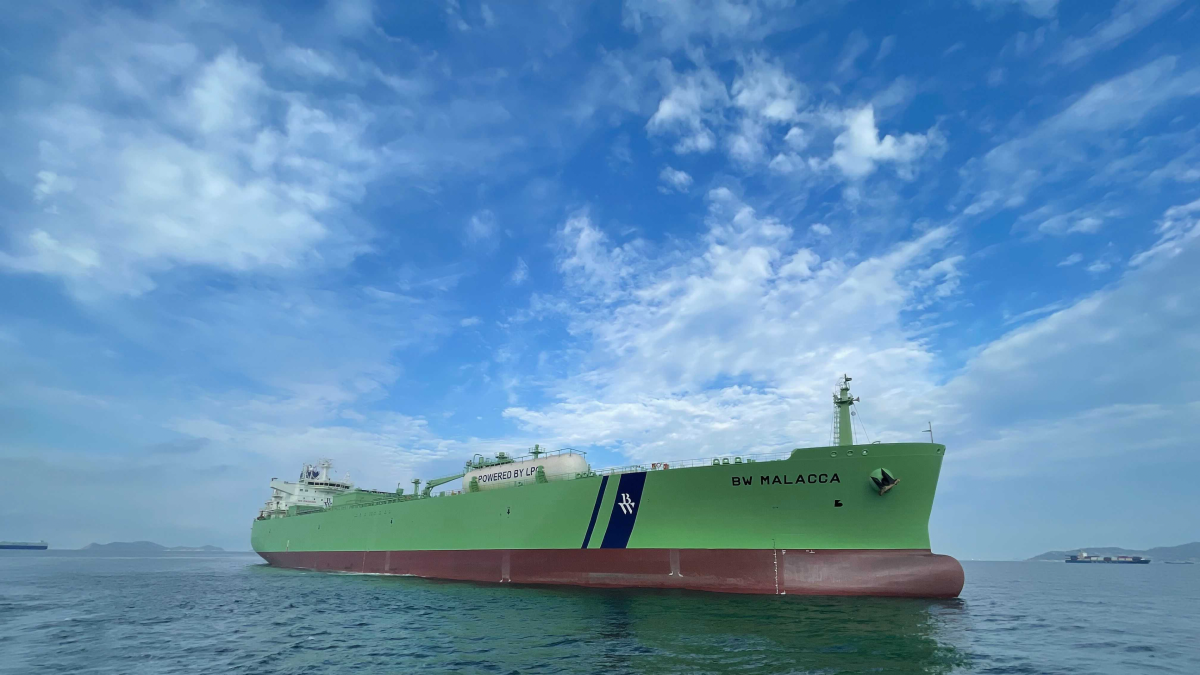
BW Malacca is the last of 15 new-generation VLGCs converted to LPG dual-fuel propulsion (source: MAN Energy Solutions)

BW Malacca is the last of 15 new-generation VLGCs converted to LPG dual-fuel propulsion (source: MAN Energy Solutions)

Initial results encourage investment

This era kicked off with the conversion in late-October 2020 of the main engine of BW LPG’s 2015-built LPG carrier BW Gemini, the first of the four VLGCs to be retrofitted for LPG propulsion.

Operational performance of the gas carrier proved the business case for LPG as a fuel; CO2 emissions were reduced by 17% as compared with marine gasoil on a well-to-wake basis, while SOx emissions were slashed by 97%, PM by 90% and NOx by 20%. Additionally, since LPG is methane free, methane slip from combustion is a non-factor.

Fuel consumption also improved. Using LPG as a marine fuel, the VLGC’s output efficiencies rose by around 10% against fuel oil, which in turn generated notable gains in total voyage fuel economics. This, along with other advantages, secured LPG’s position as a long-term, sustainable marine fuel in gas carriers.

Encouraged by the initial successful conversion of BW Gemini, BW LPG upped its commitment in 2020, earmarking an additional 11 new-generation VLGCs to burn LPG. This tipped its investment to US$130M.

Largest dual-fuel refit programme

Now one of the largest dual-fuel propulsion refit projects in history has wound down. With the redelivery of BW Malacca — the last of these 15 VLGCs to be converted — BW LPG completed the programme in May 2022.

As was the case in the previous 14 conversions, the ship’s MAN B&W 6G60ME-C9.2 type engine was retrofitted to a MAN B&W 6G60ME-C9.5-LGIP dual-fuel type, capable of operating on fuel oil and LPG. Conversion work also involved the installation of two 900 m3 deck fuel tanks, each weighing about 89 tonnes. Each of the 35 m-long tanks is made of low-temperature steel, encased in a thick insulation material. Wärtsilä Gas Solutions supplied the fuel gas supply systems for all 15 vessels. The newly converted VLGCs carry the DNV notation GF LPG.

The refit was carried out at Yiu Lian Dockyards in Shenzhen, China in conjunction with the gas carrier’s scheduled, five-year dry docking and under the supervision of MAN PrimeServ, MAN Energy Solutions’ after-sales division. BW Malacca has since passed sea trials.

“We could not have accomplished this ambitious project on our own”, said Mr Berg. “Our success lies in close collaboration with many experts in their field – MAN Energy Solutions and Yiu Lian Dockyards are two of many partners we thank for their support over the years.”

Mr Berg added: “Powered by LPG, these vessels are not only making tangible reductions in carbon emissions, but also helping our bottom-line in terms of savings on compliant fuel expenses in a high-cost supply situation”.

Added MAN PrimeServ senior vice president Michael Petersen: “As a low-carbon fuel, LPG is well on its way to becoming the new market standard in this segment. As we move towards a zero-carbon future amidst a strong, global push towards sustainability, these conversions showcase our dual-fuel engine portfolio that is future-proofed to handle whatever alternative fuels come to prominence in the decades ahead.”

With more than 120 orders, and 35 in service, the future for two-stroke LPG dual-fuel ME-LGIP engines appears set. Indeed, MAN Energy Solutions said the vast majority of current orders for LPG carriers over 30,000 m3 in capacity will be equipped with ME-LGIP technology, enabling these vessels to use their own cargo as fuel.


Fire broke out on board of ferry KMP NUSA PENIDA, docked at Dukuh Raya Port, western Lombok, Indonesia, in the afternoon Jul 16. All people who were on board fled to pier via lowered ramp, no injures reported. There were no passengers on board, ferry is said to be undergoing repairs at Dukuh Raya. Several hours after fire started, it was still on. No updates on ship’s condition, damages, as of 1800 UTC Jul 16.

New FleetMon Vessel Safety Risk Reports Available: https://www.fleetmon.com/services/vessel-risk-rating/


Company DETAILS

SHIP IP LTD
VAT:BG 202572176
Rakovski STR.145
Sofia,
Bulgaria
Phone ( +359) 24929284
E-mail: sales(at)shipip.com

ISO 9001:2015 CERTIFIED